


ASTM D5155: Polyolefin Pipe Resin Testing Services
The ASTM D5155-19 method is specific to measure the isocyanate content of aromatic isocyanates used as polyurethane raw materials. The isocyanate sample is reacted with a large amount of dibutyl amine to make the corresponding urea. The values stated in SI units are to be regarded as standard.
TRUSTED BY


Get ASTM D5155 compliant results — request your polyolefin pipe resin testing quote
- Overview
- Scope, Applications, and Benefits
- Test Process
- Specifications
- Instrumentation
- Results and Deliverables
What Is ASTM D5155 Polyolefin Pipe Resin?
ASTM D5155-19 determines the isocyanate (–NCO) content in aromatic isocyanates using a standardized titration method. It is widely used to quantify reactive functional groups that directly influence the performance of polyurethane systems and related chemical formulations. Accurate measurement ensures proper material reactivity and formulation balance.
This method is essential for quality control and product consistency in industries handling isocyanates. It supports process optimization by verifying raw material composition and ensuring compliance with required specifications. Reliable NCO content data helps maintain performance, safety, and efficiency in end-use applications.

Applications and Benefits of ASTM D5155 Polyolefin Pipe Resin Testing
Scope
ASTM D5155-19 covers the quantitative determination of isocyanate groups in aromatic isocyanates through chemical titration techniques. It applies to materials where accurate NCO content is critical for performance and formulation control.
- Applicable to aromatic isocyanate compounds
- Determines percentage of reactive –NCO groups
- Uses titration-based analytical method
- Supports quality assurance and batch consistency
- Suitable for laboratory analysis and production control
Applications
- Polyurethane raw material evaluation
- Coating and adhesive formulation control
- Foam manufacturing quality assessment
- Chemical production process monitoring
- Raw material verification in supply chains
- Research and development of isocyanate systems
- Compliance and specification testing
Benefits
- Provides accurate NCO content measurement
- Ensures formulation consistency and performance
- Supports process optimization
- Reduces risk of product failure
- Enhances quality control efficiency
- Enables reliable comparison of materials
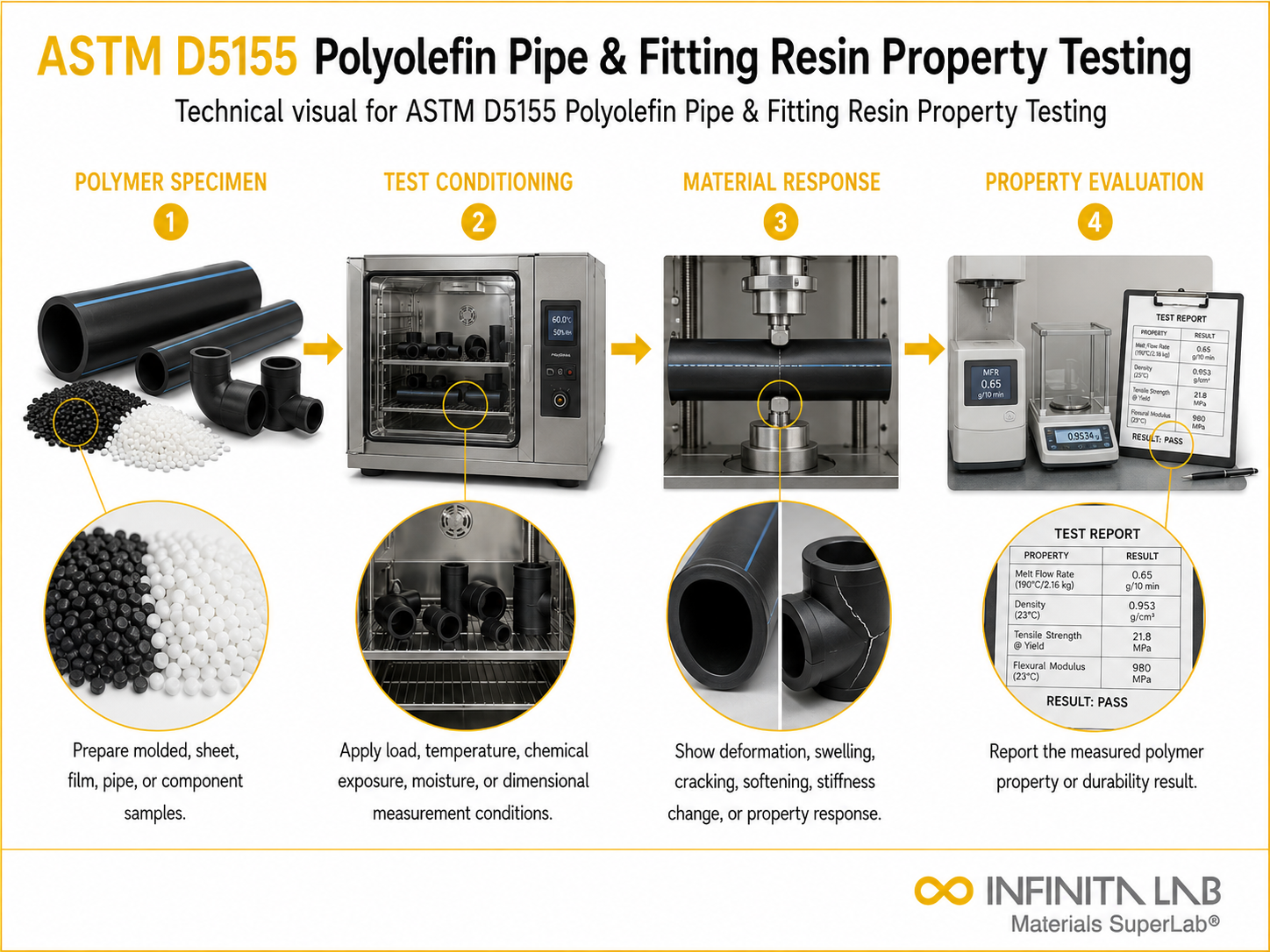
Our ASTM D5155 Testing Procedure
Sample Preparation
A measured quantity of isocyanate sample is dissolved in a suitable solvent under controlled conditions.
1Reaction with Reagent
The sample reacts with a reagent that consumes isocyanate groups quantitatively.
2Titration Step
Excess reagent is titrated with a standard solution to determine unreacted quantity.
3Calculation
Isocyanate content is calculated based on titration results and sample weight.
4ASTM D5155 Test Parameters and Requirements
| Parameter | Details |
|---|---|
| Method Type | Chemical titration (back-titration) |
| Analyte | Isocyanate (–NCO) functional groups |
| Sample Type | Aromatic isocyanates |
| Solvent System | Typically inert organic solvent |
| Reaction Mechanism | NCO group reacts with reagent quantitatively |
| Measurement Output | % NCO content |
| Endpoint Detection | Indicator or instrumental titration |
| Environment | Controlled laboratory conditions |


- Analytical balance
- Burette and titration setup
- Volumetric flasks and pipettes
- Magnetic stirrer
- Temperature control setup
- Fume hood
- Glassware for chemical handling
Equipment and Instrumentation Used for ASTM D5155 Testing
What You Receive: Test Report, Data, and Certification
- Percentage of isocyanate (NCO content)
- Titration data and calculations
- Batch consistency evaluation
- Quality compliance report
- Detailed analytical test report
- Supporting observations and remarks
ASTM D5155 Polyolefin Pipe Resin FAQs
ASTM D5155-19 is used to determine the isocyanate content in aromatic isocyanates. It helps quantify reactive –NCO groups, ensuring proper formulation, quality control, and performance consistency in polyurethane and related chemical systems.
NCO content directly affects reactivity and final product properties. ASTM D5155-19 helps ensure the correct concentration of reactive groups, which is essential for achieving desired mechanical strength, curing behavior, and durability in applications.
Accurate endpoint detection ensures correct titration results. ASTM D5155-19 may use indicators or instrumental methods to identify the endpoint precisely, which directly impacts the calculated NCO content.
In ASTM D5155-19, the solvent must not react with isocyanates. Proper solvent selection ensures accurate reaction with the reagent and prevents interference, leading to reliable titration results.
Factors such as temperature, moisture, reagent purity, and operator technique can influence results. ASTM D5155-19 requires strict adherence to procedure for consistent and reliable outcomes.
Why Choose Infinita Lab for Polyolefin Pipe Resin Testing?
At the core of this breadth is our network of 2,000+ accredited laboratories across the USA, offering access to over 10,000 testing methods and analytical services. From advanced materials characterization (SEM, TEM, RBS, XPS) to mechanical, chemical, environmental, biological, and standardized ASTM/ISO-compliant testing, we deliver unmatched flexibility, specialization, and scale. You are never limited by geography, facility, or methodology — Infinita Lab connects you to the right expertise and testing solution, every time.

Need ASTM D5155 Polyolefin Pipe Resin Testing You Can Rely On?
Send query us at hello@infinitalab.com or call us at (888) 878-3090 to learn more about our services and how we can support you.



Request a Quote
Submit your material details and receive testing procedures, pricing, and turnaround time within 24 hours.
 Quick Turnaround and Hasslefree process
 Confidentiality Guarantee
 Free, No-obligation Consultation
 100% Customer Satisfaction
