


ASTM D3294: PTFE Granular Resin Specification Testing Services
Accredited ASTM D3294 PTFE granular resin specification testing from Infinita Lab, performed to the exact standard requirements - accurate, reproducible results with full documentation for compliance, R&D, and quality control programs.
TRUSTED BY


Get ASTM D3294 compliant results - request your PTFE granular resin specification testing quote
- Overview
- Scope, Applications, and Benefits
- Test Process
- Specifications
- Instrumentation
- Results and Deliverables
What Is ASTM D3294 PTFE Granular Resin Specification?
ASTM D3294 is the standard specification that governs moulded PTFE (polytetrafluoroethylene) sheet and moulded basic shapes, setting out the material, dimensional, workmanship, and physical and electrical property requirements these products must meet before they’re approved for use. Rather than defining a single pass/fail number on its own, the standard establishes classification requirements that get verified through a series of companion test methods, giving manufacturers, fabricators, and end users a consistent way to confirm that a given batch of moulded PTFE sheet or shape performs the way it’s supposed to. Because PTFE parts are pressed and sintered from granular moulding and extrusion resins before they take final form, D3294 sits downstream in the supply chain – it checks the finished moulded output, not the raw resin powder itself.
Testing under this standard typically covers specific gravity, which serves as a practical indicator of how completely the material has crystallised and sintered during processing; tensile strength and elongation at break, both critical to how the part will hold up under mechanical load; dielectric strength, which matters for any application touching electrical insulation; and porosity, including a close visual and microscopic examination for internal cracks, voids, or foreign inclusions that could compromise part integrity over time. Dimensional and workmanship requirements round out the specification, confirming that moulded sheet meets a minimum thickness threshold and that basic shapes fall within defined size limits relative to the direction of applied m pressure.
For companies that manufacture or purchase PTFE seals, gaskets, liners, bearings, or other chemical-resistant components, ASTM D3294 testing provides objective, third-party-verifiable evidence that a batch of material meets recognised industry expectations – catching problems before they turn into field failures, warranty disputes, or rejected shipments downstream.

Applications and Benefits of ASTM D3294 PTFE Granular Resin Specification Testing
Scope
ASTM D3294 evaluates PTFE materials by defining classification categories and performance requirements. The test ensures materials meet specified standards for demanding environments.
The test evaluates:
- Establishes material, dimensional, and workmanship requirements for moulded PTFE sheet and moulded basic shapes.
- Applies to moulded sheet manufactured to a minimum thickness of 0.794 mm (1/32 in.) from PTFE resin moulding materials.
- Covers moulded basic shapes measuring 12.7 mm (0.5 in.) or greater in the dimension perpendicular to the molding pressure direction.
- Limits moulded basic shapes to 300 mm (12 in.) or less in the dimension parallel to the molding pressure direction.
- Requires that finished material be unpigmented PTFE and free from foreign matter unless otherwise agreed upon.
- Calls for verification of specific gravity, tensile strength, elongation at break, dielectric strength, and porosity.
- Requires visual and microscopic examination for internal defects such as cracks, voids, and inclusions.
- Sets workmanship expectations covering surface finish and freedom from processing flaws.
- Directs users to companion test methods for measuring each specified physical and electrical property.
- Applies to material produced from PTFE granular moulding and extrusion resins as the upstream raw material.
Applications
- PTFE seals and gaskets used in chemical processing and fluid-handling equipment rely on moulded sheet meeting this specification.
- Bearing components and wear pads benefit from the mechanical consistency this testing confirms.
- Electrical insulation parts depend on the dielectric strength verification built into the standard.
- Chemical-resistant liners for tanks, pipes, and valves are commonly fabricated from D3294-conforming moulded sheet.
- Rod, tube, and other basic shape stock used in machined PTFE components draws on this specification for quality assurance.
- Food and pharmaceutical processing equipment often specifies PTFE components verified to this standard for their purity requirements.
- Aerospace and industrial gasketing applications use D3294 testing to confirm material suitability under demanding service conditions.
Benefits
- Gives buyers and fabricators a documented, repeatable basis for accepting or rejecting incoming moulded PTFE material.
- Reduces the risk of field failures caused by internal voids or cracks that aren’t visible without microscopic inspection.
- Confirms mechanical properties needed to withstand installation stresses and long-term service loads.
- Supports procurement decisions with objective, third-party test data rather than supplier claims alone.
- Helps manufacturers demonstrate compliance when specifications or purchase orders call out ASTM D3294 by name.
- Provides a consistent quality benchmark across multiple suppliers or production lots.
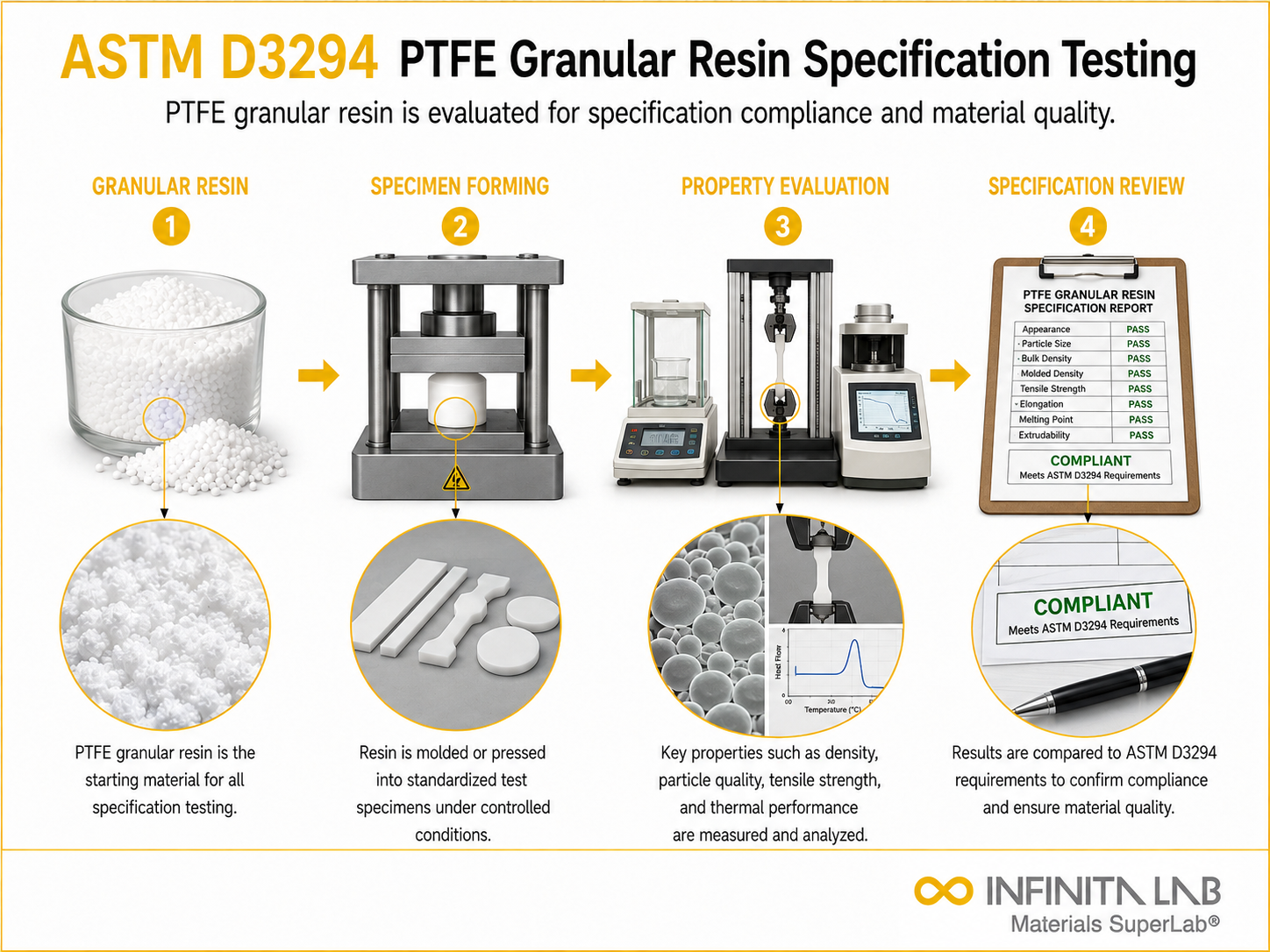
Our ASTM D3294 Testing Procedure
Sample Preparation
PTFE materials are molded or cut into test specimens.
1Saturation Process
Samples are conditioned under controlled environmental conditions.
2Property Measurement
Mechanical, thermal, and physical properties are tested.
3Data Recording & Evaluation
Results are analyzed for classification and compliance.
4ASTM D3294 Test Parameters and Requirements
| Parameter | Details |
|---|---|
| Applicable Materials | Polytetrafluoroethylene (PTFE) |
| Density Range | ~2.1 to 2.3 g/cm³ |
| Tensile Strength | ~20 MPa to 35 MPa |
| Elongation at Break | ~200% to 400% |
| Operating Temperature | ~-200°C to 260°C |
| Measured Outputs | Mechanical and thermal properties |


- Analytical Density Balance (Displacement Method) – determines the specific gravity of moulded PTFE specimens.
- Universal Testing Machine – measures tensile strength and elongation at break under controlled loading rates.
- Dielectric Breakdown Tester – evaluates electrical insulation performance by applying voltage until breakdown occurs.
- Precision Micrometres & Dimensional Gauges – verify sheet thickness and basic shape dimensions against specification tolerances.
- Stereo/Optical Microscope – inspects specimens for internal cracks, voids, and foreign inclusions.
- Environmental Conditioning Chamber – stabilizes specimens at controlled temperature and humidity before testing begins.
- Calibrated Cutting & Specimen Preparation Tools – produce test specimens to the exact dimensions each companion method requires.
Equipment and Instrumentation Used for ASTM D3294 Testing
What You Receive: Test Report, Data, and Certification
- A detailed test report documenting results against every requirement specified in ASTM D3294.
- Clear pass/fail determinations for dimensional, physical, and electrical requirements on the submitted material.
- Recorded values for specific gravity, tensile strength, elongation at break, and dielectric strength where applicable.
- Photographic or microscopic documentation whenever internal cracks, voids, or inclusions are identified during examination.
- A Certificate of Analysis suitable for procurement records, quality assurance files, and customer or regulatory submissions.
- Raw data packages available on request for engineering review, root-cause investigations, or third-party audits.
ASTM D3294 PTFE Granular Resin Specification FAQs
ASTM D3294 provides classification and specification for polytetrafluoroethylene materials. It defines requirements for physical, mechanical, and electrical properties, ensuring consistent performance in applications requiring chemical resistance and thermal stability.
Key parameters include density, tensile strength, elongation, dielectric properties, and thermal characteristics. Material form and processing conditions are also considered to ensure accurate classification and performance evaluation.
The test provides classification based on physical, mechanical, and electrical properties. Results indicate suitability of PTFE materials for sealing, insulation, and chemical-resistant applications.
ASTM D3294 applies to polytetrafluoroethylene materials used in gaskets, seals, electrical insulation, and chemical processing equipment requiring high performance and durability.
ASTM D3294 provides material specifications but may not fully represent performance under all service conditions. Additional testing may be required for long-term durability, environmental exposure, or mechanical stress applications.
Why Choose Infinita Lab for PTFE Granular Resin Specification Testing
When your PTFE Granular Resin Specification results have to hold up - for compliance, a customer audit, or an engineering decision - ASTM D3294 accuracy and an unbiased third-party report matter more than price. Infinita Lab routes your ASTM D3294 PTFE granular resin specification testing to ISO/IEC 17025-accredited U.S. partner labs with hands-on method experience, so you get defensible data, transparent reporting, and turnaround times built around your project deadline - not ours.

Need ASTM D3294 PTFE Granular Resin Specification Testing You Can Rely On?
Send query us at hello@infinitalab.com or call us at (888) 878-3090 to learn more about our services and how we can support you.



Request a Quote
Submit your material details and receive testing procedures, pricing, and turnaround time within 24 hours.
 Quick Turnaround and Hasslefree process
 Confidentiality Guarantee
 Free, No-obligation Consultation
 100% Customer Satisfaction
