


ASTM D483: Petroleum Spray Oil Unsulfonated Residue Testing Services
ASTM D483-04 is a standardized method to determine the level of unsulfonated residue present in petroleum plant spray oils. The test measures the amount of oil that remains on plants after spraying, which can have implications on pesticide effectiveness and environmental impact.
TRUSTED BY


Get ASTM D483 compliant results — request your petroleum spray oil unsulfonated residue testing quote
- Overview
- Scope, Applications, and Benefits
- Test Process
- Specifications
- Instrumentation
- Results and Deliverables
What Is ASTM D483 Petroleum Spray Oil Unsulfonated Residue?
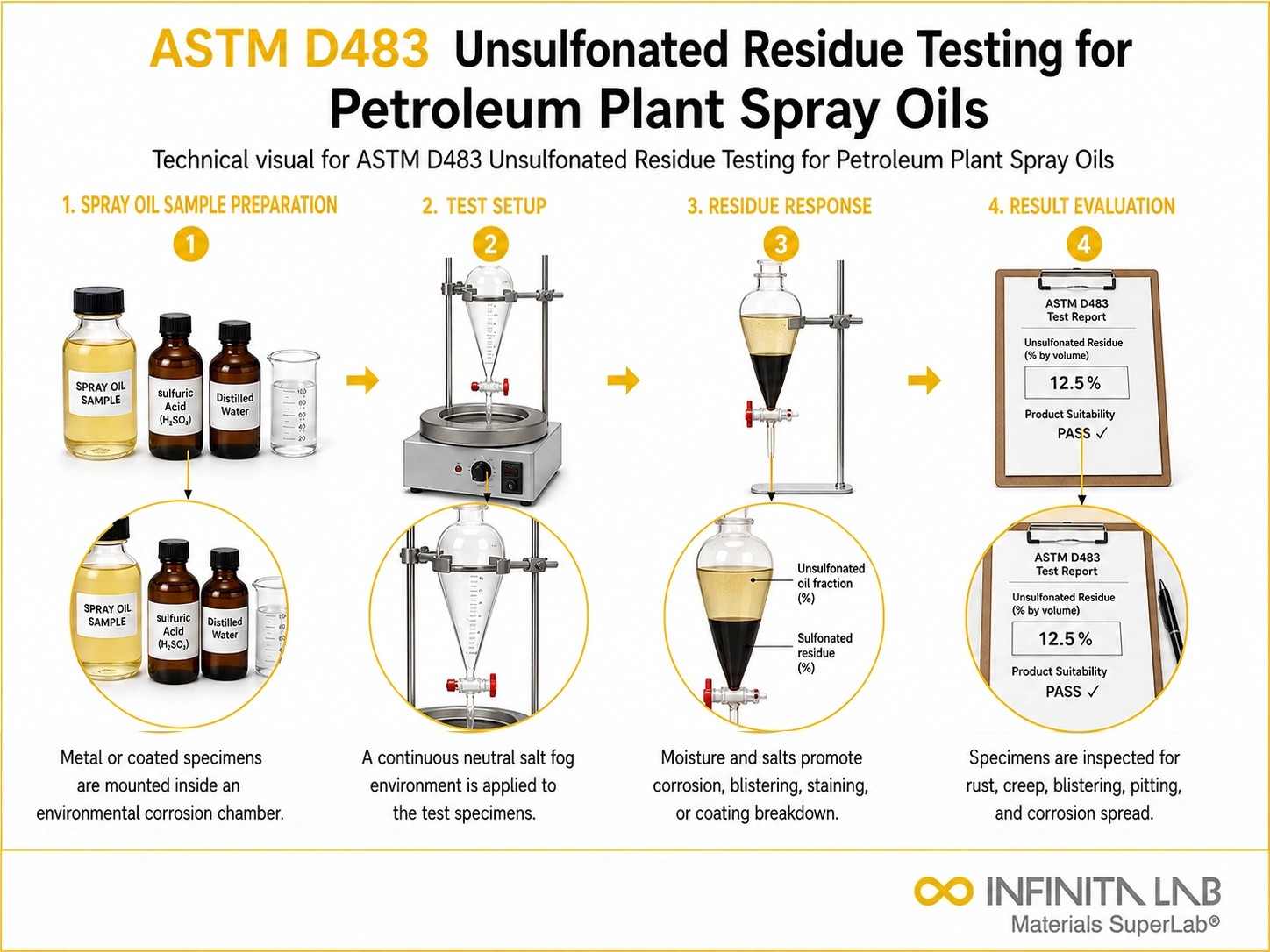
ASTM D483 defines a standardized method for determining the unsulfonated residue (UR) of petroleum-derived plant spray oils. The unsulfonated residue is the fraction of the oil that does not react with fuming sulfuric acid and represents the saturate and isoparaffinic hydrocarbon content of the oil. This parameter is the primary quality indicator for spray oils used in agriculture as pesticide carriers, as well as for horticultural dormant and summer oils.
The test involves treating the oil with a standardized volume of fuming sulfuric acid, which sulfonates the unsaturated and aromatic components. The volume of the unreacted (unsulfonated) oil layer remaining after treatment is measured and expressed as a percentage of the original oil volume. Higher UR values indicate a more highly refined, predominantly paraffinic oil, while lower UR values indicate higher aromatic content. Spray oils with UR above 92% are considered highly refined and safer for plant foliage.

Applications and Benefits of ASTM D483 Petroleum Spray Oil Unsulfonated Residue Testing
Scope
ASTM D483 evaluates:
- Unsulfonated residue (UR) percentage of plant spray oils
- Degree of oil refining and aromatic content
- Compliance with agricultural spray oil specifications
- Phytotoxicity risk correlation with UR value
- Batch-to-batch consistency of spray oil quality
- Comparison of spray oil grades for agricultural use
Applications
- Horticultural dormant spray oil qualification
- Summer and growing-season spray oil evaluation
- Insecticide and pesticide carrier oil testing
- Orchard and vineyard spray program oil selection
- Agricultural oil manufacturer quality control
- Incoming raw material inspection for pesticide formulators
- Research and development in agricultural spray oil formulation
Benefits
- Provides a key quality indicator for agricultural spray oil safety
- Enables compliance with UR specification requirements
- Correlates with phytotoxicity risk to plant foliage
- Supports the selection of safe spray oils for sensitive crops
- Provides documentation for agricultural spray program records
- Enables supplier qualification for spray oil procurement
Our ASTM D483 Testing Procedure
Oil Measurement
A measured volume of spray oil is placed in a calibrated centrifuge tube.
1Acid Treatment
Fuming sulfuric acid of specified strength is added to the oil sample.
2Mixing and Centrifugation
Sample is mixed and centrifuged to separate the sulfonated and unsulfonated fractions.
3Volume Measurement
Volume of the clear unsulfonated oil layer is measured and expressed as a percentage.
4ASTM D483 Test Parameters and Requirements
| Parameter | Details |
|---|---|
| Test Principle | Sulfonation of aromatic/unsaturated fractions with fuming H₂SO₄ |
| Acid Type | Fuming sulfuric acid (oleum) |
| Applicable Materials | Petroleum-derived plant spray oils |
| Output Units | Volume percent (%) unsulfonated residue |
| Measured Outputs | Unsulfonated residue (UR) percentage |


- Calibrated centrifuge tubes
- Centrifuge
- Fuming sulfuric acid (oleum)
- Chemical-resistant mixing apparatus
- Chemical fume hood
- Data recording system
Equipment and Instrumentation Used for ASTM D483 Testing
What You Receive: Test Report, Data, and Certification
- Unsulfonated residue (UR) percentage
- Batch compliance evaluation against the specification
- Oil refining quality classification
- Compliance reports
- Agricultural spray program support records
ASTM D483 Petroleum Spray Oil Unsulfonated Residue FAQs
ASTM D483-04 determines unsulfonated residue of petroleum spray oils. It evaluates oil purity and suitability for agricultural applications, ensuring minimal phytotoxic effects on plants and crops during spraying operations.
Key parameters include acid treatment conditions, temperature control, reaction time, and phase separation. Controlled conditions ensure accurate determination of unsulfonated residue in petroleum spray oils.
The test measures percentage of unsulfonated residue remaining after treatment. Results indicate oil stability and potential plant safety during agricultural use.
ASTM D483-04 applies to petroleum-based spray oils used in agriculture for pest control and crop protection where oil purity affects plant safety.
ASTM D483-04 results depend on reaction conditions and sample handling. It may not fully represent field performance, requiring additional testing for environmental and application-specific factors.
Why Choose Infinita Lab for Petroleum Spray Oil Unsulfonated Residue Testing
At the core of this breadth is our network of 2,000+ accredited laboratories across the USA, offering access to over 10,000 testing methods and analytical services. From advanced materials characterization (SEM, TEM, RBS, XPS) to mechanical, chemical, environmental, biological, and standardized ASTM/ISO-compliant testing, we deliver unmatched flexibility, specialization, and scale. You are never limited by geography, facility, or methodology — Infinita Lab connects you to the right expertise and testing solution, every time.

Looking for an Accredited Partner for ASTM D483 Petroleum Spray Oil Unsulfonated Residue Testing?
Send query us at hello@infinitalab.com or call us at (888) 878-3090 to learn more about our services and how we can support you.



Request a Quote
Submit your material details and receive testing procedures, pricing, and turnaround time within 24 hours.
 Quick Turnaround and Hasslefree process
 Confidentiality Guarantee
 Free, No-obligation Consultation
 100% Customer Satisfaction
