


ASTM D3720: Titanium Dioxide Anatase Rutile XRD Testing Services
Accredited ASTM D3720 titanium dioxide anatase rutile XRD testing from Infinita Lab, performed to the exact standard requirements - accurate, reproducible results with full documentation for compliance, R&D, and quality control programs.
TRUSTED BY


Get ASTM D3720 compliant results - request your titanium dioxide anatase rutile XRD testing quote
- Overview
- Scope, Applications, and Benefits
- Test Process
- Specifications
- Instrumentation
- Results and Deliverables
What Is ASTM D3720 Titanium Dioxide Anatase Rutile XRD?
ASTM D3720 determines the ratio of anatase to rutile phases in titanium dioxide pigments using X-ray diffraction (XRD). This method quantifies crystalline composition, which directly influences pigment properties such as brightness, opacity, and durability.
This test is essential for quality control and product consistency in pigment manufacturing. It enables precise phase identification and quantification, helping ensure pigments meet performance requirements for coatings, plastics, and other applications.

Applications and Benefits of ASTM D3720 Titanium Dioxide Anatase Rutile XRD Testing
Scope
ASTM D3720 defines a standardized XRD method for determining the relative proportions of anatase and rutile phases in titanium dioxide pigments.
- Applicable to titanium dioxide pigments
- Determines anatase-to-rutile ratio
- Uses X-ray diffraction analysis
- Provides quantitative phase composition
- Suitable for quality control and research
- Supports material identification and comparison
- Ensures compliance with pigment specifications
Applications
- Paints and coatings
- Plastics and polymers
- Printing inks
- Pigment manufacturing
- Material quality control
Benefits
- Provides accurate phase composition analysis
- Ensures consistent pigment quality
- Supports performance optimization
- Enables comparison between pigment grades
- Improves product reliability
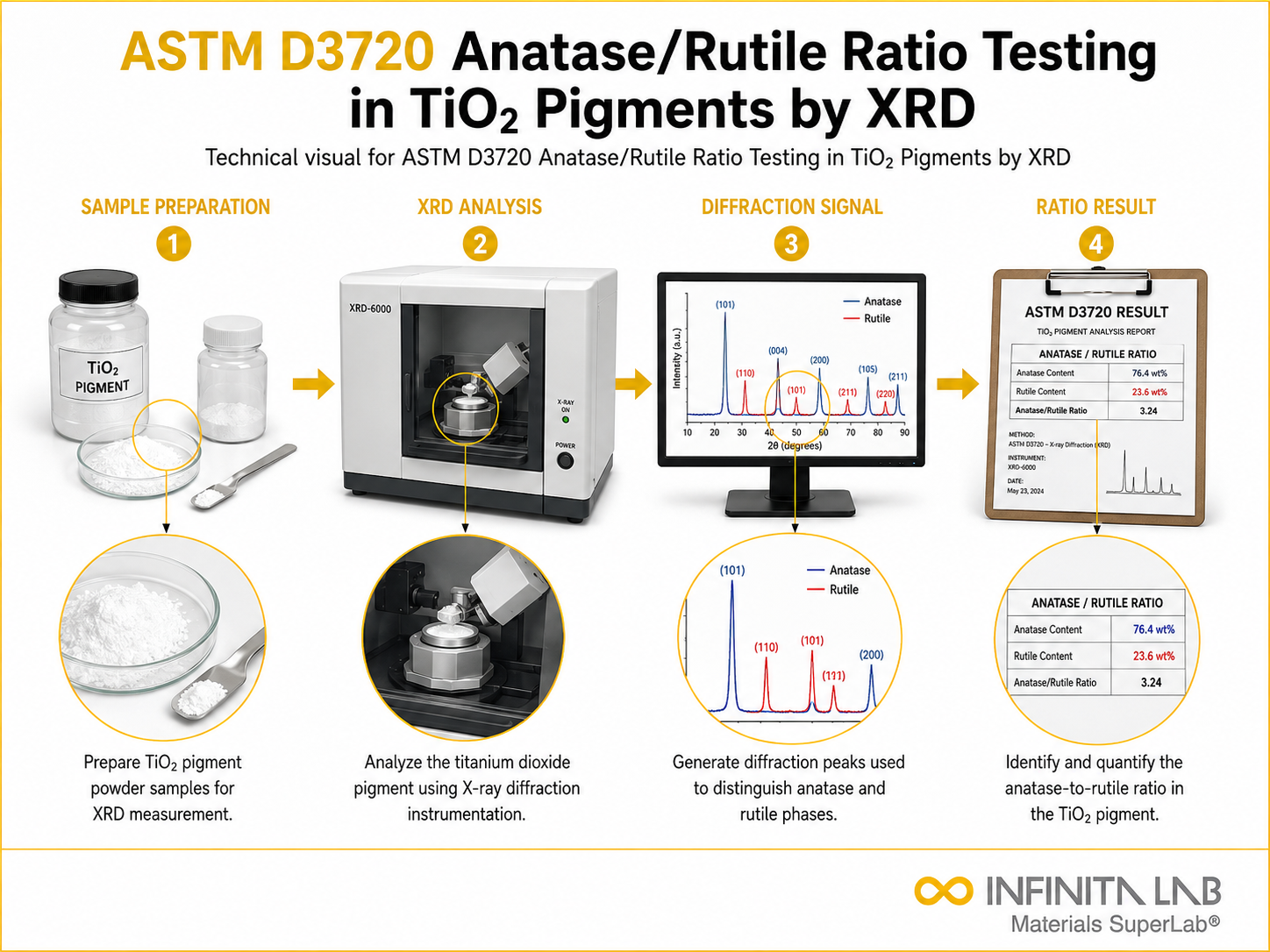
Our ASTM D3720 Testing Procedure
Sample Preparation
Pigment sample is finely prepared and mounted for XRD analysis.
1XRD Measurement
Sample is exposed to X-rays to obtain diffraction patterns.
2Peak Identification
Anatase and rutile peaks are identified from diffraction data.
3Ratio Calculation
Relative peak intensities are used to calculate phase ratio.
4ASTM D3720 Test Parameters and Requirements
| Parameter | Details |
|---|---|
| Material Type | Titanium dioxide pigments |
| Method | X-ray diffraction (XRD) |
| Measurement | Anatase-to-rutile ratio |
| Output | Phase composition percentage |
| Units | Relative percentage (%) |
| Relative percentage (%) | Powder |
| Analysis | Diffraction peak intensity |


- X-ray diffractometer (XRD)
- Sample holder and preparation tools
- Data analysis software
- Calibration standards
- Laboratory balance
Equipment and Instrumentation Used for ASTM D3720 Testing
What You Receive: Test Report, Data, and Certification
- Anatase and rutile percentage
- Diffraction pattern data
- Phase identification report
- Test conditions and observations
- Compliance statement with ASTM D3720
ASTM D3720 Titanium Dioxide Anatase Rutile XRD FAQs
ASTM D3720 is used to determine the ratio of anatase to rutile phases in titanium dioxide pigments using X-ray diffraction. It ensures pigment quality, consistency, and performance by accurately identifying crystalline composition for various industrial applications.
The ratio affects optical and durability properties. Rutile provides better opacity and weather resistance, while anatase offers higher brightness. Controlling the ratio ensures pigments meet specific performance requirements in coatings, plastics, and other products.
XRD identifies crystalline phases by analyzing diffraction patterns produced when X-rays interact with the material. Each phase has unique peaks, allowing precise identification and quantification of anatase and rutile components.
Factors include sample homogeneity, instrument calibration, measurement conditions, and data analysis methods. Proper control ensures reliable results.
Anatase offers higher brightness and whiteness but lower durability compared to rutile, making it suitable for indoor or less demanding applications.
Rutile X-ray diffraction (XRD) testing identifies and evaluates the crystalline structure of rutile titanium dioxide (TiO₂). A powdered sample is exposed to X-rays, and the resulting diffraction pattern is compared with reference data to confirm the rutile phase and assess crystallinity and potential impurities. XRD can also estimate the proportions of rutile and anatase when both phases are present, supporting material characterization and quality control.
Why Choose Infinita Lab for Titanium Dioxide Anatase Rutile XRD Testing?
When your Titanium Dioxide Anatase Rutile XRD results have to hold up - for compliance, a customer audit, or an engineering decision - ASTM D3720 accuracy and an unbiased third-party report matter more than price. Infinita Lab routes your ASTM D3720 titanium dioxide anatase rutile XRD testing to ISO/IEC 17025-accredited U.S. partner labs with hands-on method experience, so you get defensible data, transparent reporting, and turnaround times built around your project deadline - not ours.

Looking for an Accredited Partner for ASTM D3720 Titanium Dioxide Anatase Rutile XRD Testing?
Send query us at hello@infinitalab.com or call us at (888) 878-3090 to learn more about our services and how we can support you.



Request a Quote
Submit your material details and receive testing procedures, pricing, and turnaround time within 24 hours.
 Quick Turnaround and Hasslefree process
 Confidentiality Guarantee
 Free, No-obligation Consultation
 100% Customer Satisfaction
