


ASTM E81 Quantitative Pole Figure Texture Analysis Testing
In ASTM E81, X-ray diffraction is the important non-destructive tool used to study all types of matter ranging from fluids to powders and crystals. X-ray diffraction methods are used for the identification of crystalline phases of different materials and for quantitative phase analysis. X-ray diffraction methods are better for understanding the three-dimensional atomic structure of crystalline solids. Data for constructing pole figures are obtained with an X-ray diffractometer, using reflection and transmission techniques.
TRUSTED BY


Precision-driven testing for dimensional accuracy and compliance
- Overview
- Scope, Applications, and Benefits
- Test Process
- Specifications
- Instrumentation
- Results and Deliverables
Overview
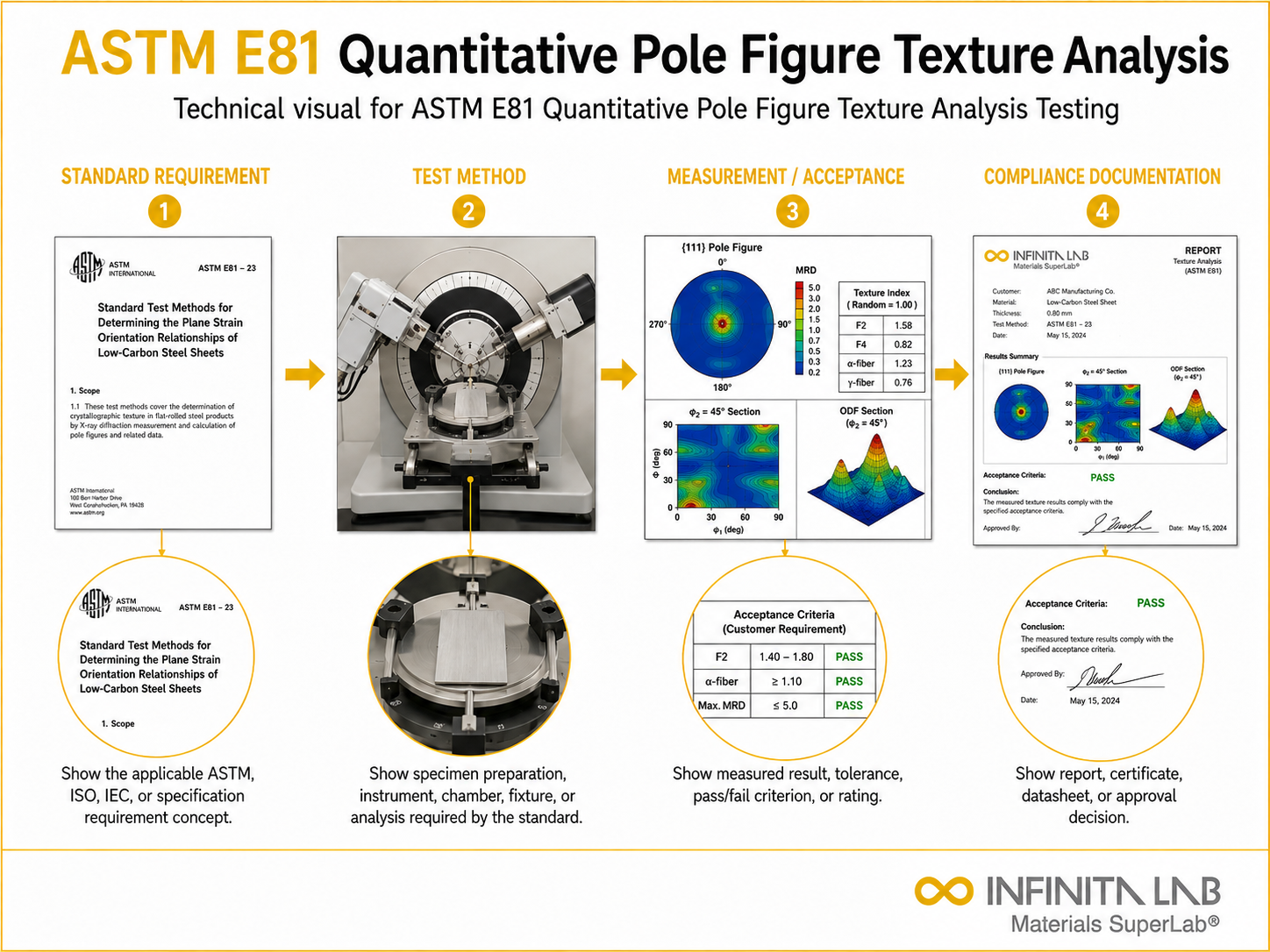
ASTM E 81 quantitative pole figure testing is the standardized procedure for the preparation of quantitative pole figures of metallic materials using X-ray diffraction, which involves the characterization of the crystallographic texture and preferred orientation of polycrystalline metallic materials using specific scanning methods with a diffractometer and data collection methods for the pole figure of the metallic material under consideration. ASTM E 81 quantitatively defines the specimen preparation, configuration, and measurement procedure of the pole figure, which is essential for the accurate characterization of the crystallographic texture of the metallic material, allowing materials engineers, metallurgists, and researchers to use the data for the characterization of the material in the process of forming, anisotropy, and supplier evaluation programs.

Scope, Applications, and Benefits
Scope
Quantitative pole figures of metallic materials are prepared by the ASTM E 81 standard by passing defined specimens through a series of tilt and rotation angles in a calibrated X-ray diffractometer and collecting the intensity of diffracted X-rays as a function of the specimen orientation.
ASTM E 81 quantitative pole figure testing evaluates:
- Crystallographic texture and preferred orientation of metallic sheet and plate materials
- Pole figure intensity distribution across defined crystallographic planes and orientations
- Comparative texture characteristics of metallic materials across processing conditions
- Effect of rolling, forming, heat treatment, and deformation on crystallographic texture
- Compliance against defined texture requirements for metallic material forming applications
Applications
- Sheet metal forming materials requiring crystallographic texture and anisotropy characterization
- Automotive body panel steel and aluminum sheet texture assessment for forming programs
- Electrical steel and transformer core material texture characterization programs
- Cold-rolled, annealed, and heat-treated metallic material texture verification programs
- Materials research requiring quantitative pole figure crystallographic texture data
Benefits
- Provides reliable crystallographic texture data for metallic material forming analysis
- Supports texture specification compliance and supplier assessment programs
- Identifies unfavorable texture distributions in metallic materials before forming operations
- Delivers traceable pole figure data for engineering and research submissions
- Reduces forming risk by verifying crystallographic texture early in material assessment
Test Process
Sample Preparation
Metallic specimens prepared to defined surface condition and geometry per ASTM E 81 requirements.
1Diffractometer Setup
Specimen mounted in X-ray diffractometer and configured for defined pole figure scanning geometry.
2Pole Figure Data Collection
X-ray intensity measured across systematic tilt and rotation angles generating pole figure data.
3Data Analysis & Reporting
Pole figure intensity data processed to generate quantitative texture representation and test compliance result.
4Technical Specifications
| Parameter | Details |
|---|---|
| Applicable Materials | Metallic sheet, plate, and wrought materials requiring crystallographic texture characterization |
| Specimen Geometry | Defined specimen dimensions and surface preparation per ASTM E 81 requirements |
| Scanning Conditions | Systematic tilt and rotation angles per ASTM E 81 pole figure data collection requirements |
| Measured Parameters | Diffracted X-ray intensity as a function of specimen tilt and rotation orientation |
| Measured Outputs | Pole figure intensity data, texture representation maps, and test compliance result |


- X-ray diffractometer with a defined Eulerian cradle or texture goniometer configuration
- X-ray source with a defined wavelength for target metallic material diffraction
- Pole figure scanning and data collection control system
- Specimen preparation tools for defined surface conditions and geometry
- Specialist pole figure data acquisition and texture analysis software
- Data reporting and pole figure visualization system
Instrumentation Used for Testing
Results and Deliverables
- Quantitative pole figure intensity data across systematic tilt and rotation scan angles
- Pole figure representations for defined crystallographic planes of tested metallic materials
- Comparative texture distribution data across processing conditions, where applicable
- Test compliance result assessed against defined crystallographic texture requirements
- ASTM E 81 pole figure test report
Frequently Asked Question
ASTM E81 provides steps for preparing quantitative pole figures. These figures analyze the crystallographic texture in materials. They help determine the orientation distribution of grains and improve our understanding of anisotropic behavior in metals and other crystalline materials.
Pole figures help assess crystallographic texture, which affects mechanical properties, forming behavior, and anisotropy. ASTM E81 supports precise analysis of grain orientation for materials used in structural and manufacturing applications.
ASTM E81 is often used for metals, alloys, and crystalline materials in aerospace, automotive, and manufacturing industries. Grain orientation impacts performance and forming characteristics.
ASTM E81 involves preparing specimens and using diffraction techniques like X-ray diffraction. This is done to measure the intensity distribution of crystallographic planes and to create quantitative pole figures that show grain orientation.
ASTM E81 needs special equipment and careful sample preparation. Results can be affected by measurement errors, sample quality, and interpretation methods. This means expertise is necessary for precise crystallographic analysis.
Why Choose Infinita Lab for Advanced Materials Testing and Characterization?
At the core of this breadth is our network of 2,000+ accredited laboratories across the USA, offering access to over 10,000 testing methods and analytical services. From advanced materials characterization (SEM, TEM, RBS, XPS) to mechanical, chemical, environmental, biological, and standardized ASTM/ISO-compliant testing, we deliver unmatched flexibility, specialization, and scale. You are never limited by geography, facility, or methodology — Infinita Lab connects you to the right expertise and testing solution, every time.

Looking for a Trusted Partner for Accurate and Reliable Testing Services?
Send query us at hello@infinitalab.com or call us at (888) 878-3090 to learn more about our services and how we can support you.



Request a Quote
Submit your material details and receive testing procedures, pricing, and turnaround time within 24 hours.
 Quick Turnaround and Hasslefree process
 Confidentiality Guarantee
 Free, No-obligation Consultation
 100% Customer Satisfaction
