


ASTM D3222: PVDF Molding Coating Material Testing Services
Accredited ASTM D3222 PVDF molding coating material testing from Infinita Lab, performed to the exact standard requirements - accurate, reproducible results with full documentation for compliance, R&D, and quality control programs.
TRUSTED BY


Get ASTM D3222 compliant results - request your PVDF molding coating material testing quote
- Overview
- Scope, Applications, and Benefits
- Test Process
- Specifications
- Instrumentation
- Results and Deliverables
What Is ASTM D3222 PVDF Molding Coating Material?
ASTM D3222 provides a classification system and specification requirements for polyvinylidene fluoride (PVDF) molding and coating materials. PVDF is a high-performance fluoropolymer known for its exceptional chemical resistance, thermal stability, UV resistance, and piezoelectric properties. Standardising its characterisation ensures consistent material quality for demanding industrial and electronic applications.
The standard classifies PVDF materials based on melt flow rate, tensile strength, elongation, and other performance properties, and defines test methods for verifying conformance. ASTM D3222 serves as a procurement and qualification tool, allowing users to specify PVDF grades based on their performance requirements and enabling suppliers to certify their materials against defined property ranges.

Applications and Benefits of ASTM D3222 PVDF Molding Coating Material Testing
Scope
ASTM D3222 covers:
- Classification of PVDF molding and coating materials
- Melt flow rate requirements
- Tensile strength and elongation at break
- Dielectric properties
- Colour and appearance requirements
- Thermal stability characterisation
- Density and specific gravity
Applications
- Chemical process piping and valves
- Semiconductor equipment components
- Electrical wire and cable jacketing
- Architectural coating membranes
- Pharmaceutical and biotech fluid handling
- Piezoelectric sensor films
- Water treatment membranes
Benefits
- Ensures material consistency for critical applications
- Simplifies procurement with standardised classification
- Enables supplier qualification against defined criteria
- Supports design of chemical-resistant systems
- Provides traceability for materials used in regulated industries
- Facilitates comparison of PVDF grades across suppliers
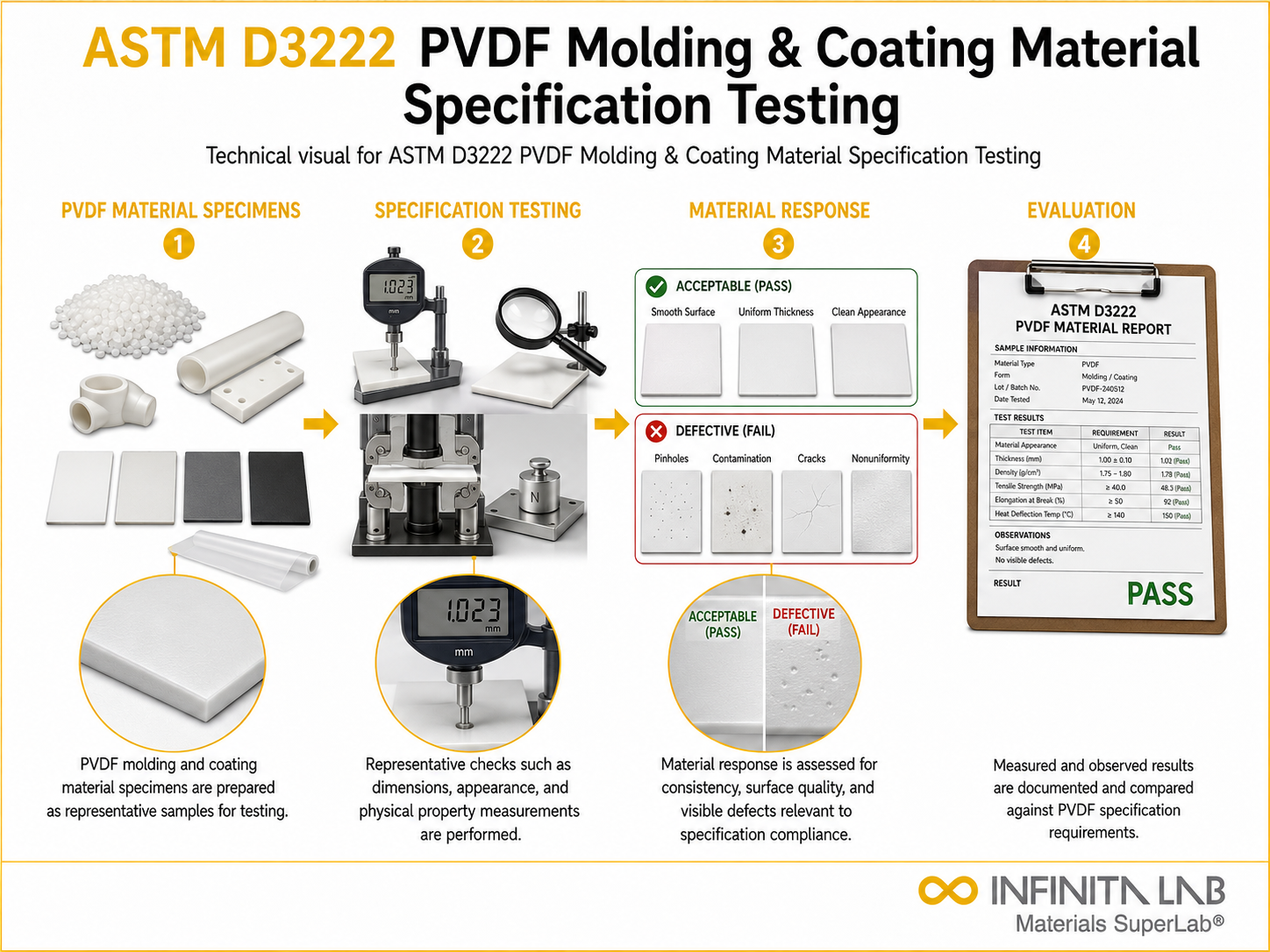
Our ASTM D3222 Testing Procedure
Specimen Preparation
PVDF specimens are molded or prepared per applicable ASTM procedures for each property test.
1Melt Flow Rate
MFR is determined per ASTM D1238 at the specified temperature and load.
2Tensile Testing
Tensile strength and elongation are measured per ASTM D638.
3Dielectric Testing
Dielectric constant and dissipation factor are measured per ASTM D150.
4ASTM D3222 Test Parameters and Requirements
| Parameter | Details |
|---|---|
| Applicable Materials | Unmodified PVDF (virgin homopolymer) |
| Material Forms | Pellets, powder, coating grade resin |
| Melting Range | Thermoplastic fluoropolymer |
| Thermal Stability | 156–180°C |
| Thermal Stability | Up to ~370°C |
| Typical Properties Evaluated | Melt flow, specific gravity, tensile, dielectric properties |


- Melt flow indexer (MFI tester)
- Universal testing machine (UTM)
- Injection molding machine for specimen preparation
- Density / specific gravity measurement apparatus
- Dielectric test equipment
- Data recording system
Equipment and Instrumentation Used for ASTM D3222 Testing
What You Receive: Test Report, Data, and Certification
- PVDF material classification grade
- Tensile strength and elongation data
- Melt flow rate values
- Density and specific gravity measurements
- Dielectric property data
ASTM D3222 PVDF Molding Coating Material FAQs
It covers unmodified PVDF homopolymer materials used in molding, extrusion, and coating applications.
The standard applies to pellet and powder forms of virgin PVDF resin.
No, it applies only to virgin unmodified homopolymer PVDF, not reinforced, filled, or copolymer grades.
Typical properties include melting point, density, flow rate, tensile strength, and dielectric performance.
PVDF generally melts between 156°C and 180°C.
Why Choose Infinita Lab for PVDF Molding Coating Material Testing?
When your PVDF Molding Coating Material results have to hold up - for compliance, a customer audit, or an engineering decision - ASTM D3222 accuracy and an unbiased third-party report matter more than price. Infinita Lab routes your ASTM D3222 PVDF molding coating material testing to ISO/IEC 17025-accredited U.S. partner labs with hands-on method experience, so you get defensible data, transparent reporting, and turnaround times built around your project deadline - not ours.

Need ASTM D3222 PVDF Molding Coating Material Testing You Can Rely On?
Send query us at hello@infinitalab.com or call us at (888) 878-3090 to learn more about our services and how we can support you.



Request a Quote
Submit your material details and receive testing procedures, pricing, and turnaround time within 24 hours.
 Quick Turnaround and Hasslefree process
 Confidentiality Guarantee
 Free, No-obligation Consultation
 100% Customer Satisfaction
