

What Is ASTM D3170 Coating Chip Resistance?
ASTM D3170 provides a standardised method for evaluating the resistance of coatings to chipping when impacted by gravel or other projectiles. Chip resistance is a critical performance attribute for automotive exterior coatings, truck bed liners, underbody coatings, and any protective finish applied to surfaces exposed to road debris or mechanical impacts.
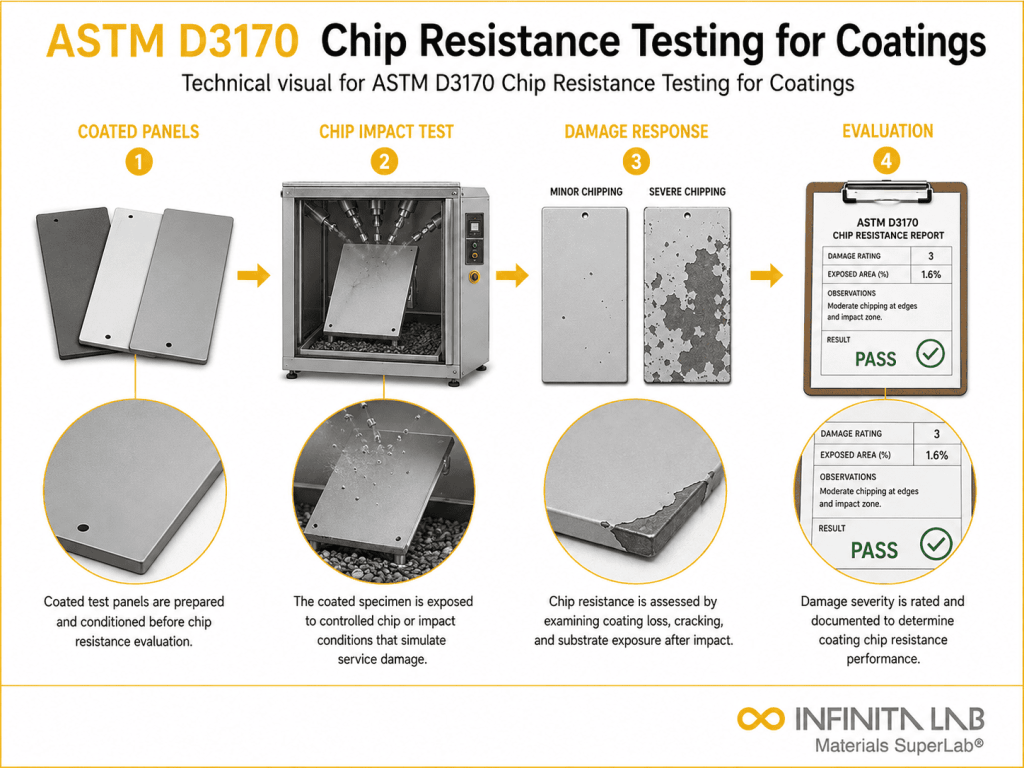
The test uses a gravelometer apparatus in which a stream of standardised gravel is propelled by compressed air against the coated test panel. The resulting chip damage is compared visually to a photographic reference chart, and a numerical rating from 10 (no chipping) to 0 (severe chipping) is assigned. This rating system allows direct comparison of coating systems and supports the design and specification of chip-resistant finishes.
Applications and Benefits of ASTM D3170 Coating Chip Resistance Testing
Scope
ASTM D3170 evaluates:
- Chip resistance of organic coatings on metal substrates
- Effect of coating type and thickness on chip performance
- Impact of substrate preparation on chip resistance
- Temperature dependence of chipping behaviour
- Comparative ranking of coating systems
- Coating adhesion failure vs. cohesive chip patterns
Applications
- Automotive OEM exterior coatings
- Truck bed liner coatings
- Underbody and rocker panel coatings
- Fleet vehicle protective finishes
- Heavy equipment coatings
- Agricultural machinery coatings
- Quality control in automotive paint lines
Benefits
- Simulates real-world gravel impact damage
- Enables objective chip resistance rating
- Supports selection of chip-resistant coating systems
- Identifies adhesion weaknesses under impact conditions
- Provides data for coating system qualification
- Enables testing at low temperature to simulate cold-weather chipping
Our ASTM D3170 Testing Procedure
Specimen Preparation
Coated metal panels are prepared at specified dry film thickness and fully cured.
1Temperature Conditioning
Panels are optionally conditioned at -18°C or specified temperature before testing.
2Gravel Impact
Panel is mounted in the gravelometer; 500 mL of standardized gravel is propelled at the coated surface with compressed air.
3Rating
Panel is compared to the SAE J400 / ASTM D3170 photographic chart and assigned a numerical chip resistance rating.
4ASTM D3170 Test Parameters and Requirements
| Parameter | Details |
|---|---|
| Applicable Materials | Painted metal panels, coated automotive body panels, coated substrates |
| Specimen Types | Flat coated test panels |
| Impact Media | Standard gravel or specified chipping media |
| Test Temperature | Ambient or low-temperature conditioned environment |
| Test Environment | Controlled laboratory conditions |


- Gravelometer apparatus with compressed air delivery
- Standardised SAE gravel (angular, 9–16 mm)
- Photographic rating chart (SAE J400/ASTM D3170)
- Low-temperature conditioning chamber
- Film thickness gauge
- Magnifying glass for chip examination
Equipment and Instrumentation Used for ASTM D3170 Testing
What You Receive: Test Report, Data, and Certification
- Chip resistance rating (numeric, 0–10)
- Chip pattern photographs
- Dry film thickness measurements
- Temperature-dependent chip resistance data
- Coating system qualification reports
ASTM D3170 Coating Chip Resistance FAQs
It measures the chip resistance of coatings when impacted by gravel, stones, or other flying objects.
It is widely used in the automotive, industrial coatings, and paint manufacturing industries.
Typically, coated metal test panels or painted automotive body panels are used.
It helps evaluate how well a coating can withstand road debris impact, which is critical for vehicle durability and appearance.
Yes, it is similar to SAE J400, another widely used gravelometer chip resistance test.
Gravelometer testing evaluates the resistance of surface coatings, such as automotive paints, clear coats, and metallic finishes, to chipping caused by flying gravel and road debris. According to ASTM D3170/D3170M, a coated test panel is mounted inside a gravelometer, where compressed air propels a controlled quantity of standardized gravel against its surface. After the impact, the specimen is removed, cleaned, and covered with adhesive tape to remove loose coating fragments. The damaged surface is then examined visually and compared with standardized rating references to determine the extent and size of the coating chips. The results help manufacturers assess coating durability and improve the performance of automotive finishes exposed to road conditions.
Chipping resistance measures a coating's ability to withstand localized impact from stones, gravel, and other flying particles without cracking, flaking, or separating from the underlying surface. It is commonly evaluated using a controlled impact test in which standardized gravel or other impact media are propelled against a coated specimen. After exposure, the surface is inspected for coating damage, including the number, size, and distribution of chips. The results are used to assess coating adhesion, flexibility, and overall resistance to mechanical impact. Chipping resistance testing is particularly important for automotive bodies, protective coatings, metal components, and industrial finishes that experience repeated impact from external debris.
Why Choose Infinita Lab for Coating Chip Resistance Testing?
When your Coating Chip Resistance results have to hold up - for compliance, a customer audit, or an engineering decision - ASTM D3170 accuracy and an unbiased third-party report matter more than price. Infinita Lab routes your ASTM D3170 coating chip resistance testing to ISO/IEC 17025-accredited U.S. partner labs with hands-on method experience, so you get defensible data, transparent reporting, and turnaround times built around your project deadline - not ours.

Need ASTM D3170 Coating Chip Resistance Testing You Can Rely On?
Send query us at hello@infinitalab.com or call us at (888) 878-3090 to learn more about our services and how we can support you.