


ASTM D3159: Modified PTFE Molding Specification Testing Services
This ASTM D 3159 standard specification covers materials for molding and extrusion made of modified ETFE fluoropolymer. A resin made of ETFE Tetrafluoroethylene and Ethylene copolymer. ETFE modified Other fluoro monomers make up no more than 5% of the resin.
TRUSTED BY


Get ASTM D3159 compliant results — request your modified PTFE molding specification testing quote
- Overview
- Scope, Applications, and Benefits
- Test Process
- Specifications
- Instrumentation
- Results and Deliverables
What Is ASTM D3159 Modified PTFE Molding Specification?
ASTM D3159 provides standard specifications for modified ETFE (ethylene-tetrafluoroethylene) fluoropolymer coatings and molding compounds. The specification defines the property requirements — including tensile strength, elongation, melting point, and melt flow rate — that ETFE materials must meet to ensure performance consistency for electrical wire insulation, chemical process equipment, and speciality coating applications.
Compliance testing per ASTM D3159 supports incoming material qualification, product line consistency verification, and performance confirmation for end-use applications demanding the unique chemical resistance, high-temperature capability, and electrical properties of modified ETFE fluoropolymers.

Applications and Benefits of ASTM D3159 Modified PTFE Molding Specification Testing
Scope
ASTM D3159 evaluates the key physical, thermal, mechanical, and electrical properties of fluoropolymer materials to ensure their suitability for demanding industrial and electrical applications. The standard helps characterise material performance, processing behaviour, and quality consistency.
Key parameters evaluated include:
- Tensile strength and elongation at break to assess mechanical durability and flexibility
- Melt flow rate (MFR) and rheological classification to determine processability and flow characteristics during molding or extrusion
- Melting point by DSC to measure thermal transition behaviour
- Dielectric properties, including dielectric constant and dissipation factor, for electrical insulation performance
- Specific gravity to verify material density and composition consistency
Applications
- Electrical wire and cable fluoropolymer insulation qualification
- Chemical process equipment lining and coating materials
- Semiconductor process fluid handling components
- High-performance tube and hose inner liners
- Aerospace and automotive wiring fluoropolymer materials
Benefits
- Ensures consistent material performance across production lots
- Supports incoming QC for wire and cable manufacturers
- Enables compliance with UL, MIL-W, and aerospace wiring specifications
- Provides a standardised basis for fluoropolymer supplier qualification
- Identifies off-specification material before processing
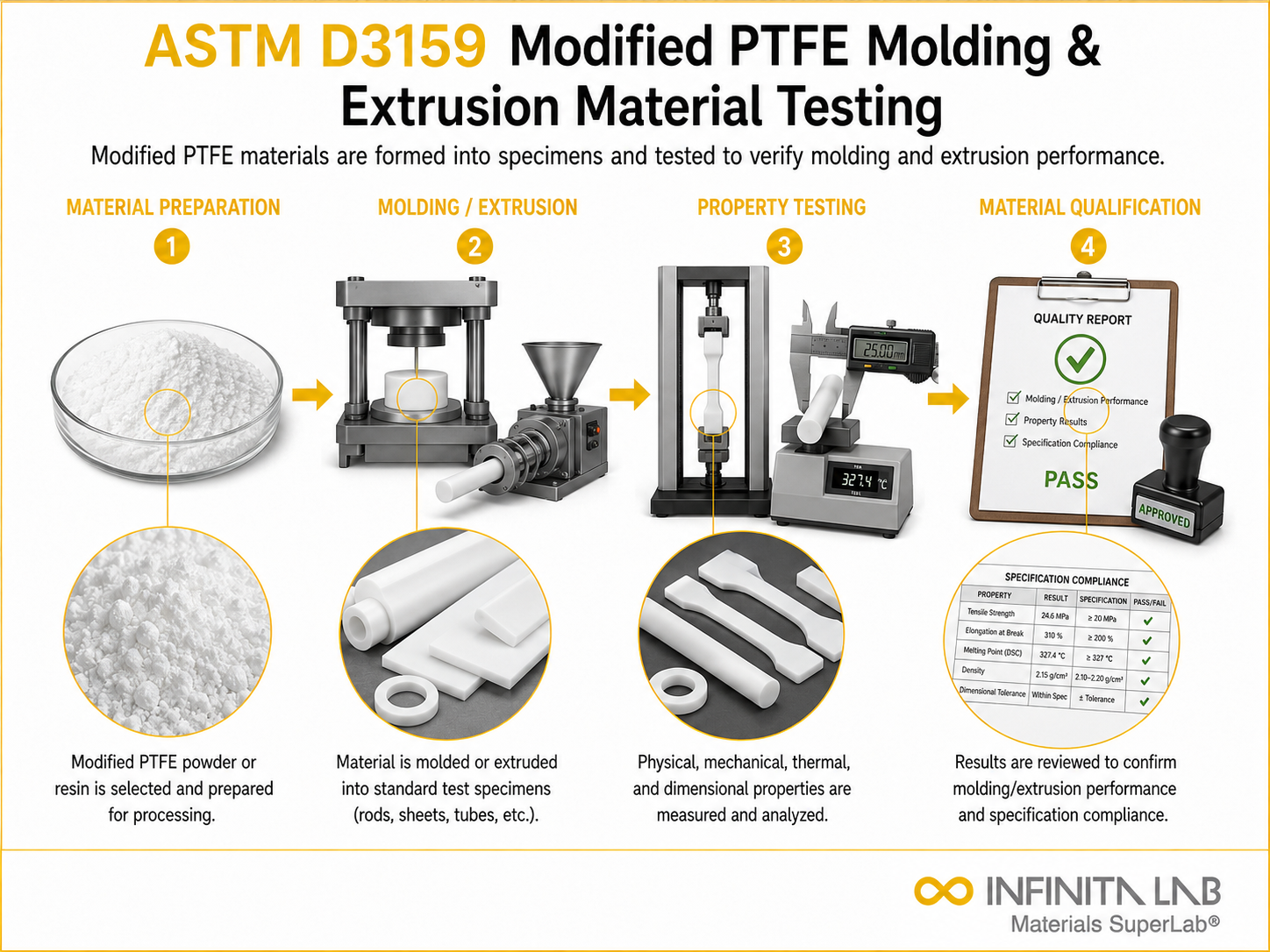
Our ASTM D3159 Testing Procedure
Sample Preparation
Specimens are molded or extruded as per ASTM D3159 requirements.
1Physical & Thermal Testing
Mechanical, density, and melting point properties are measured.
2Rheological Testing
Melt flow rate is tested for grade classification.
3Compliance Check
Results are verified against ASTM D3159 limits and reported with CoA.
4ASTM D3159 Test Parameters and Requirements
| Parameter | Details |
|---|---|
| Material | Modified ETFE fluoropolymer |
| Key Tests | Tensile strength (D638), elongation (D638), MFR (D1238), melting point (D3418), specific gravity (D792) |
| Typical Tensile Strength | ≥34.5 MPa |
| Typical Elongation | ≥300% |
| Melting Point | 250–270 °C (grade dependent) |


- Universal testing machine (UTM) with dumbbell die
- Melt flow indexer
- DSC (differential scanning calorimeter)
- Density/specific gravity balance
- Precision compression mold press
Equipment and Instrumentation Used for ASTM D3159 Testing
What You Receive: Test Report, Data, and Certification
- Tensile strength and elongation at break values
- Melt flow rate and rheological grade classification
- DSC melting peak temperature
- Specific gravity measurement
ASTM D3159 Modified PTFE Molding Specification FAQs
ETFE (ethylene-tetrafluoroethylene) is a copolymer with a balance of carbon-hydrogen and carbon-fluorine bonds, giving it higher tensile strength and better radiation resistance than PTFE while retaining good chemical resistance and a higher operating temperature than most engineering plastics.
Modified ETFE refers to copolymers of ethylene and tetrafluoroethylene with additional monomers incorporated to modify specific properties (e.g., improved stress crack resistance, processability, or adhesion). ASTM D3159 covers these commercial grades.
MFR characterizes the processing viscosity of the material and ensures that the resin grade selected is appropriate for the intended processing method (extrusion, injection molding, powder coating). Different MFR grades are suitable for different processing conditions.
No. ASTM D3159 is specific to modified ETFE. PTFE is covered by ASTM D4745, FEP by ASTM D2116, and PFA by ASTM D3307. Each fluoropolymer family has its own specification standard.
Typical testing requires 5 dumbbell specimens for tensile/elongation testing, 3 specimens for specific gravity, and sufficient material for MFR and DSC testing. The total material requirement is approximately 200–500 g of pellets or sheet.
Why Choose Infinita Lab for Modified PTFE Molding Specification Testing
At the core of this breadth is our network of 2,000+ accredited laboratories across the USA, offering access to over 10,000 testing methods and analytical services. From advanced materials characterization (SEM, TEM, RBS, XPS) to mechanical, chemical, environmental, biological, and standardized ASTM/ISO-compliant testing, we deliver unmatched flexibility, specialization, and scale. You are never limited by geography, facility, or methodology — Infinita Lab connects you to the right expertise and testing solution, every time.

Looking for an Accredited Partner for ASTM D3159 Modified PTFE Molding Specification Testing?
Send query us at hello@infinitalab.com or call us at (888) 878-3090 to learn more about our services and how we can support you.



Request a Quote
Submit your material details and receive testing procedures, pricing, and turnaround time within 24 hours.
 Quick Turnaround and Hasslefree process
 Confidentiality Guarantee
 Free, No-obligation Consultation
 100% Customer Satisfaction
