


ASTM D3045: Plastic Heat Aging Without Load Testing Services
Accredited ASTM D3045 plastic heat aging without load testing from Infinita Lab, performed to the exact standard requirements - accurate, reproducible results with full documentation for compliance, R&D, and quality control programs.
TRUSTED BY


Get ASTM D3045 compliant results - request your plastic heat aging without load testing quote
- Overview
- Scope, Applications, and Benefits
- Test Process
- Specifications
- Instrumentation
- Results and Deliverables
What Is ASTM D3045 Plastic Heat Aging Without Load?
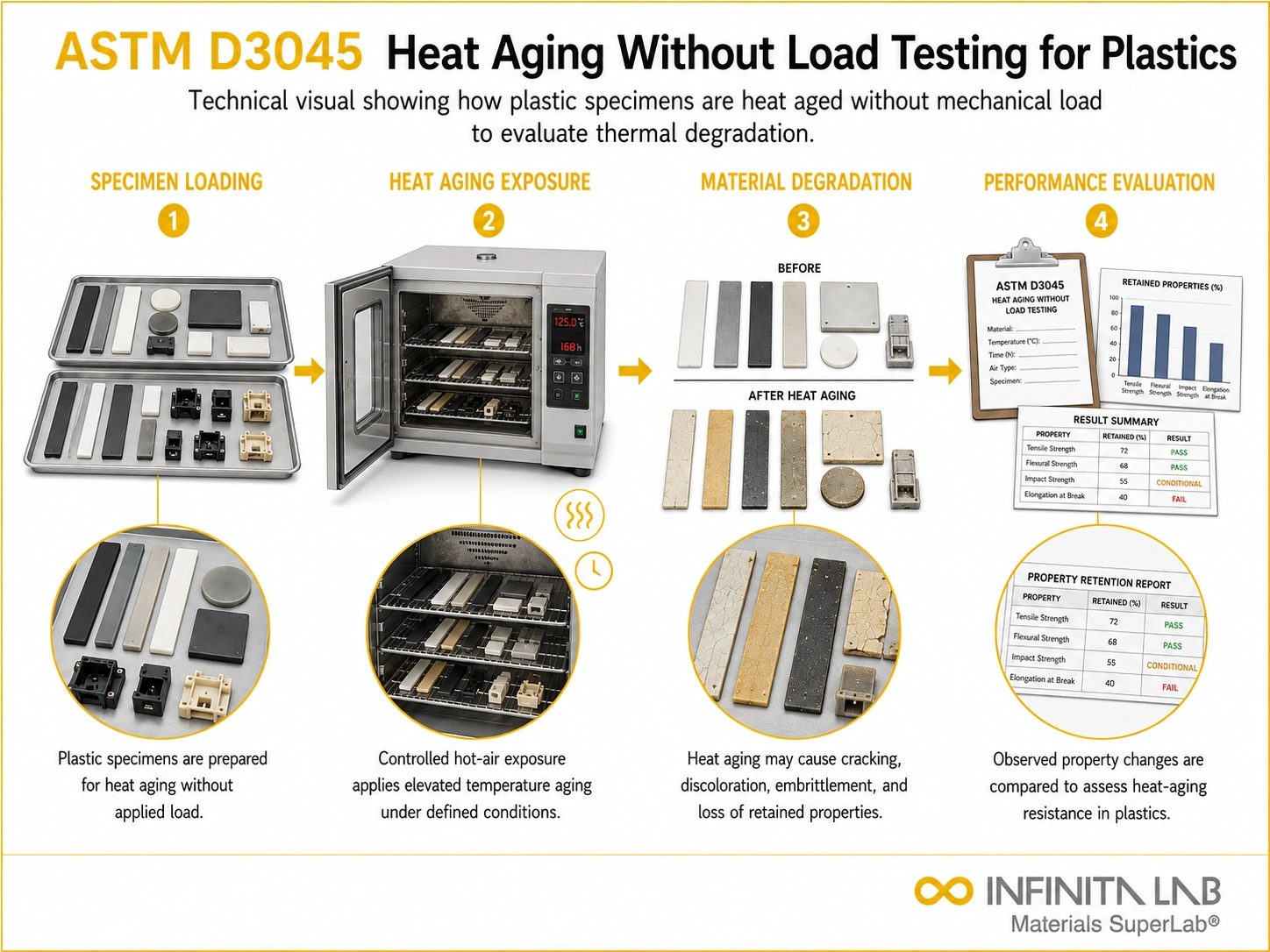
ASTM D3045 is the standard practice ASTM International publishes for evaluating how well plastic materials hold up to heat over time, with no mechanical load involved. Worth noting upfront: D3045 isn’t a test method in the strict sense – it’s a practice, laying out the procedure (exposing unstressed specimens to elevated temperatures in a forced-air, circulating-air oven for an extended stretch) but leaving the actual temperatures, exposure durations, and number of test intervals up to whoever runs the study, based on the material and what the ageing program needs to show. Specimens come out of the oven at scheduled intervals, get conditioned at room temperature, and are then measured for mechanical, physical, or appearance properties using whatever companion test method fits – tensile strength, impact resistance, colour and gloss retention, mass change, and so on. Compare those retained values against unaged baseline specimens across a range of temperatures and durations, and degradation trends start to emerge; where the Arrhenius relationship holds up for the material in question, that data can even be extrapolated into service-life estimates at lower, real-world operating temperatures. This same logic drives UL 746B relative thermal index (RTI) evaluations, which lean on similarly structured long-term ageing programs to rate how hot a material can run continuously against reference materials with established RTI values. Because the specimens carry no load, D3045 isolates thermal-oxidative degradation from the messier stress-temperature-environment interactions that drive failures in loaded components – think of it as a controlled baseline, not a full simulation of real service life. Manufacturers of electrical insulation, appliance housings, automotive under-hood components, and other heat-exposed plastic parts lean on D3045 data to compare candidate materials, back up substitution decisions, validate formulation or supplier changes, and build the documentation thermal-index certification and long-term reliability claims require.

Applications and Benefits of ASTM D3045 Plastic Heat Aging Without Load Testing
Scope
- At its core, this is a standard practice for ageing unstressed plastic specimens in a controlled, circulating-air oven at elevated temperature over an extended exposure period.
- Covers both rigid and flexible plastic materials, tested in specimen form with no mechanical load applied during exposure.
- Exposure temperature, duration, and the number of intervals are left to the user, chosen based on the material and what the study is meant to show.
- Specimens need to be pulled from the oven periodically for property measurement – there’s no continuous in-oven monitoring built into the practice.
- Property testing happens at room temperature after conditioning, not while specimens are still hot.
- For actual property values, users are directed to companion ASTM test methods – tensile, flexural, impact, colour, and the like.
- Specimen thickness should be comparable to, but not greater than, the minimum thickness expected in the end-use application.
- Data generated at multiple temperatures makes it possible to evaluate an Arrhenius-based relationship for thermal-life estimation.
- One thing D3045 explicitly won’t do: predict ageing behaviour where stress, environment, temperature, and time interact to drive failure.
- It also serves as the foundational practice behind broader thermal-endurance and thermal-index programs, including UL 746B.
Applications
- Screening and ranking candidate resins or compounds for thermal stability before locking in a production formulation.
- UL 746B relative thermal index (RTI) programs for electrical insulation and other continuous-use temperature ratings rely heavily on this kind of data.
- Appliance housings, control panels, and connector components that see sustained operating or ambient heat get evaluated this way too.
- Automotive under-hood, interior, and electrical components exposed to elevated thermal environments are frequent candidates.
- When a material or supplier changes, this testing confirms the new option performs at least as well thermally as the qualified baseline.
- Long-term thermal endurance estimates feed directly into product design life and warranty planning.
- It also supports quality control and batch-to-batch consistency checks for thermally sensitive formulations.
Benefits
- A controlled, repeatable exposure procedure that isolates thermal-oxidative degradation from the effects of mechanical loading.
- Retained-property data that can be trended across both temperature and time, making it easier to spot when and how fast degradation sets in.
- Where applicable, Arrhenius-based extrapolation turns accelerated high-temperature data into service-life estimates at real-world operating temperatures.
- Feeds directly into UL 746B relative thermal index evaluations, supporting formal thermal-rating and certification work.
- Gives engineering teams an objective way to compare multiple candidate materials before design finalisation.
- Catches thermally unstable formulations early, which cuts down the risk of premature failures once parts are in the field.
Our ASTM D3045 Testing Procedure
Sample Preparation & Conditioning
Specimens are prepared and conditioned in accordance with ASTM D618 and material standards.
1Heat Aging Exposure
Samples are placed in a hot-air oven at selected temperatures for defined durations.
2Cooling & Property Testing
Controlled cooling is done (if required), followed by testing per ASTM D3045.
3Comparison & Data Analysis
Results are recorded, compared with control samples, and analyzed statistically.
4ASTM D3045 Test Parameters and Requirements
| Parameter | Details |
|---|---|
| Applicable Materials | Plastic and polymeric materials |
| Exposure Environment | Hot air oven |
| Load Condition | No mechanical load |
| Temperature Selection | As per ASTM D618 |
| Number of Temperatures | Minimum four recommended |
| Sample Replicates | Minimum three per material |
| Analysis Methods | Regression and variance analysis |


- Forced-circulating-air ageing oven – Keeps a stable, uniform elevated temperature around the unloaded specimens for the full exposure period.
- Calibrated temperature monitoring and recording equipment – Logs oven temperature stability throughout the exposure schedule so the data holds up to scrutiny.
- Specimen racks and holders – Position specimens for uniform air circulation, without putting any mechanical stress on them.
- Universal testing machine – Used to measure retained tensile and flexural properties per the selected companion method.
- Impact testing equipment – Quantifies how much impact resistance (Izod or Charpy) a specimen has retained after thermal exposure.
- Colorimeter/spectrophotometer – Tracks colour change and gloss retention as thermal-oxidative degradation progresses.
- Analytical balance – Weighs specimens before and after ageing to catch any mass loss or gain.
Equipment and Instrumentation Used for ASTM D3045 Testing
What You Receive: Test Report, Data, and Certification
- A detailed test report covering exposure temperatures, durations, and the companion test methods used to evaluate each property.
- Retained-property data – tensile, impact, colour, weight, and whatever else was measured – presented alongside the unaged baseline values.
- Property-retention trends plotted against exposure time, and against temperature too when multiple temperatures were part of the study.
- Where the data supports it, Arrhenius-based thermal endurance estimates.
- Photos documenting visible appearance changes like discolouration, cracking, or surface degradation.
- Data packaged in a form suitable for UL 746B relative thermal index submissions or internal material qualification files.
ASTM D3045 Plastic Heat Aging Without Load FAQs
ASTM D3045 determines the Heat Aging of Plastics Without Load and can predict how materials will degrade or oxidize over time.
This practice plays a vital role in comparing the thermal weathering properties of substances at a single temperature. Thus, It aids the manufacturer in predicting material performance at high temperatures.
The limitations of ASTM D3045 are: The test is limited to specific temperatures, It is a time-consuming process, especially at lower temperatures, It will not fully replicate real-world environmental conditions. Additionally, careful control of testing parameters is required to ensure accurate results.
ASTM D3045 specifically focuses on heat aging without load, providing a more targeted assessment of thermal degradation. Other aging tests may include environmental factors like UV exposure or mechanical loading.
ASTM D3045 is the Standard Practice for Heat Aging of Plastics Without Load. It evaluates changes in plastic properties after prolonged exposure to elevated temperatures without mechanical load.
Why Choose Infinita Lab for Plastic Heat Aging Without Load Testing
When your Plastic Heat Aging Without Load results have to hold up - for compliance, a customer audit, or an engineering decision - ASTM D3045 accuracy and an unbiased third-party report matter more than price. Infinita Lab routes your ASTM D3045 plastic heat aging without load testing to ISO/IEC 17025-accredited U.S. partner labs with hands-on method experience, so you get defensible data, transparent reporting, and turnaround times built around your project deadline - not ours.

Need ASTM D3045 Plastic Heat Aging Without Load Testing You Can Rely On?
Send query us at hello@infinitalab.com or call us at (888) 878-3090 to learn more about our services and how we can support you.



Request a Quote
Submit your material details and receive testing procedures, pricing, and turnaround time within 24 hours.
 Quick Turnaround and Hasslefree process
 Confidentiality Guarantee
 Free, No-obligation Consultation
 100% Customer Satisfaction
