


ASTM D257: Surface Volume Resistivity Testing Services
Accredited ASTM D257 surface volume resistivity testing from Infinita Lab, performed to the exact standard requirements — accurate, reproducible results with full documentation for compliance, R&D, and quality control programs.
TRUSTED BY


Get ASTM D257 compliant results — request your surface volume resistivity testing quote
- Overview
- Scope, Applications, and Benefits
- Test Process
- Specifications
- Instrumentation
- Results and Deliverables
What Is ASTM D257 Surface Volume Resistivity?
ASTM D257, Standard Test Methods for DC Resistance or Conductance of Insulating Materials, defines procedures for measuring the surface resistivity and volume resistivity of solid electrical insulating materials, including plastics, rubber, ceramics, films, and composite laminates. Surface resistivity describes a material’s resistance to leakage current travelling across its surface, while volume resistivity describes its resistance to current passing through the bulk of the material; together, these two values are among the most fundamental indicators of how well a material performs as an electrical insulator, and both are closely tied to a material’s ability to resist dielectric breakdown and prevent unwanted electrical leakage.
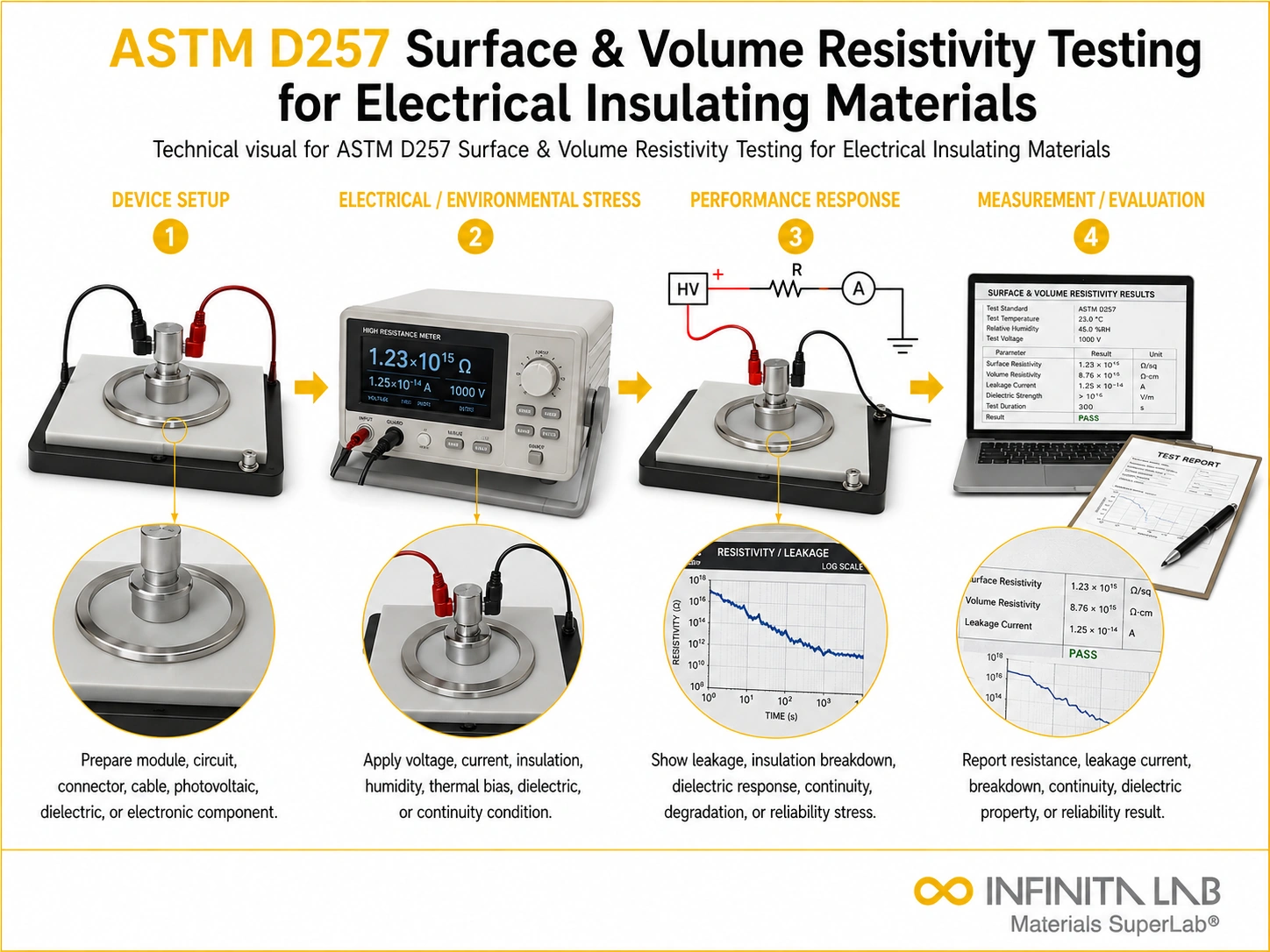
At a high level, testing places a conditioned specimen between a three-electrode system consisting of a test electrode, an unenergized measurement electrode, and a guard-ring electrode that diverts stray surface leakage current away from the volume-resistivity measurement, and vice versa for surface resistivity. A DC voltage, commonly in the range of 10 to 1000 volts, is applied across the electrodes, and the resulting current or resistance is measured with a megohmmeter or high-resistance meter after a standardised electrification time, typically sixty seconds, since resistance in insulating materials continues to drift as the applied voltage polarises the material. The measured resistance is then converted into surface resistivity, expressed in ohms per square, or volume resistivity, expressed in ohm-centimetres, using the specimen’s dimensions and electrode geometry.
Testing to ASTM D257 matters because a material that appears mechanically and visually sound can still fail electrically if its resistivity drifts outside acceptable limits due to moisture absorption, contamination, or material degradation. Verified resistivity data supports safe electrical system design, insulation material qualification, ESD control programs, and ongoing quality assurance across the electronics, aerospace, medical device, and electrical component industries.

Applications and Benefits of ASTM D257 Surface Volume Resistivity Testing
Scope
- Establishes standardised DC test methods for measuring the surface resistivity and volume resistivity of solid insulating materials, such as plastics, rubber, ceramics, glass, and composite laminates.
- Applicable to materials with resistivity values spanning roughly 10⁷ to greater than 10¹³ ohms, covering everything from mildly conductive or static-dissipative materials to highly insulating dielectrics.
- Defines the three-terminal, guarded electrode configuration — test electrode, unguarded electrode, and guard-ring electrode — used to separate surface leakage current from bulk (volume) current during measurement.
- Specifies specimen conditioning requirements, including controlled temperature and relative humidity, since moisture content significantly affects measured resistivity.
- Defines applied DC voltage ranges, commonly 10 to 1000 volts, and the standardised electrification time used before a resistance reading is taken.
- Provides calculation methods for converting measured resistance into surface resistivity (ohms per square) and volume resistivity (ohm-centimetres) based on specimen and electrode geometry.
- Applicable to specimen forms including flat sheets, films, molded plaques, disks, and thin coatings on rigid substrates.
- Supports evaluation of both bulk insulating materials and surface treatments intended to control static charge, such as antistatic or ESD-dissipative coatings and films.
- Applicable across industries including electronics, aerospace, medical devices, automotive, packaging, and general electrical component manufacturing.
- Provides the basis for material selection, incoming material qualification, and ongoing quality assurance testing of insulating and static-control materials.
Applications
- Electrical and electronic component manufacturers verifying the insulation performance of housings, connectors, and circuit substrates.
- Packaging manufacturers evaluating antistatic and ESD-protective films, bags, and trays used in electronics handling.
- Aerospace and defence programs qualifying insulating materials for wiring, connectors, and structural components.
- Medical device manufacturers verifying the insulation integrity of device housings and electrical components.
- Semiconductor and cleanroom facilities testing static-dissipative flooring, work surfaces, and packaging materials.
- Polymer and material producers performing formulation development, quality control, and regulatory documentation.
Benefits
- Provides standardised, repeatable resistivity data that can be compared across suppliers, material lots, and testing laboratories.
- Identifies materials at risk of dielectric breakdown or unwanted electrical leakage before putting them into service.
- Confirms that antistatic and ESD-control materials fall within the resistivity ranges required for safe static charge dissipation.
- Detects material degradation, contamination, or moisture absorption that can alter electrical performance over time.
- Supports informed material selection and design decisions for electrical insulation and static-control applications.
- Provides documented data for compliance, qualification, and quality assurance programs.
Our ASTM D257 Testing Procedure
Specimen Preparation
Test specimens are prepared according to the required dimensions and conditioned under controlled temperature and humidity.
1Test Setup
Electrodes are applied to the specimen using standardized configurations, and the sample is placed in a controlled test environment.
2Resistance Measurement
A DC voltage is applied using a megohmmeter or insulation resistance tester to measure surface and volume resistance.
3Data Evaluation
Surface and volume resistivity values are calculated and recorded for material comparison and analysis.
4Equipment and Instrumentation Used for ASTM D257 Testing
| Parameter | Details |
|---|---|
| Test Principle | Measurement of DC resistance or conductance of insulating materials |
| Measured Properties | Surface resistivity, volume resistivity |
| Sample Types | Plastics, polymers, insulating materials |
| Environmental Control | Controlled temperature and humidity |
| Voltage Source | DC voltage via megohmmeter or insulation tester |
| Result Output | Resistivity values (ohm/sq and ohm·cm) |


- Megohmmeter / High-Resistance Meter – Applies DC test voltage and measures the resulting resistance or current.
- Three-Terminal Guarded Electrode System – Test, unguarded, and guard-ring electrodes used to isolate surface and volume current paths.
- Resistivity Test Cell/Fixture – Holds the specimen and electrode assembly in a fixed, repeatable configuration during testing.
- Environmental Conditioning Chamber – Maintains specimens at controlled temperature and relative humidity before and during testing.
- Precision Thickness Gauge – Measures specimen thickness for accurate volume resistivity calculation.
- Data Acquisition System – Records voltage, current, resistance, and timing data throughout the test.
Equipment and Instrumentation Used for ASTM D257 Testing
What You Receive: Test Report, Data, and Certification
- Surface resistivity value, expressed in ohms per square.
- Volume resistivity value, expressed in ohm-centimetres.
- Specimen conditioning record, including temperature and relative humidity at the time of test.
- Comparison of results against specification limits or reference and historical values.
- An assessment of the material’s suitability as an electrical insulator or static-control material for its intended application.
- A documented test report supporting material qualification, compliance, and quality assurance records.
ASTM D257 Surface Volume Resistivity FAQs
ASTM D257 includes applied voltage typically 10 to 1000 volts, electrode configuration, specimen thickness, temperature, humidity, and measurement time, determining surface and volume resistivity of insulating materials under controlled conditions.
ASTM D257 determines surface resistivity in ohms per square and volume resistivity in ohm-centimeters, providing data on electrical insulation properties and leakage current resistance of materials.
ASTM D257 is commonly applied to plastics, rubber, coatings, insulating materials, and electronic components used in electrical and electronic applications.
ASTM D257 requires a resistivity meter, guarded electrodes, voltage source, and environmental control chamber to ensure accurate measurement of electrical resistance properties.
ASTM D257 evaluates resistivity under controlled laboratory conditions and may be influenced by surface contamination, humidity, temperature variations, and material aging affecting electrical performance in real applications.
ASTM D257 provides standardized methods for measuring DC resistance or conductance and calculating electrical resistivity of insulating materials.
ASTM D257 covers methods for determining volume and surface resistance or conductance of insulating materials under specified conditions.
Why Choose Infinita Lab for Surface Volume Resistivity Testing
When your Surface Volume Resistivity results have to hold up - for compliance, a customer audit, or an engineering decision - ASTM D257 accuracy and an unbiased third-party report matter more than price. Infinita Lab routes your ASTM D257 surface volume resistivity testing to ISO/IEC 17025-accredited U.S. partner labs with hands-on method experience, so you get defensible data, transparent reporting, and turnaround times built around your project deadline - not ours.

Looking for an Accredited Partner for ASTM D257 Surface Volume Resistivity Testing?
Send query us at hello@infinitalab.com or call us at (888) 878-3090 to learn more about our services and how we can support you.



Request a Quote
Submit your material details and receive testing procedures, pricing, and turnaround time within 24 hours.
 Quick Turnaround and Hasslefree process
 Confidentiality Guarantee
 Free, No-obligation Consultation
 100% Customer Satisfaction
