

What Is ASTM D2463 Blow Molded Container Drop Impact?
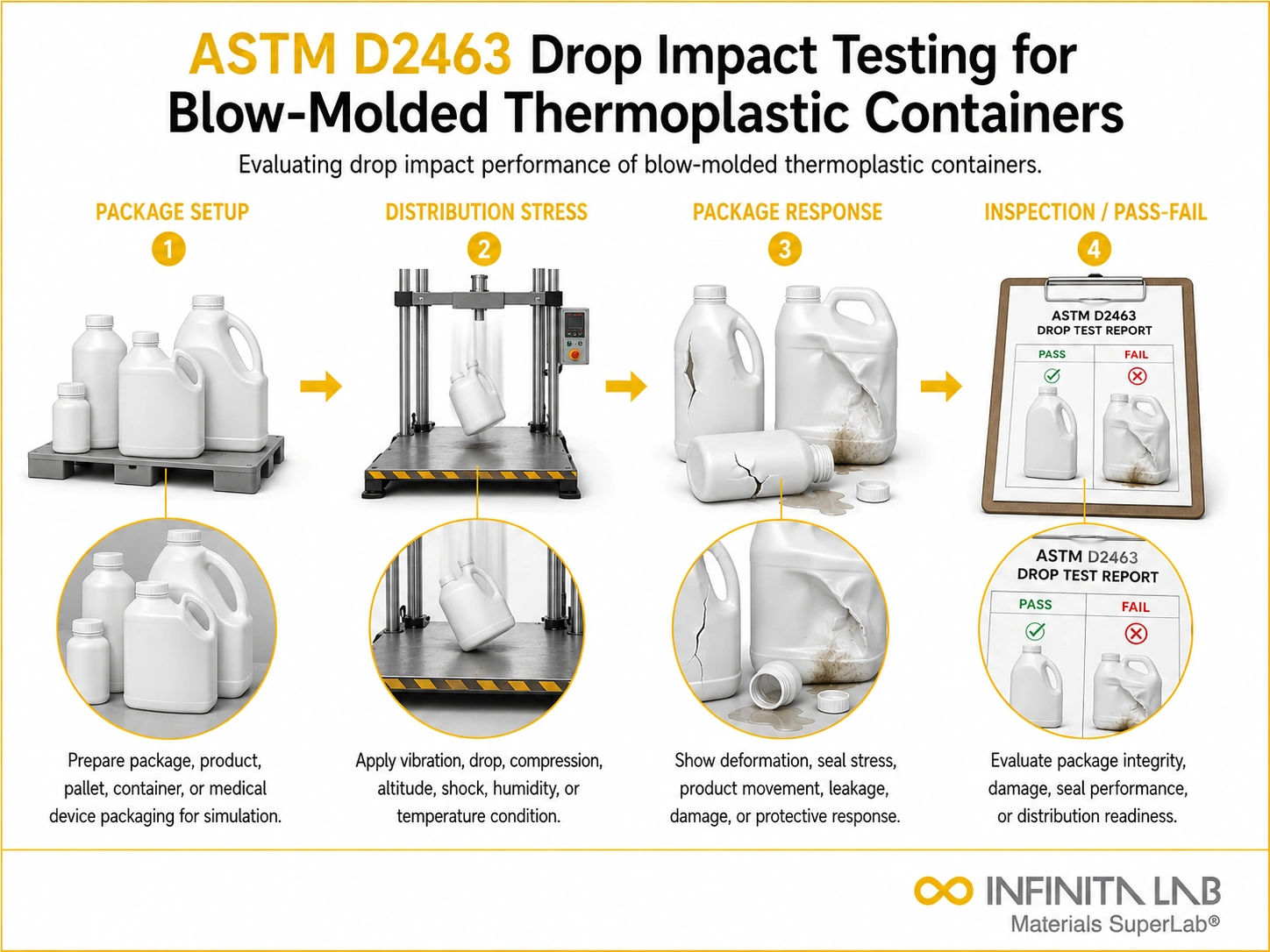
ASTM D2463, “Standard Test Method for Drop Impact Resistance of Blow-Molded Thermoplastic Containers,” does exactly what its title promises: it gives manufacturers and packaging engineers a repeatable way to measure how a blow-molded plastic container holds up when it takes a hard hit. Currently in force as D2463-23, the standard lays out a controlled procedure rather than leaving drop testing to guesswork or gut feel. The method’s mechanics are straightforward. A container gets filled with water to its nominal capacity, closure fitted, then dropped onto a rigid steel surface, usually a hot-rolled, chrome-plated plate built to transfer impact energy rather than soak any of it up. Simple setup. The number it produces still captures a lot: resin behavior, wall thickness distribution, molding quality, and container geometry, all folded into one comparable result.
Two procedures sit at the core of the standard, and each is built for a different job. Procedure A is a static drop height test: a batch of specimens drops from one fixed height, and the result comes back as a pass/fail failure percentage, fast and practical for routine QC checks on a production line. Procedure B, the Bruceton staircase method, asks more of the data. Each specimen’s drop height depends on whether the one before it survived or broke, stepping up or down in a staircase pattern that, run across enough specimens, yields a statistically grounded mean failure height plus a standard deviation for the lot.
Worth flagging up front: D2463 is a test method, not a container design spec. It tells you how a given container performs under a defined impact, not what wall thickness or dimensions to design toward. That narrow, well-defined scope is exactly what makes it useful – a shared, repeatable benchmark that resin suppliers, molders, and brand owners can all point to and trust.

Applications and Benefits of ASTM D2463 Blow Molded Container Drop Impact Testing
Scope
ASTM D2463 evaluates blow-molded thermoplastic containers by assessing their physical and mechanical performance under specified conditions. The test ensures containers meet required standards for safe use.
The test evaluates:
- ASTM D2463 establishes a test method for evaluating the drop impact resistance of blow-molded thermoplastic containers under controlled, repeatable conditions.
- Impact performance, as the method measures it, reflects the combined effect of the base resin, the molding process, wall thickness distribution, and the container’s overall design – no single variable in isolation.
- Specimens get filled with water to nominal fill capacity before testing. Fill weight changes the impact force, so this step isn’t optional.
- Two primary procedures are defined. Procedure A is a static drop height method meant for quick quality control screening; Procedure B, the Bruceton staircase method, is used to determine mean failure height statistically.
- A minimum number of representative containers is pulled from the lot or production run under evaluation and fitted with the appropriate closures before testing starts.
- Specimens typically sit at standard laboratory temperature and humidity for a set conditioning period before any drops happen, so the results aren’t skewed by material that’s unusually warm, cold, or brittle.
- Drops land on a rigid, flat impact surface, most often a hot-rolled, chrome-plated steel plate. The surface itself shouldn’t absorb or cushion any of the impact.
- Perpendicular drop orientations are what the standard primarily addresses, though angled impact testing with a positioning jig is also allowed when a project calls for it.
- Depending on which procedure is used, results come back either as a simple failure percentage at a given height or as a calculated mean failure height with an associated standard deviation.
- The method applies specifically to rigid and semi-rigid blow-molded containers. It’s not intended to simulate performance with carbonated products, aerosols, or other non-still liquid fills unless that correlation has been separately established.
Applications
- Qualifying new bottle, jug, or drum designs before they move into full-scale production.
- Comparing drop performance across different resin grades, blends, or recycled-content formulations.
- Checking whether a change in wall thickness or neck/handle geometry has quietly weakened overall impact resistance.
- Packaging qualification and vendor approval work for household, industrial, and personal care liquid products.
- Investigating field failures or distribution complaints tied to cracked or leaking containers.
- Benchmarking a molder’s production consistency across shifts, machines, or production lots.
- Generating supporting data for retailer or regulatory packaging performance requirements.
Benefits
- An objective, repeatable number in place of a subjective “it felt sturdy” judgment call.
- Catches weak points in a design before they become costly recalls, customer complaints, or damaged-goods claims.
- Makes direct, apples-to-apples comparison possible between resins, suppliers, or design revisions.
- Supports smarter material selection, which can translate into real cost savings through lighter-weighting without giving up durability.
- A documented record that backs up packaging decisions when customers, retailers, or auditors come asking.
- Fits naturally alongside related transit and distribution testing to round out a fuller picture of real-world package performance.
Our ASTM D2463 Testing Procedure
Sample Preparation
Sample Preparation
1Conditioning
Samples are conditioned under specified environmental conditions.
2Performance Testing
Containers are subjected to load, drop, or deformation tests.
3Data Recording & Evaluation
Results are analyzed to assess compliance with ASTM requirements.
4ASTM D2463 Test Parameters and Requirements
| Parameter | Details |
|---|---|
| Applicable Materials | Blow-molded thermoplastics |
| Capacity Range | ~50 mL to 50 L |
| Wall Thickness | ~0.5 mm to 5 mm |
| Test Temperature | ~23°C ± 2°C |
| Load/Drop Conditions | Application-specific |
| Measured Outputs | Structural integrity, deformation resistance |


- Drop Impact Tester – A platform-and-release rig that raises specimens to a precise height and lets them fall freely onto the impact surface.
- Steel Impact Plate – A rigid, flat, chrome-plated steel surface. Its job is to transfer impact energy to the specimen rather than absorb any of it into the test setup.
- Height Measurement System – Calibrated scale or digital measurement device for setting and verifying drop height on each specimen.
- Fixtures matter too: a Specimen Positioning Jig holds or orients containers consistently, including for angled drop configurations when required.
- Environmental Conditioning Chamber – Controlled-atmosphere space that brings specimens to standard temperature and humidity before testing begins.
- Precision Balance – Confirms each specimen has been filled to the correct nominal fill weight before testing starts.
- Data Logging Tools – Record pass/fail outcomes, drop heights, and the sequence data that staircase-method calculations need.
Equipment and Instrumentation Used for ASTM D2463 Testing
What You Receive: Test Report, Data, and Certification
- A clear pass/fail failure percentage for the tested lot when Procedure A is the method used.
- A calculated mean failure height and standard deviation when Procedure B (the staircase method) is used instead.
- Full documentation of specimen details, including container size, material, and lot or batch identification.
- A record of conditioning parameters alongside the drop heights or height increments used during testing.
- Photographic or written observations of failure modes – crack location, seam separation, that sort of thing – where relevant.
- A formal test report suitable for internal engineering review, supplier qualification files, or customer submission.
ASTM D2463 Blow Molded Container Drop Impact FAQs
ASTM D2463 provides classification and specification for blow-molded thermoplastic containers. It defines material and performance requirements to ensure durability, strength, and suitability for packaging liquids and chemicals.
Key parameters include wall thickness, impact resistance, environmental stress crack resistance, and dimensional stability. Material properties and manufacturing conditions are also considered.
The test verifies compliance with physical and performance requirements. Results indicate container strength, durability, and suitability for storage and transportation applications.
ASTM D2463 applies to thermoplastics such as polyethylene and polypropylene used in blow-molded containers for industrial, chemical, and packaging applications.
ASTM D2463 provides specification guidelines but may not fully represent all field conditions. Additional testing may be required for extreme environments, long-term storage, or specific chemical compatibility.
A thermoplastic container is made by heating plastic until it softens, forming it into the desired shape, and cooling it to solidify. It can typically be reheated and reshaped because thermoplastics soften when heated.
Why Choose Infinita Lab for Blow Molded Container Drop Impact Testing
When your Blow Molded Container Drop Impact results have to hold up - for compliance, a customer audit, or an engineering decision - ASTM D2463 accuracy and an unbiased third-party report matter more than price. Infinita Lab routes your ASTM D2463 blow molded container drop impact testing to ISO/IEC 17025-accredited U.S. partner labs with hands-on method experience, so you get defensible data, transparent reporting, and turnaround times built around your project deadline - not ours.

Need ASTM D2463 Blow Molded Container Drop Impact Testing You Can Rely On?
Send query us at hello@infinitalab.com or call us at (888) 878-3090 to learn more about our services and how we can support you.





