


- Insulation resistance values at specified temperatures
- Volume resistivity values
- Temperature vs. resistance data
- Resistivity behavior trend analysis
- Material uniformity assessment
- Quality control documentation
ASTM D1829: Ceramic Electrical Resistance Elevated Temperature Testing Services
ASTM D1829 involves two procedures that can determine the electrical resistance of Ceramics at elevated temperatures. Insulation resistance and volume resistivity of ceramic samples can be evaluated using this test method. Values are stated in imperial units.
TRUSTED BY


Get ASTM D1829 compliant results — request your ceramic electrical resistance elevated temperature testing quote
- Overview
- Scope, Applications, and Benefits
- Test Process
- Specifications
- Instrumentation
- Results and Deliverables
What Is ASTM D1829 Ceramic Electrical Resistance Elevated Temperature?
ASTM D1829 is a standardized test procedure used to evaluate the resistance of ceramic insulating materials to electricity when they are hot. This test procedure is used to determine the insulation resistance and volume resistivity of materials over a temperature range of 100 to 500 °C.
This test procedure is critical in determining the performance of ceramic insulators in hot electrical systems. Since electrical resistivity varies with temperature, understanding this phenomenon is essential in developing reliable insulating components. Materials that have higher resistance are considered to be better insulators, providing good electrical insulation and contributing to the mechanical integrity of electrical assemblies.
Applications and Benefits of ASTM D1829 Ceramic Electrical Resistance Elevated Temperature Testing
Scope
ASTM D1829 is applicable to ceramic insulating materials. This test is used to determine the insulation resistance and volume resistivity of ceramic insulating materials when they are hot. The test starts from 100 °C to 500 °C to check the electrical properties of the material when it is subjected to heat. There are two procedures: Procedure A, which is for testing one specimen over a wide range of temperatures, and Procedure B, which is for rapid testing of multiple specimens at one temperature.
Applications
- Design of high-temperature electrical insulators
- Evaluation of ceramic insulating materials
- Detection of conductive impurities
- Quality control of ceramic processing
- Uniformity assessment of insulating materials
- Electrical system component design
- High-temperature equipment and furnace components
- Power transmission and distribution systems
Benefits
- Determines temperature-dependent electrical resistance
- Assesses material suitability for high-temperature applications
- Detects contamination and conductive inclusions
- Supports insulation design calculations
- Ensures material uniformity and quality
- Provides standardized and repeatable measurements
- Improves reliability of electrical insulation systems
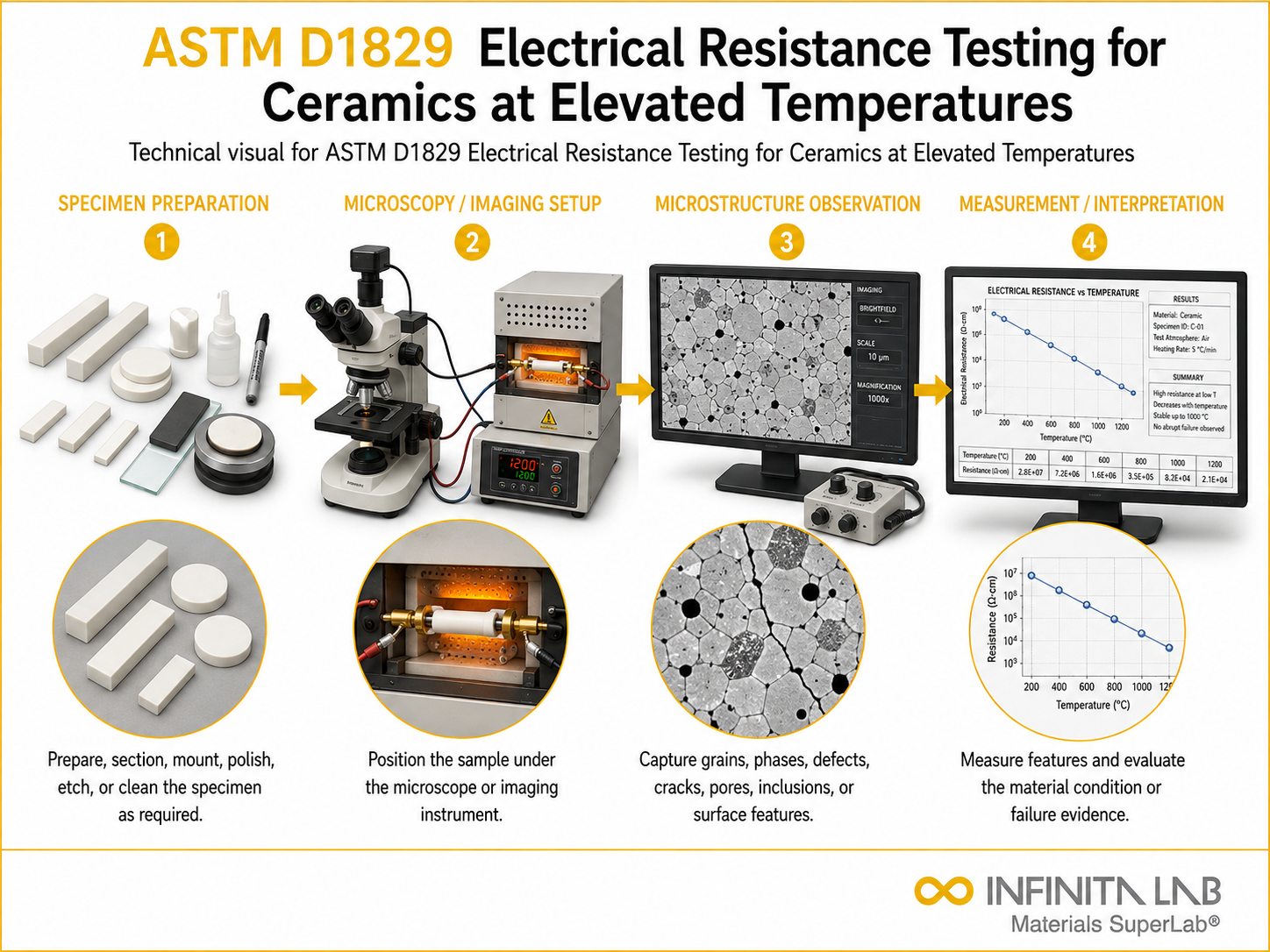
Our ASTM D1829 Testing Procedure
Specimen Preparation & Placement
The ceramic sample is prepared to specified dimensions and placed in a high-temperature chamber with proper electrodes.
1Temperature Conditioning
The specimen is heated to the required temperature between 100–500 °C.
2Electrical Measurement
Voltage or current is applied, and the corresponding electrical response is measured to determine resistance.
3Resistivity Evaluation
Volume resistivity is calculated from resistance and specimen dimensions across the temperature range.
4ASTM D1829 Test Parameters and Requirements
| Parameter | Details |
|---|---|
| Applicable Materials | Ceramic insulating materials |
| Temperature Range | 100 °C to 500 °C |
| Test Procedures | Procedure A (wide temperature range), Procedure B (single fixed temperature) |
| Measured Properties | Insulation resistance, Volume resistivity |
| Output Units | Ohms (Ω), Ohm·cm or Ohm·m |
- High-temperature furnace or test chamber
- Electrode assembly
- Precision voltage source
- Current measuring device (ammeter or electrometer)
- Resistance meter or electrometer system
- Temperature measurement system (thermocouples)
- Dimensional measurement tools
- Data acquisition and analysis software
Equipment and Instrumentation Used for ASTM D1829 Testing
What You Receive: Test Report, Data, and Certification
ASTM D1829 Ceramic Electrical Resistance Elevated Temperature FAQs
ASTM D1829 determines the insulation resistance and volume resistivity of ceramic insulating materials at elevated temperatures. These measurements help characterize how electrical insulation performance changes as temperature increases.
The method covers elevated-temperature testing from approximately 100 to 500 °C. The temperature-dependent measurements can be used to develop resistance-versus-temperature characteristics for ceramic insulating materials.
ASTM D1829 includes Procedure A, which obtains resistance-versus-temperature characteristics for an individual specimen over a wide temperature range, and Procedure B, which is intended for rapid testing of multiple specimens at a fixed temperature.
Electrical resistance and volume resistivity data help evaluate the suitability of ceramics for high-temperature electrical insulation. The measurements can also help identify contamination or conductive impurities and provide design information for high-temperature insulating devices.
No. ASTM D1829-90(1999) was withdrawn in 2001, with no replacement listed by ASTM. Therefore, it should not be presented as a current active ASTM method. For current testing requirements, the applicable alternative should be selected based on the ceramic material, electrical property, temperature range, and customer's specification.
Why Choose Infinita Lab for Ceramic Electrical Resistance Elevated Temperature Testing?
At the core of this breadth is our network of 2,000+ accredited laboratories across the USA, offering access to over 10,000 testing methods and analytical services. From advanced materials characterization (SEM, TEM, RBS, XPS) to mechanical, chemical, environmental, biological, and standardized ASTM/ISO-compliant testing, we deliver unmatched flexibility, specialization, and scale. You are never limited by geography, facility, or methodology — Infinita Lab connects you to the right expertise and testing solution, every time.

Looking for an Accredited Partner for ASTM D1829 Ceramic Electrical Resistance Elevated Temperature Testing?
Send query us at hello@infinitalab.com or call us at (888) 878-3090 to learn more about our services and how we can support you.



Request a Quote
Submit your material details and receive testing procedures, pricing, and turnaround time within 24 hours.
 Quick Turnaround and Hasslefree process
 Confidentiality Guarantee
 Free, No-obligation Consultation
 100% Customer Satisfaction
