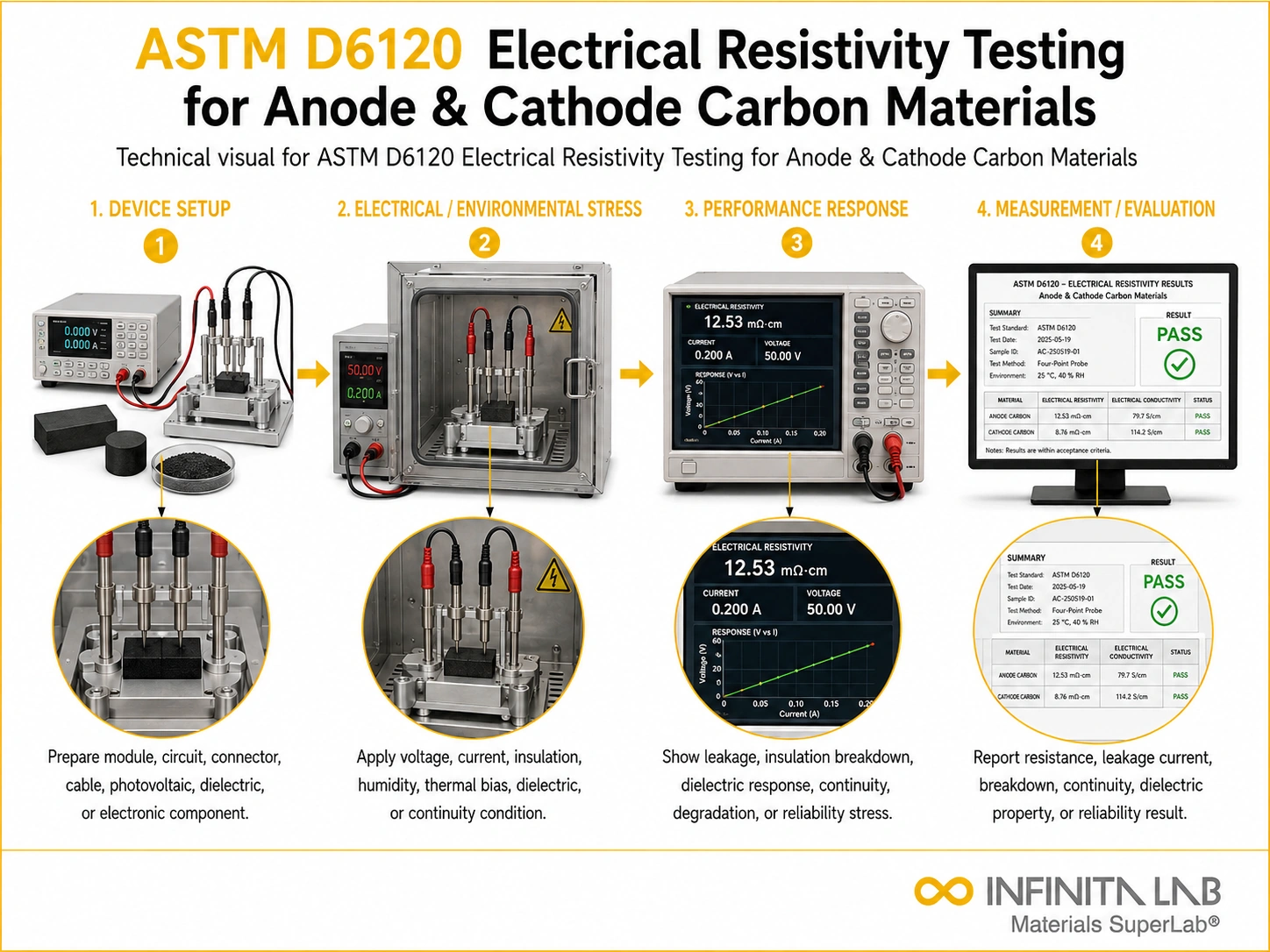


What Is ASTM D6120 Carbon Anode Cathode Electrical Resistivity?
ASTM D6120 determines the electrical resistivity of carbon materials used as anodes and cathodes at room temperature. It evaluates how effectively these materials conduct electrical current, which is critical for electrochemical and industrial applications.
This test is essential for assessing material quality, consistency, and performance in electrical environments. By measuring resistivity, manufacturers can optimize carbon formulations and ensure efficient current flow, reduced energy losses, and reliable operation in demanding systems.

Applications and Benefits of ASTM D6120 Carbon Anode Cathode Electrical Resistivity Testing
Scope
This test method measures the electrical resistivity of carbon-based anode and cathode materials under controlled room temperature conditions. It evaluates material conductivity characteristics for quality control and performance assessment.
Includes:
- Measurement of electrical resistivity of carbon materials
- Evaluation under room temperature conditions
- Suitability for anode and cathode applications
- Determination of current conduction efficiency
- Assessment of material uniformity and quality
Applications
- Aluminum smelting electrodes
- Electrochemical cells and systems
- Battery electrode materials
- Carbon blocks and graphite components
- Metallurgical industry applications
- Energy storage and conversion systems
Benefits
- Ensures efficient electrical conductivity
- Helps reduce energy losses in systems
- Supports material quality and consistency
- Enables comparison of carbon materials
- Assists in process optimization
- Improves performance of electrochemical systems
Our ASTM D6120 Testing Procedure
Specimen Preparation
Carbon samples are machined to specified dimensions and conditioned at room temperature.
1Electrode Placement
Electrical contacts are properly positioned to ensure accurate current flow through the specimen.
2Resistance Measurement
Electrical resistance is measured using appropriate instruments under controlled conditions.
3Resistivity Calculation
Resistivity is calculated based on resistance, specimen dimensions, and test parameters.
4ASTM D6120 Test Parameters and Requirements
| Parameter | Details |
|---|---|
| Property Measured | Electrical resistivity |
| Material Type | Carbon anode and cathode materials |
| Test Condition | Room temperature |
| Measurement Unit | Ohm-meter (Ω·m) |
| Specimen Shape | Machined solid sample |
| Method | Direct current resistance measurement |
| Output | Resistivity value |


- Digital ohmmeter or micro-ohmmeter
- Four-point probe setup (if applicable)
- Power supply for current application
- Voltage measurement device
- Calipers or micrometer for dimensions
- Data acquisition system
Equipment and Instrumentation Used for ASTM D6120 Testing
What You Receive: Test Report, Data, and Certification
- Electrical resistivity values
- Material conductivity assessment
- Test conditions and measurement details
- Comparative analysis of samples
- Quality evaluation report
- Compliance with ASTM D6120
ASTM D6120 Carbon Anode Cathode Electrical Resistivity FAQs
Electrical resistivity determines how efficiently current flows through carbon electrodes. Lower resistivity reduces energy losses, improves system efficiency, and ensures stable performance in electrochemical processes such as smelting, batteries, and industrial electrical applications.
The test provides accurate resistivity values that help manufacturers optimize material composition and structure. This ensures better conductivity, reduced heat generation, and improved operational efficiency in systems where carbon electrodes are used.
A good resistivity value depends on the application, but generally lower values indicate better conductivity. High-performance electrodes require minimal resistivity to ensure efficient current transfer and reduced energy consumption during operation.
Higher resistivity leads to increased electrical resistance, causing energy loss in the form of heat. Lower resistivity improves energy efficiency, reduces operational costs, and enhances the overall performance of electrical systems.
Resistivity is influenced by material density, porosity, graphitization level, and composition. Processing conditions such as temperature and pressure during manufacturing also play a significant role in determining conductivity.
Why Choose Infinita Lab for Carbon Anode Cathode Electrical Resistivity Testing?
At the core of this breadth is our network of 2,000+ accredited laboratories across the USA, offering access to over 10,000 testing methods and analytical services. From advanced materials characterization (SEM, TEM, RBS, XPS) to mechanical, chemical, environmental, biological, and standardized ASTM/ISO-compliant testing, we deliver unmatched flexibility, specialization, and scale. You are never limited by geography, facility, or methodology — Infinita Lab connects you to the right expertise and testing solution, every time.

Looking for an Accredited Partner for ASTM D6120 Carbon Anode Cathode Electrical Resistivity Testing?
Send query us at hello@infinitalab.com or call us at (888) 878-3090 to learn more about our services and how we can support you.





