

What Is ASTM D1693 Ethylene Plastic Environmental Stress Cracking?
ASTM D1693 describes a standard method of test for determining the resistance to environmental stress cracking (ESCR) of ethylene plastics. This type of cracking arises from a combination of mechanical stress and exposure to specific chemicals, and it often results in premature, and sometimes catastrophic, failure of the plastic part.
The ASTM D 1693 technique approximates ESCR by immersing unstressed or prestressed plastic specimens in high-temperature chemical environments. A controlled defect is introduced to generate localized multiaxial stresses, one of the conditions under which stress cracking most frequently occurs. The resulting ESCR values provide a measure of a material’s susceptibility to slow crack growth and long-term failure.

Applications and Benefits of ASTM D1693 Ethylene Plastic Environmental Stress Cracking Testing
Scope
ASTM D1693 outlines procedures for assessing the resistance of ethylene plastics to environmental stress cracking under chemically aggressive conditions.
It evaluates:
- Susceptibility of polyethylene to slow crack growth
- Crack initiation and propagation behavior
- Resistance to combined chemical and mechanical stress
- Material durability under simulated service conditions
The method applies primarily to polyethylene and related ethylene-based plastics commonly used in industrial and consumer products.
Applications
- Automotive plastic components (e.g., lighting and housings)
- Packaging containers and closures
- Pipes, tanks, and chemical storage products
- Consumer goods exposed to detergents and chemicals
- Quality control of polyethylene resins
- Material selection for chemically demanding environments
Benefits
- Identifies materials prone to environmental stress cracking
- Supports the selection of ESC-resistant polymers
- Helps prevent premature and catastrophic product failures
- Improves material reliability and service life
- Enables standardized comparison of polyethylene resins
- Enhances quality assurance and product safety
Our ASTM D1693 Testing Procedure
Specimen Preparation
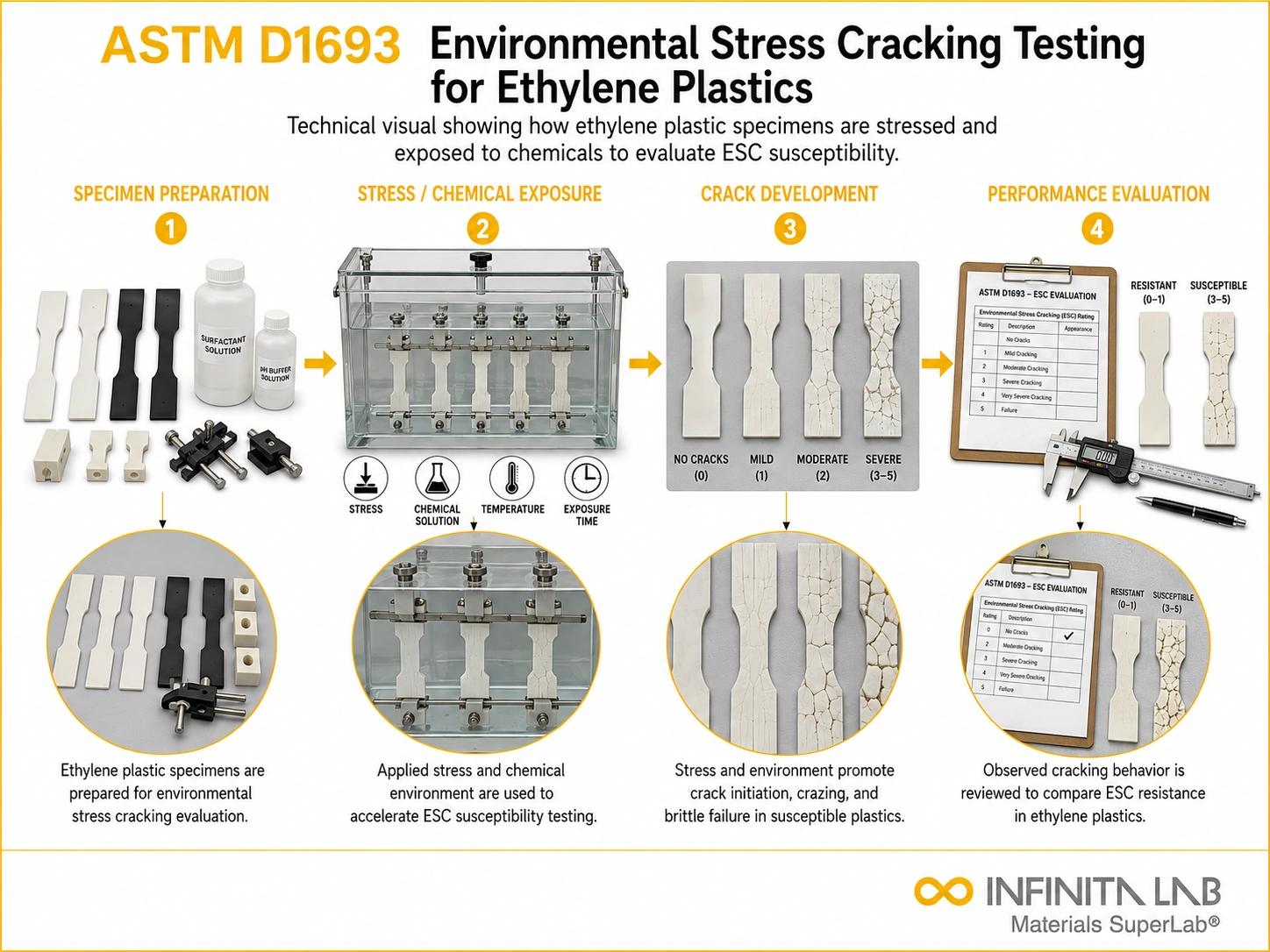
Plastic specimens are molded or cut and formed into loops or U-shaped samples to introduce controlled stress concentrations.
1Chemical Immersion
Specimens are immersed in a specified chemical agent at elevated temperature to simulate aggressive service environments.
2Exposure & Monitoring
Samples are maintained under exposure for a defined period (often several hundred hours) and monitored for crack initiation and growth.
3Crack Evaluation
The number, size, and location of cracks are recorded to assess environmental stress cracking resistance.
4ASTM D1693 Test Parameters and Requirements
| Parameter | Details |
|---|---|
| Applicable Materials | Ethylene plastics, primarily polyethylene |
| Specimen Geometry | Loop or U-shaped specimens |
| Stress Introduction | Controlled bending to create localized multiaxial stress |
| Exposure Medium | Chemical agent relevant to the intended service |
| Measured Outputs | Time to crack, crack density, crack severity |


- Temperature-controlled chemical bath
- Chemical immersion containers
- Specimen holders or jigs for looped samples
- Timers and monitoring systems
- Optical magnification tools for crack inspection
- Data recording and reporting tools
Equipment and Instrumentation Used for ASTM D1693 Testing
What You Receive: Test Report, Data, and Certification
- Environmental stress cracking resistance ranking
- Crack initiation time and failure behavior
- Crack location, size, and distribution data
- Comparative performance of polyethylene resins
- Data supporting material qualification and selection
- Quality control documentation for ESC resistance
ASTM D1693 Ethylene Plastic Environmental Stress Cracking FAQs
ASTM D1693 is the standard test method for ethylene plastics' environmental stress cracking resistance. The resistance is estimated by immersing unstressed and prestressed specimens into chemicals at increased temperatures.
It is a process that occurs in plastic materials when they are subjected to stress and certain chemicals. Stress is produced by mechanical forces on the material, such as tension or compression, or it can be induced by the environment, such as temperature changes or UV radiation.
Prevention of ESC can be achieved by abiding the following steps: By ensuring the selection of ESC-resistant materials, By Designing products to avoid stress concentrations and By optimizing processing techniques to minimize internal stresses.
The specimens are exposed to a particular chemical agent according to their anticipated use. The duration of the testing is variable but usually runs into a few hundred hours. During this time, the specimens are continually monitored for any cracking tendencies.
Environmental Stress Cracking Resistance (ESCR) testing evaluates the susceptibility of ethylene plastics, particularly polyethylene, to cracking under stress when exposed to certain chemicals. According to ASTM D1693, notched specimens are subjected to controlled strain and immersed in a specified test reagent at a controlled temperature. The specimens are monitored for cracking, and the number of failures over a specified period is recorded to assess stress-cracking resistance.
An ESCR tester holds notched plastic specimens under controlled strain while exposing them to a specified chemical reagent at a controlled temperature. In ASTM D1693 testing, the apparatus maintains the required test conditions so specimens can be monitored for cracking over time. The results help determine the material’s resistance to environmentally induced stress cracking.
An ESCR test measures how long a plastic material withstands stress and chemical exposure before cracking. Under ASTM D1693, notched ethylene-plastic specimens are placed under specified strain conditions in a controlled-temperature bath containing the test reagent. The laboratory records the number of specimens that crack within the test period to evaluate environmental stress-cracking resistance.
Why Choose Infinita Lab for Ethylene Plastic Environmental Stress Cracking Testing
When your Ethylene Plastic Environmental Stress Cracking results have to hold up - for compliance, a customer audit, or an engineering decision - ASTM D1693 accuracy and an unbiased third-party report matter more than price. Infinita Lab routes your ASTM D1693 ethylene plastic environmental stress cracking testing to ISO/IEC 17025-accredited U.S. partner labs with hands-on method experience, so you get defensible data, transparent reporting, and turnaround times built around your project deadline - not ours.

Need ASTM D1693 Ethylene Plastic Environmental Stress Cracking Testing You Can Rely On?
Send query us at hello@infinitalab.com or call us at (888) 878-3090 to learn more about our services and how we can support you.