


ASTM D1623: Rigid Cellular Plastics Tensile Testing Services
Accredited ASTM D1623 rigid cellular plastics tensile testing from Infinita Lab, performed to the exact standard requirements - accurate, reproducible results with full documentation for compliance, R&D, and quality control programs.
TRUSTED BY


Get ASTM D1623 compliant results - request your rigid cellular plastics tensile testing quote
- Overview
- Scope, Applications, and Benefits
- Test Process
- Specifications
- Instrumentation
- Results and Deliverables
What Is ASTM D1623 Rigid Cellular Plastics Tensile?
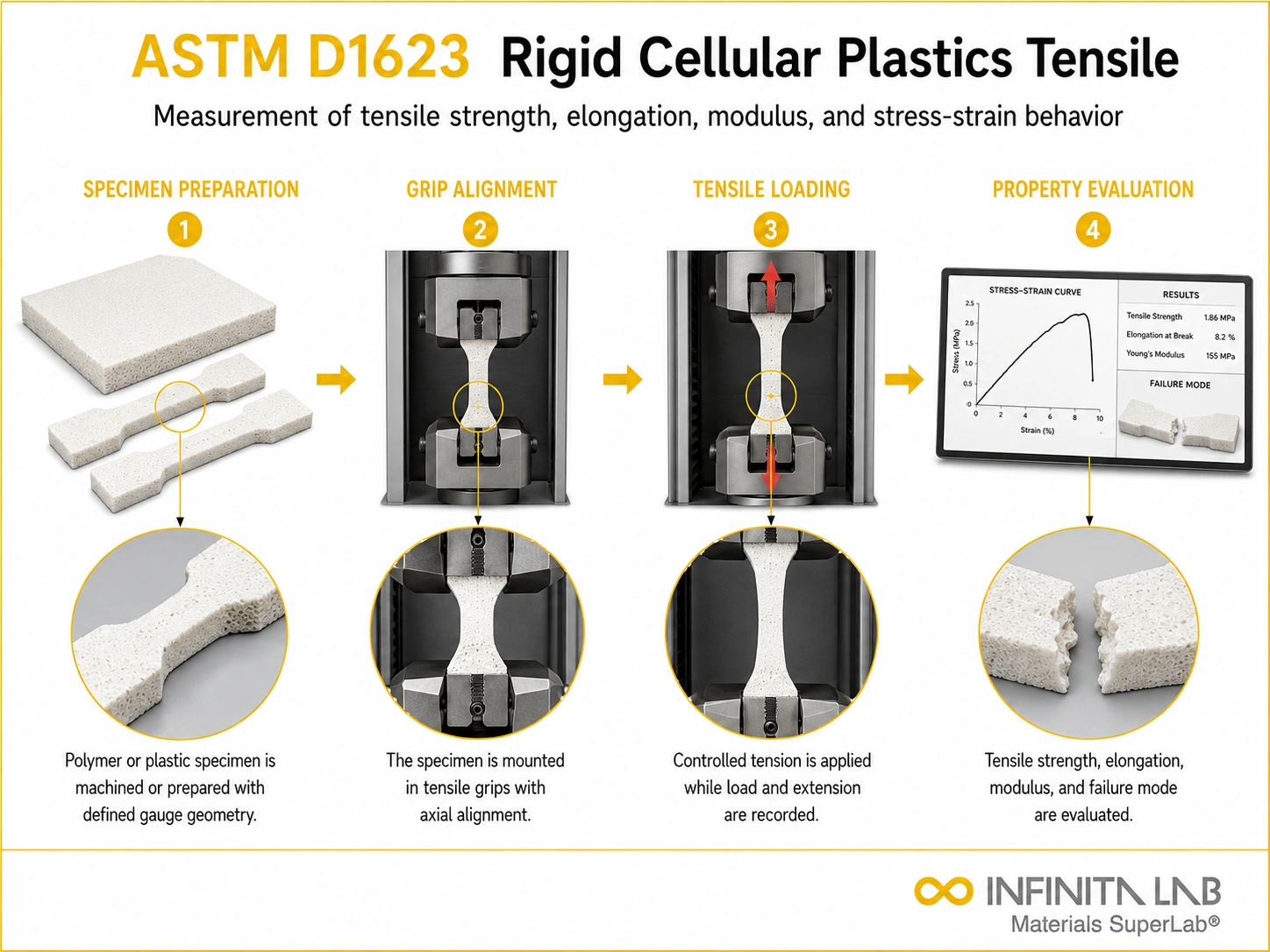
ASTM D1623, Standard Test Method for Tensile and Tensile Adhesion Properties of Rigid Cellular Plastics, defines how to determine the tensile and tensile adhesion properties of rigid cellular materials under controlled conditions of temperature, humidity, and testing machine speed. The currently active edition is D1623-17(2023), maintained by ASTM Subcommittee D20.22 on cellular materials. The standard doesn’t offer separate lettered test methods. Instead, it provides three specimen configurations, each determining what is measured. Type A specimens are preferred when enough material is available to prepare a standard shape. For smaller samples, such as those taken from sandwich panels, Type B is preferred. Type C is used to determine the tensile adhesive properties of a cellular plastic bonded to a substrate, so the result reflects the strength of the foam-to-facing interface rather than the foam alone. Each has its own grip or fixture assembly. The apparatus includes a constant-rate crosshead-movement testing machine with self-aligning grips that keep load application axial, plus extension indicators to measure elongation and lathe-type cutters to prepare specimens. The method records the load at which a specimen fails and relates it to the measured cross-sectional area to calculate tensile strength. Elongation is derived from extension measurements. Because rigid foams are cellular and frequently anisotropic, the orientation of a specimen relative to the foam rise direction can influence the result, and the location of failure, whether within the foam, at the bond line, or in the substrate, carries diagnostic meaning. The method is widely applied to rigid polyurethane, polyisocyanurate, and polystyrene foam products used for thermal insulation and as cores in sandwich construction. It supports quality control and material specification and allows comparison of formulations or densities. ASTM lists no known ISO equivalent, so exact dimensions, speeds, and reporting requirements should be taken from the current edition.

Applications and Benefits of ASTM D1623 Rigid Cellular Plastics Tensile Testing
Scope
ASTM D1623 applies to rigid cellular plastic materials including polyurethane, polyisocyanurate, polystyrene, and phenolic foams, as well as syntactic foams and other rigid cellular materials. The standard covers both foam substrate properties and core-facing bond properties. Key evaluation areas include:
- The standard covers the determination of tensile and tensile adhesion properties of rigid cellular plastics.
- Specimens of standard shape are tested under defined conditions of temperature, humidity, and testing machine speed.
- Three specimen types (A, B, and C) suit different material availability and measurement goals.
- Type A: the preferred configuration when sufficient material exists to prepare the standard specimen shape.
- For smaller samples, such as those cut from sandwich panels, Type B is preferred.
- Type C measures the tensile adhesive properties of a cellular plastic bonded to a substrate.
- Tensile strength and elongation values come out of the method for the cellular material.
- A constant-rate-of-crosshead-movement machine with self-aligning grips and extension indicators is required.
- Jurisdiction sits with ASTM Subcommittee D20.22, and the standard appears in Volume 08.01 of the Annual Book of ASTM Standards.
- Active edition: D1623-17(2023). ASTM lists no known ISO equivalent.
Applications
- Qualifying rigid polyurethane and polyisocyanurate foam used in building insulation boards and panels.
- Bond evaluation between spray-applied or poured foam and its substrate or facing.
- Characterizing foam cores used in sandwich panel construction.
- Quality control and lot acceptance for foam manufacturers.
- During product development, comparing foam formulations, densities, and cure conditions.
- Verifying insulation performance of refrigeration, cold-storage, and marine structures.
- Field failures where delamination or debonding is suspected can be investigated too.
Benefits
- Provides a recognized, repeatable basis for comparing rigid foam products across suppliers and lots.
- The strength of the foam itself is separated from the strength of its adhesive bond to a substrate.
- Specimen options accommodate both bulk foam and small samples removed from finished panels.
- Failure-mode observations help identify whether weakness lies in the foam, the interface, or the facing.
- It supports specification compliance and documentation for customers, auditors, and regulators.
- The data informs formulation changes, density targets, and process adjustments.
Our ASTM D1623 Testing Procedure
Specimen Preparation
Specimens are cut from the foam in the specified orientation relative to rise direction.
1Conditioning
Specimens are conditioned at standard temperature and humidity or at the specified test temperature
2Load Application
Method A: dumbbell specimens are gripped and loaded to failure in tension. Method B: flatwise tensile load is applied perpendicular
3Data Recording and Failure Examination
Failure load, tensile strength, and elongation are recorded.
4ASTM D1623 Test Parameters and Requirements
| Parameter | Details |
|---|---|
| Standard | ASTM D1623 |
| Method A | Tensile strength and elongation of foam substrate |
| Method B | Tensile adhesion strength of foam-to-facing bond |
| Specimen Orientation | Parallel and perpendicular to foam rise direction |
| Applicable Materials | Polyurethane, polystyrene, polyisocyanurate, phenolic, and syntactic foams |


- Universal Testing Machine – applies tension at a constant rate of crosshead movement and records load through failure.
- Self-Aligning Grips – keep the applied load axial, so bending and uneven stress don’t distort results.
- Type A, B, and C Fixtures – hold each specimen configuration; bonded tensile-adhesion specimens included.
- Extension Indicator (Extensometer) – measures specimen extension so elongation can be calculated.
- Lathe Specimen Cutter – prepares specimens of the required shape from foam stock.
- Environmental Conditioning Chamber – keeps specimens at the specified temperature and humidity before testing.
- Calipers and Measuring Gauges – determine specimen dimensions and cross-sectional area.
Equipment and Instrumentation Used for ASTM D1623 Testing
What You Receive: Test Report, Data, and Certification
- Tensile strength values for each specimen, with the mean and variability across the specimen set.
- Elongation data where extension measurements are required.
- Type C specimens bonded to a substrate yield tensile adhesion strength.
- Recorded failure mode and location, such as foam failure, interface failure, or substrate failure.
- Documentation of specimen type, orientation, conditioning, and testing machine settings.
- A formal test report suitable for quality records, specification review, and customer submittals.
ASTM D1623 Rigid Cellular Plastics Tensile FAQs
ASTM D1623 is a guideline for determining cellular plastic's tensile and tensile adhesion properties. It also detects the effect of specific conditions of temperature and humidity and tests machine speed on rigid cellular plastics.
Tensile testing is valuable for mechanical strength and elasticity. It helps to understand how the material performs under stress, and thus, it plays a vital role in attaining durability and reliability in applications.
The temperature and humidity environment are controlled during the test to provide consistent, repeatable results. The standard may specify these or require that they be controlled over a specific range.
Why Choose Infinita Lab for Rigid Cellular Plastics Tensile Testing
When your Rigid Cellular Plastics Tensile results have to hold up - for compliance, a customer audit, or an engineering decision - ASTM D1623 accuracy and an unbiased third-party report matter more than price. Infinita Lab routes your ASTM D1623 rigid cellular plastics tensile testing to ISO/IEC 17025-accredited U.S. partner labs with hands-on method experience, so you get defensible data, transparent reporting, and turnaround times built around your project deadline - not ours.

Need ASTM D1623 Rigid Cellular Plastics Tensile Testing You Can Rely On?
Send query us at hello@infinitalab.com or call us at (888) 878-3090 to learn more about our services and how we can support you.



Request a Quote
Submit your material details and receive testing procedures, pricing, and turnaround time within 24 hours.
 Quick Turnaround and Hasslefree process
 Confidentiality Guarantee
 Free, No-obligation Consultation
 100% Customer Satisfaction
