


ASTM C837: Clay Methylene Blue Index Testing Services
ASTM C837 is used to measure the adsorption of methylene blue dye by clay or dye adsorption. Values are calculated by Methylene Blue Index (MBI). The result obtained is dominated by the nature of the end of the particle size distribution.
TRUSTED BY


Get ASTM C837 compliant results — request your clay methylene blue index testing quote
- Overview
- Scope, Applications, and Benefits
- Test Process
- Specifications
- Instrumentation
- Results and Deliverables
What Is ASTM C837 Clay Methylene Blue Index?
ASTM C837 determines the methylene blue index (MBI) of clay, which indicates the presence and activity of clay minerals in fine aggregates or soils. It measures the adsorption capacity of clay particles, reflecting their surface area and reactivity.
This test is widely used in the construction and geotechnical engineering industry to evaluate clay contamination in aggregates and soils. The results help assess material suitability for construction applications, as excessive clay content can negatively affect strength, durability, and bonding properties.

Applications and Benefits of ASTM C837 Clay Methylene Blue Index Testing
Scope
ASTM C837 evaluates the amount and activity of clay minerals present in aggregates or soils using methylene blue dye adsorption.
It helps identify harmful clay content that may impact material performance in construction applications.
- Clay content determination
- Methylene blue adsorption analysis
- Aggregate quality assessment
- Soil contamination evaluation
- Material suitability verification
- Comparative analysis of fines
- Quality control and compliance
Applications
- Fine aggregates for concrete
- Road base and subgrade soils
- Construction materials testing
- Quarry and mining materials
- Geotechnical investigations
Benefits
- Detects harmful clay contamination
- Improves concrete and soil performance
- Supports material selection decisions
- Enhances durability and bonding
- Reduces risk of structural issues
- Enables quality control
- Ensures compliance with standards
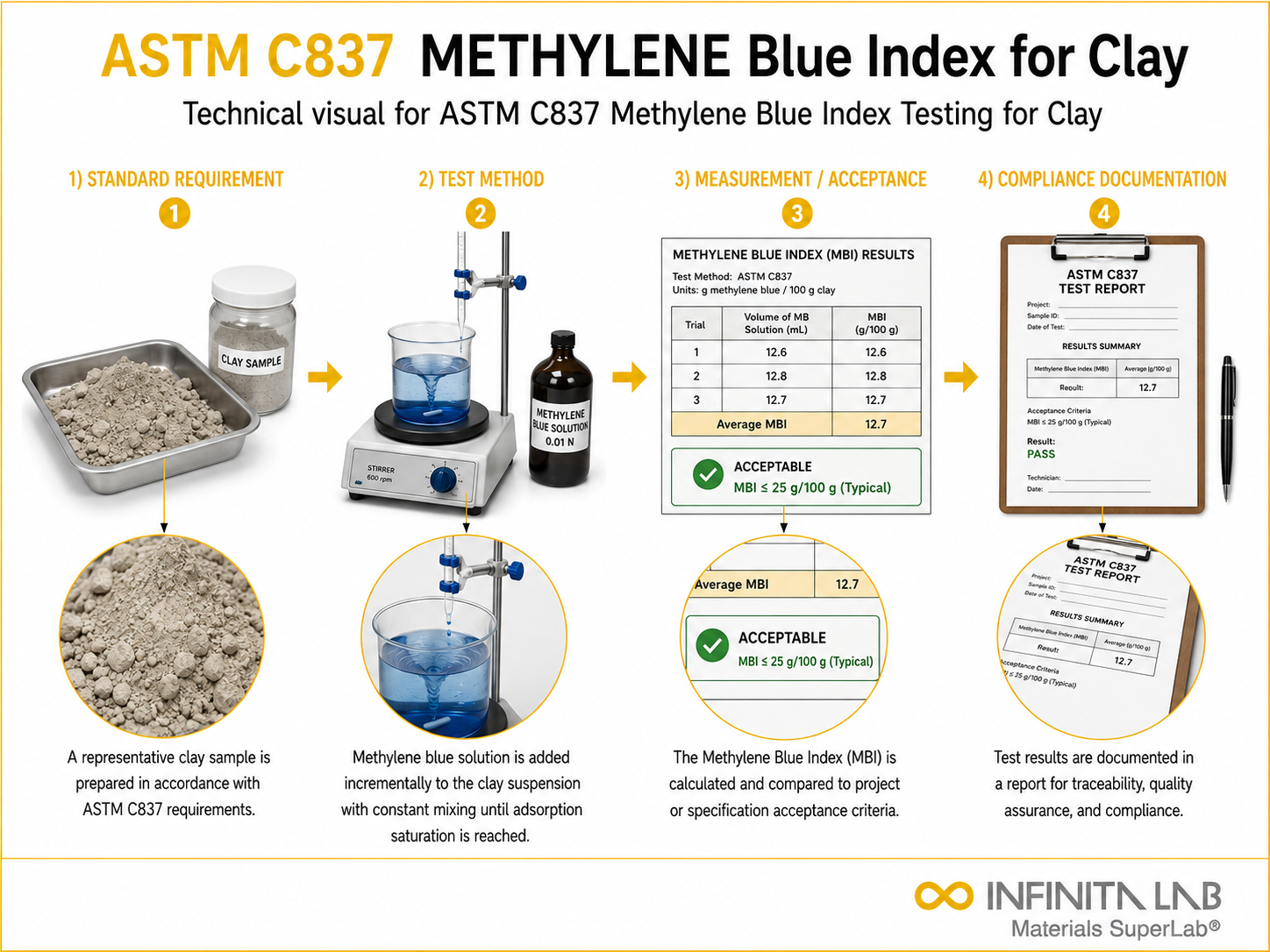
Our ASTM C837 Testing Procedure
Sample Preparation
Fine material is dried and prepared for testing under standard conditions.
1Dye Addition
Methylene blue solution is added gradually to the sample.
2Titration Process
Dye is added until adsorption reaches endpoint indicated by color change.
3Result Calculation
Methylene blue index is calculated based on dye consumption.
4ASTM C837 Test Parameters and Requirements
| Parameter | Details |
|---|---|
| Material Type | Fine aggregates, soils, and clay-containing materials. |
| Measured Parameter | Methylene blue index (MBI). |
| Sample Condition | Dry and finely divided material. |
| Reagent Used | Methylene blue dye solution. |
| End Point Detection | Visual color change indication. |
| Test Duration | Typically short duration test. |
| Result Unit | mg/g or equivalent index value. |


- Titration setup
- Analytical balance
- Drying oven
- Glassware (beakers, burettes)
- Stirring apparatus
- Pipettes and measuring cylinders
Equipment and Instrumentation Used for ASTM C837 Testing
What You Receive: Test Report, Data, and Certification
- Methylene blue index values
- Clay content evaluation
- Aggregate or soil quality assessment
- Comparative analysis reports
- Compliance with ASTM C837
- Test documentation
- Final test certification
ASTM C837 Clay Methylene Blue Index FAQs
ASTM C837 is a test method used to determine the methylene blue index of clay in aggregates or soils, helping evaluate the presence and activity of clay minerals that may affect material performance.
The index indicates the amount and activity of clay minerals, which can impact strength, durability, and bonding properties in construction materials.
A high index value indicates a higher presence of active clay minerals, which may lead to poor bonding, increased water demand, and reduced durability in construction materials.
Excessive clay can weaken the bond between cement and aggregates, increase shrinkage, and reduce overall strength and durability of concrete structures over time.
While effective for detecting active clay minerals, the test may not fully identify all types of non-reactive fines, so it is often used alongside other tests for comprehensive evaluation.
Why Choose Infinita Lab for Clay Methylene Blue Index Testing
At the core of this breadth is our network of 2,000+ accredited laboratories across the USA, offering access to over 10,000 testing methods and analytical services. From advanced materials characterization (SEM, TEM, RBS, XPS) to mechanical, chemical, environmental, biological, and standardized ASTM/ISO-compliant testing, we deliver unmatched flexibility, specialization, and scale. You are never limited by geography, facility, or methodology — Infinita Lab connects you to the right expertise and testing solution, every time.

Need ASTM C837 Clay Methylene Blue Index Testing You Can Rely On?
Send query us at hello@infinitalab.com or call us at (888) 878-3090 to learn more about our services and how we can support you.



Request a Quote
Submit your material details and receive testing procedures, pricing, and turnaround time within 24 hours.
 Quick Turnaround and Hasslefree process
 Confidentiality Guarantee
 Free, No-obligation Consultation
 100% Customer Satisfaction
