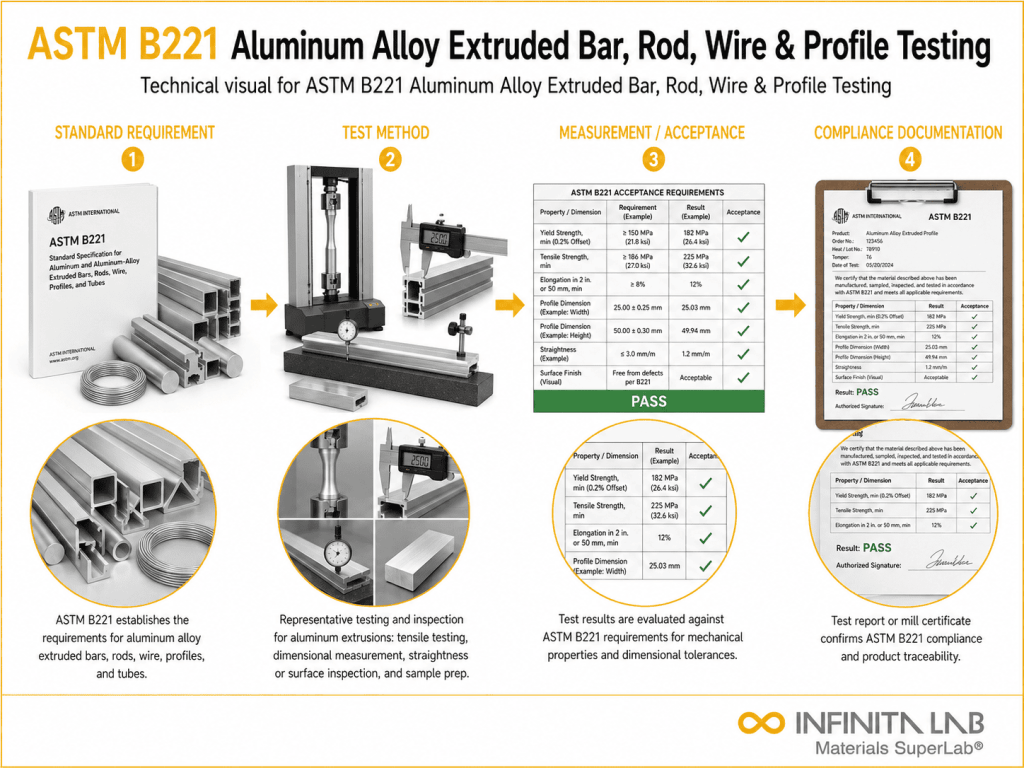


What Is ASTM B221 Aluminum Alloy Extruded Bar?
ASTM B221-21 specifies requirements for aluminum and aluminum-alloy extruded products including bars, rods, wire, profiles, and tubes. The standard defines mechanical properties, chemical composition, dimensional tolerances, and surface quality to ensure consistent performance across various industrial applications. It supports the production of high-quality extrusions with reliable strength and corrosion resistance.
This standard is widely used in construction, transportation, aerospace, and electrical industries where lightweight and durable materials are essential. ASTM B221-21 ensures uniformity in manufacturing and testing, enabling manufacturers to meet performance requirements, regulatory compliance, and customer expectations for aluminum extruded products.
Applications and Benefits of ASTM B221 Aluminum Alloy Extruded Bar Testing
Scope
ASTM B221-21 covers extruded aluminum and aluminum-alloy products in various shapes and sizes. It includes requirements for chemical composition, mechanical properties, heat treatment conditions, and inspection criteria to ensure quality and consistency.
Includes:
- Extruded bars, rods, wire, profiles, and tubes
- Alloy designations and temper conditions
- Mechanical property requirements
- Chemical composition limits
- Dimensional tolerances and surface quality
- Testing and inspection procedures
Applications
- Structural components in construction
- Automotive and transportation parts
- Aerospace structural profiles
- Electrical conductors and components
- Industrial machinery and equipment
- Architectural frames and fittings
Benefits
- Lightweight with high strength-to-weight ratio
- Excellent corrosion resistance
- Good thermal and electrical conductivity
- Versatile formability and machinability
- Consistent quality and dimensional accuracy
- Suitable for complex extruded shapes
Our ASTM B221 Testing Procedure
Sample Preparation
Specimens are cut from extruded products to standard dimensions, ensuring representative material properties.
1Mechanical Testing
Tensile and hardness tests are performed to evaluate strength, elongation, and compliance
2Chemical Analysis
Alloy composition is verified using spectrometric methods to ensure conformity with specified limits.
3Dimensional & Surface Inspection
Dimensions and surface quality are checked to confirm compliance with tolerances and absence of defects
4ASTM B221 Test Parameters and Requirements
| Parameter | Details |
|---|---|
| Material Type | Aluminum and aluminum alloys across multiple series |
| Product Forms | Extruded bars, rods, wire, profiles, and tubes |
| Alloy Series | Commonly 1xxx, 2xxx, 3xxx, 5xxx, 6xxx, and 7xxx series |
| Temper Conditions | T4, T5, T6, and other heat-treated tempers |
| Yield Strength | Specified yield strength requirements for each alloy condition |
| Elongation | Minimum elongation values ensuring required ductility |
| Chemical Composition | Controlled limits for elements such as Si, Mg, Cu, Zn, Mn |
| Dimensional Tolerances | Tight tolerances for cross-section, straightness, and length |


- Universal Testing Machine (UTM)
- Optical Emission Spectrometer (OES)
- Hardness testing machine
- Vernier calipers and micrometers
- Surface inspection tools
- Metallurgical microscope
Equipment and Instrumentation Used for ASTM B221 Testing
What You Receive: Test Report, Data, and Certification
- Mechanical properties test report
- Chemical composition analysis report
- Dimensional inspection report
- Surface quality evaluation report
- Compliance certificate as per ASTM B221-21
- Test summary with acceptance criteria
ASTM B221 Aluminum Alloy Extruded Bar FAQs
ASTM B221-21 is used to define requirements for aluminum and aluminum-alloy extruded products, ensuring consistent mechanical properties, chemical composition, and dimensional accuracy for reliable performance across various industrial and structural applications.
Temper designation indicates the heat treatment condition of aluminum, which directly affects its strength, hardness, and mechanical performance in different applications.
Extrusion is a process where aluminum is forced through a die to create specific cross-sectional shapes, allowing production of complex and precise profiles.
Aluminum extrusions offer lightweight structure, high strength, corrosion resistance, and flexibility in design, making them suitable for a wide range of applications.
By providing high-strength aluminum alloys, ASTM B221-21 enables reduction in material weight without compromising structural integrity, improving efficiency and performance in various applications.
ASTM B211/B211M covers rolled or cold-finished aluminum bars, rods, and wires, while ASTM B221/B221M covers extruded aluminum bars, rods, wires, profiles, and tubes. Both standards specify requirements for chemical composition, mechanical properties, dimensions, and product quality. ASTM B211 focuses on rolled and cold-finished products, whereas B221 addresses extruded products. The appropriate standard is selected based on the product's manufacturing process and form. Both help ensure aluminum products meet specified quality and performance requirements.
Why Choose Infinita Lab for Aluminum Alloy Extruded Bar Testing
When your Aluminum Alloy Extruded Bar results have to hold up - for compliance, a customer audit, or an engineering decision - ASTM B221 accuracy and an unbiased third-party report matter more than price. Infinita Lab routes your ASTM B221 aluminum alloy extruded bar testing to ISO/IEC 17025-accredited U.S. partner labs with hands-on method experience, so you get defensible data, transparent reporting, and turnaround times built around your project deadline - not ours.

Need ASTM B221 Aluminum Alloy Extruded Bar Testing You Can Rely On?
Send query us at hello@infinitalab.com or call us at (888) 878-3090 to learn more about our services and how we can support you.



