


Air Jet Sieve Particle Size Analysis Testing Services
Accredited air jet sieve particle size analysis testing from Infinita Lab, performed to the exact standard requirements - accurate, reproducible results with full documentation for compliance, R&D, and quality control programs.
TRUSTED BY


Get compliant results - request your air jet sieve particle size analysis testing quote
- Overview
- Scope, Applications, and Benefits
- Test Process
- Specifications
- Instrumentation
- Results and Deliverables
What Is Air Jet Sieve Particle Size Analysis?
Air-Jet Sieve is another testing method for particles used in size analysis. It is used to identify the size of fine powdery materials and granules. This analysis is achieved by using air to separate and filter particles through a fine mesh sieve without allowing them to clump together.
This testing method is used in various fields such as pharmaceuticals, chemicals, food processing, minerals, and powder technology to accurately determine the sizes of fine particles. This is achieved through the use of air jets, which help separate particles efficiently without allowing them to stick together.

Applications and Benefits of Air Jet Sieve Particle Size Analysis Testing
Scope
Air-Jet Sieve analysis is used to measure the particle size distribution of fine powders and particulate materials using a controlled air stream and precision sieve system. The method ensures accurate separation of fine particles.
The scope includes:
Determination of fine particle size distribution
Analysis of powders and granular materials
Testing of free-flowing or cohesive powders
Quality control of industrial powders and chemicals
Evaluation of powder processing performance
Applications
- Chemical and pigment industries
Food and beverage powders
Mineral and cement powders
Additive manufacturing powders
Benefits
Accurate measurement of fine particles
Prevents particle agglomeration during sieving
Faster analysis compared to traditional sieving
Suitable for cohesive and lightweight powders
Improves quality control in powder processing
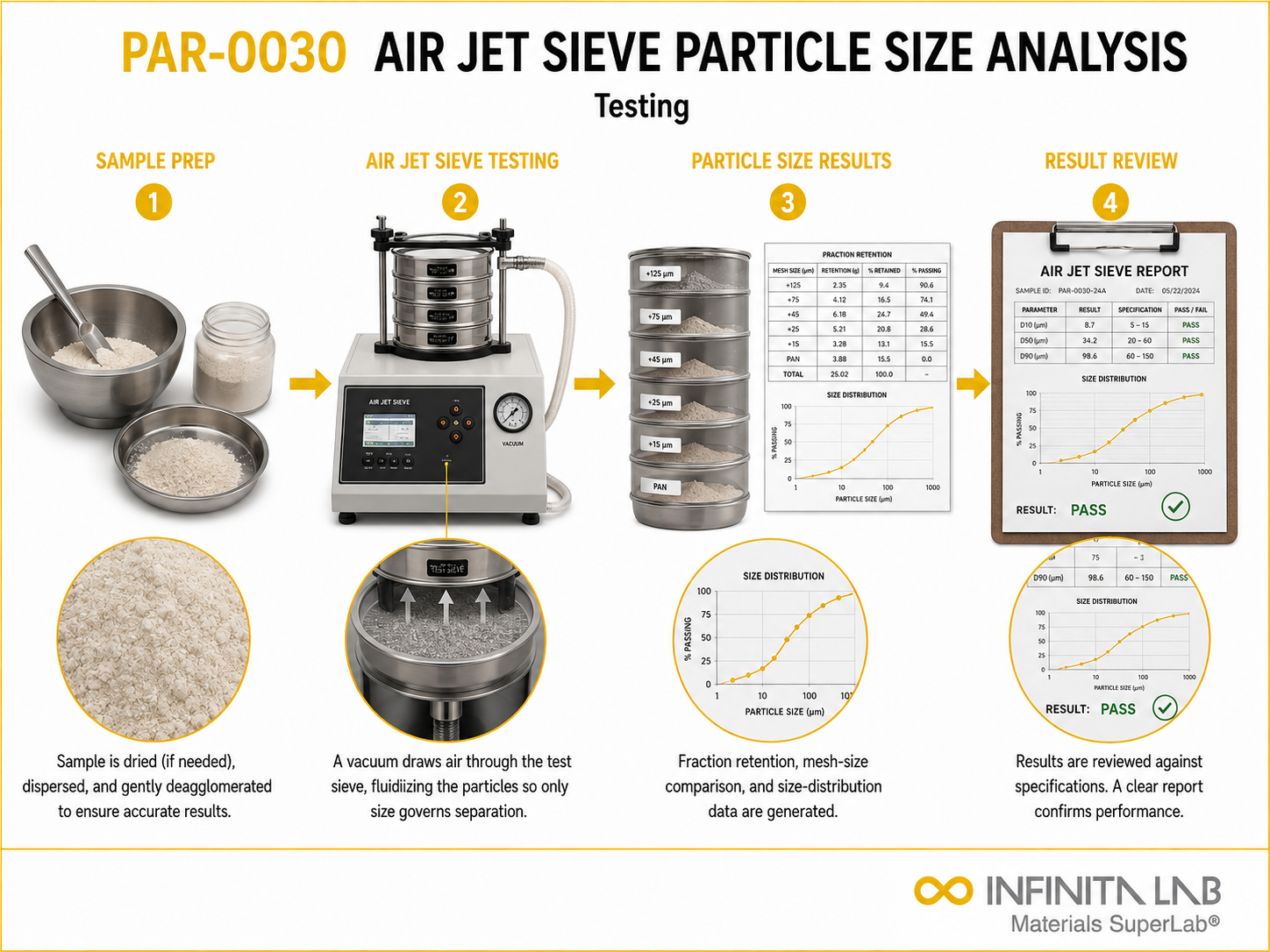
Our Testing Procedure
Sample Preparation
A measured amount of powder sample is placed on a calibrated sieve inside the air-jet sieve apparatus.
1Air Jet Dispersion
A controlled stream of air is directed through the sieve to disperse particles and prevent clumping.
2Particle Separation
Fine particles pass through the sieve openings while larger particles remain on the sieve surface.
3Result Evaluation
The retained and passed particles are measured to determine particle size distribution.
4Test parameters and requirements
| Parameter | Details |
|---|---|
| Test Principle | Air dispersion and sieve separation |
| Sieve Range | Typically 20 µm to 5 mm |
| Sample Type | Fine powders and granular materials |
| Test Duration | Usually 1–5 minutes per sample |
| Air Pressure | Controlled vacuum or compressed air system |
| Output Data | Particle size distribution and retained fraction |


Air-Jet Sieve Analyzer
Precision Test Sieves
Vacuum or Air Supply System
Sample Weighing Balance
Data Recording Software
Equipment and Instrumentation Used for Testing
What You Receive: Test Report, Data, and Certification
Particle size distribution report
Percentage retained on sieve
Fine particle fraction analysis
Powder quality evaluation report
Detailed test documentation
Air Jet Sieve Particle Size Analysis FAQs
Air-Jet Sieve analysis is a particle size testing method used to determine the distribution of fine powders by using a controlled air stream that disperses particles and passes them through precision sieve openings.
Air helps disperse particles and prevents agglomeration, allowing finer particles to pass through the sieve openings more effectively than conventional mechanical sieving methods.
Air-Jet Sieve analysis provides faster results, better dispersion of fine powders, reduced particle agglomeration, and improved accuracy for fine particle size measurement.
Yes, the air dispersion mechanism helps break up cohesive powder clusters, making it effective for materials that are difficult to analyze with traditional mechanical sieving.
Particle size distribution affects properties such as flowability, reactivity, mixing behavior, and product performance, making it an important parameter in powder processing and quality control.
ASTM D5158 determines the particle size of fine-mesh and powdered activated carbon using an air-jet sieve. Air disperses the sample across a test sieve, allowing smaller particles to pass through while larger particles remain. The retained material is weighed to calculate the percentage passing through the sieve.
An air-jet sieve uses a rotating nozzle to direct air through a fine-mesh sieve, dispersing particles and moving undersized material into a collection chamber. The remaining sample is weighed to determine the particle size fraction. ASTM D5158 is specifically intended for fine-mesh and powdered activated carbon.
Why Choose Infinita Lab for Air Jet Sieve Particle Size Analysis Testing
When your Air Jet Sieve Particle Size Analysis results have to hold up - for compliance, a customer audit, or an engineering decision - accuracy and an unbiased third-party report matter more than price. Infinita Lab routes your air jet sieve particle size analysis testing to ISO/IEC 17025-accredited U.S. partner labs with hands-on method experience, so you get defensible data, transparent reporting, and turnaround times built around your project deadline - not ours.

Looking for an Accredited Partner for Air Jet Sieve Particle Size Analysis Testing?
Send query us at hello@infinitalab.com or call us at (888) 878-3090 to learn more about our services and how we can support you.



Request a Quote
Submit your material details and receive testing procedures, pricing, and turnaround time within 24 hours.
 Quick Turnaround and Hasslefree process
 Confidentiality Guarantee
 Free, No-obligation Consultation
 100% Customer Satisfaction
