


A Complete Guide on Peel Strength Testing
Discover the fundamental information regarding peel strength testing in this comprehensive guide. Learn about the testing methods, best practices, and how it ensure strong, reliable material bonds.


What Is Peel Strength Testing?
Peel strength testing measures the force required to separate two bonded materials by peeling one from the other at a defined angle and speed. It is a fundamental adhesion test used across the packaging, automotive, electronics, and medical device industries to validate adhesive bonds, laminated films, coated substrates, and pressure-sensitive labels. The results — expressed in force per unit width (N/mm or lbf/in) — quantify the practical adhesive strength of a joint under conditions that simulate real-world separation forces.
Standards governing peel strength testing include ASTM D1876, ASTM D903, ASTM D6862, PSTC-101, and ISO 8510.
Types of Peel Tests
T-Peel Test (ASTM D1876)
The T-peel test is used for flexible-to-flexible laminates. Both bonded substrates are bent back at approximately 180° to form a T-shape, and the peel force is measured as both arms are separated. It is common in flexible packaging and protective film evaluation.
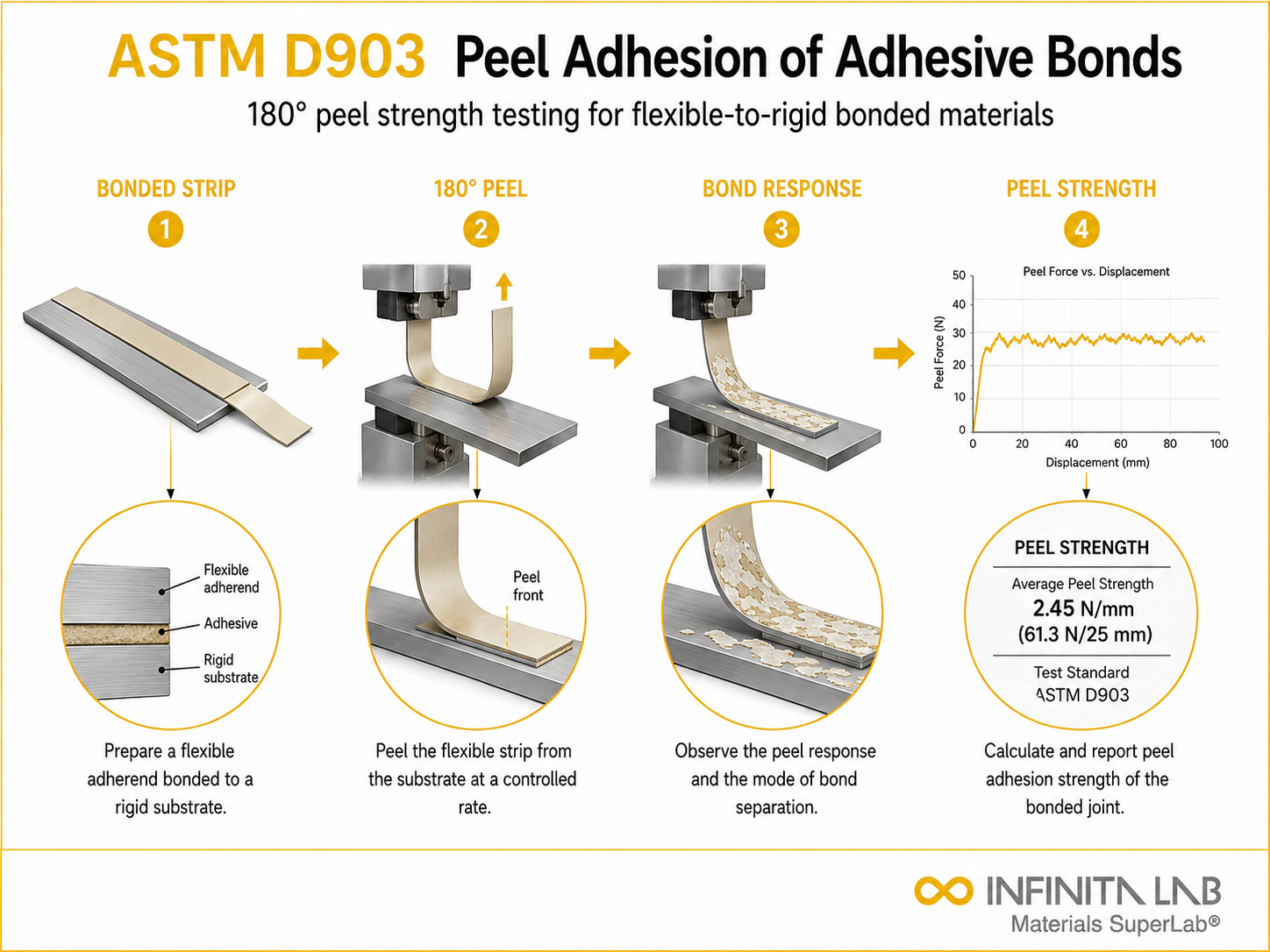
180-Degree Peel Test (ASTM D903 / PSTC-101)
One flexible substrate is peeled directly back over the bonded surface at 180°. This geometry is widely used for pressure-sensitive adhesive (PSA) tapes, labels, and medical wound dressings.
90-Degree Peel Test (ISO 8510-2)
The substrate is pulled perpendicular to the bonded surface. This configuration minimises the substrate bending energy contribution, providing a cleaner measure of interfacial adhesive strength. Used extensively in electronics, flex circuit and automotive film adhesive testing.
Also Read – Top 20 Adhesive Testing Methods for Structural & Industrial Bonds
Floating Roller Peel Test (ASTM D3167)
A roller fixture maintains a consistent peel angle while accommodating rigid-to-flexible bond geometries. Preferred for structural adhesive films in aerospace applications.
How Peel Strength Testing Is Conducted
Equipment and Setup
A universal testing machine (UTM) with appropriate grips and a load cell (typically 10 N to 500 N capacity) is used. Specimen width is standardised (usually 25 mm) to allow force-per-width normalisation. Crosshead speed is specified by the relevant standard — typically 25 mm/min to 300 mm/min.
Data Analysis
The peel force trace is recorded continuously. Average peel force, peak force, and peel front characteristics are extracted. Cohesive failure (within the adhesive), adhesive failure (at the interface), and substrate failure modes are identified visually and by fracture surface analysis.
Environmental Conditioning
Testing at elevated temperature, after humidity conditioning, or after chemical immersion reveals service-life performance. Automotive applications frequently require testing after 1,000-hour salt spray or thermal cycling per ASTM B117 or GMW14872.
Industry Applications
The packaging industry uses peel strength to validate seal integrity for food and sterile medical pouches. Electronics manufacturers test flex circuit adhesion and EMI shielding film bonding. Automotive OEMs evaluate body panel protection films and structural adhesive bonds.
Conclusion
Peel strength testing is a critical method for evaluating adhesive performance and bond durability, providing quantitative insight into how materials behave under real-world separation forces; guided by standards such as ASTM D903 and ISO 8510, it enables manufacturers to ensure product reliability, optimise material selection, and meet quality requirements across packaging, automotive, electronics, and medical applications.
Also Read – Tear Resistance Testing: Methods, Standards & Material Applications
Why Choose Infinita Lab for Peel Strength Testing?
With Infinita Lab (www.infinitalab.com), you are guaranteed a Nationwide Network of Accredited Laboratories spread across the USA, the best Consultants from around the world, Convenient Sample Pick-Up and Delivery, and Fast Turnaround Time.
Our team understands the stakes and subtleties of every test. Whether you’re validating a new Product, de-risking a prototype, or navigating complex compliance requirements, our specialists guide the process with rigour and clarity.
Looking for a trusted partner to achieve your research goals? Schedule a meeting with us, send us a request, or call us at (888) 878-3090 to learn more about our services and how we can support you. Request a Quote
Frequently Asked Questions (FAQs)
It helps evaluate adhesion performance, ensuring product durability, reliability, and resistance to delamination in real-world conditions.
Standard methods include 90° peel, 180° peel, and T-peel tests, depending on the material type and application.
Peel testing is used for adhesives, tapes, flexible laminates, films, coatings, and bonded joints.
Surface preparation, adhesive type, bonding conditions, temperature, and test angle all influence peel strength results.
A universal testing machine (UTM) is typically used to apply controlled force and measure peel resistance.
3 Easy Steps
to Start Testing
- Share Your Testing Material Details with Us
- Hassle-Free Collection Pick-Up Service
- We Find the Lab, You Get the Results

Error: Contact form not found.

Case Studies
In-depth examination of genuine material testing solutions
Case Study: Dopant & Ultra-Low Concentration Analysis via…

Case Study: Dopant & Ultra-Low Concentration Analysis via…
Introduction to STEM-EELS for Elemental Analysis Scanning Transmission Electron Microscopy (STEM) combined with Electron Energy Loss...
Read Case StudyAFM Silicon Wafer Nano Roughness Measurement Guide Testing…

AFM Silicon Wafer Nano Roughness Measurement Guide Testing…
Nano-scale surface roughness is a critical parameter in fabricated thin-films that are used in optics, solar...
Read Case StudyTalk to Our Experts Today!
Submit your contact info and we’ll get back to you within 24 hours


