


ASTM E70: Aqueous Solution Ph Glass Electrode Testing Services
ASTM E70 test method defines the apparatus and procedures for measuring pH values in aqueous solutions electrometrically using a glass electrode. The values expressed in SI units are considered standard.
TRUSTED BY


Get ASTM E70 compliant results — request your aqueous solution ph glass electrode testing quote
- Overview
- Scope, Applications, and Benefits
- Test Process
- Specifications
- Instrumentation
- Results and Deliverables
What Is ASTM E70 Aqueous Solution Ph Glass Electrode?
ASTM E70 is a standardized test method to measure the pH value of aqueous solutions by utilizing a glass electrode. The test method is helpful in obtaining accurate results for the hydrogen ion concentration, which is critical in the control of chemical processes.
The pH value is one of the critical analytical requirements in the chemical industry, water treatment, and pollution control. ASTM E70 is helpful in obtaining accurate results for the pH value.

Applications and Benefits of ASTM E70 Aqueous Solution Ph Glass Electrode Testing
Scope
ASTM E70 provides guidance for measuring pH in aqueous solutions, such as water samples and mild buffer solutions. It discusses the use of a glass electrode system that is properly calibrated using the necessary standard buffer solutions to ensure accurate results are obtained. The standard also provides performance criteria for the electrode system, which include the necessary millivolt tolerances to ensure that the system is properly calibrated and accurate results are obtained during the test.
Applications
- Chemical process control
- Water quality testing
- Environmental monitoring
- Pollution control analysis
- Laboratory quality control
- Industrial wastewater testing
- Research and development
Benefits
- Accurate hydrogen ion concentration measurement
- High repeatability and precision
- Rapid and simple testing procedure
- Suitable for routine laboratory use
- Standardized and widely accepted method
- Supports regulatory compliance
- Improves process control reliability
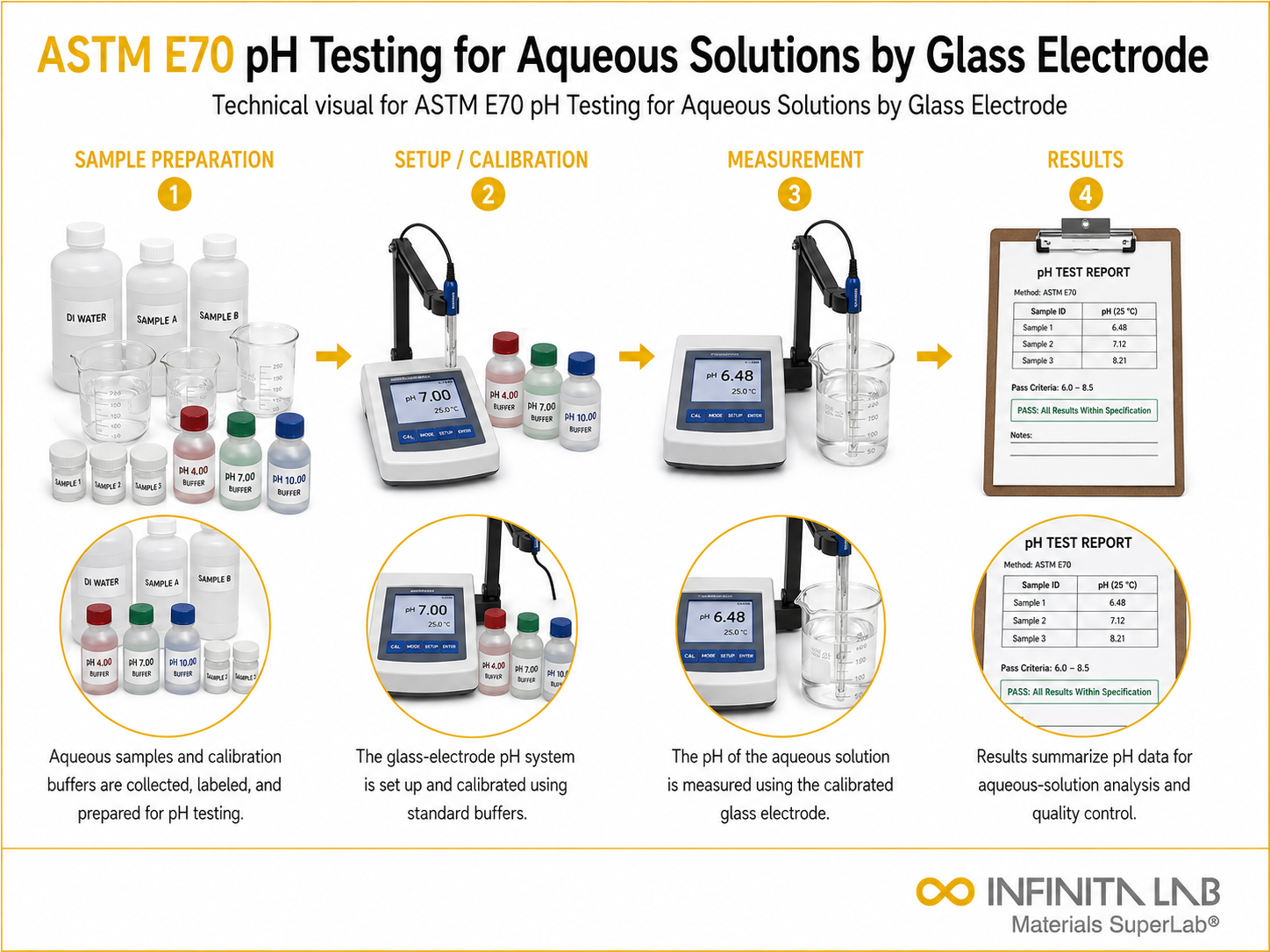
Our ASTM E70 Testing Procedure
Calibration
The pH meter is calibrated using two standard buffer solutions to ensure accuracy before testing.
1Electrode Preparation
The glass and reference electrodes are properly cleaned, dried, and prepared for immersion.
2Sample Measurement
The test solution is placed in a clean container, the electrodes are immersed, and a preliminary pH reading is obtained.
3Stabilization and Recording
The reading is allowed to stabilize (drift ≤ 0.01 pH units within 1–2 minutes), after which the final, stable pH value is recorded.
4ASTM E70 Test Parameters and Requirements
| Parameter | Details |
|---|---|
| Applicable Materials | Aqueous and slightly buffered solutions |
| Calibration Requirement | Two standard buffer solutions |
| Electrode Requirement | High-alkalinity glass electrode |
| Electrode Performance Criteria | Potential difference within ±3 mV at pH 12.8 compared to pH 9.18 |
| Repeatability | ±0.02 pH units |
| Drift Requirement | Less than 0.01 pH units in 1–2 minutes |
| Output Units | pH (reported to nearest 0.01 unit) |
| Temperature Reporting | Reported to nearest 1°C |


- pH meter (potentiometric type)
- Glass electrode (high-alkalinity type)
- Reference electrode
- Standard buffer solutions
- Temperature probe or thermometer
- Sample beakers or cups
- Cleaning and rinsing solutions
Equipment and Instrumentation Used for ASTM E70 Testing
What You Receive: Test Report, Data, and Certification
- Accurate pH value (reported to nearest 0.01 unit)
- Test temperature (reported to nearest 1°C)
- Calibration verification data
- Electrode performance confirmation
- Quality control documentation
- Validation reports
Frequently Asked Question
ASTM E70 describes detailed procedures for precise pH determination with glass electrodes. The standard outlines requirements for calibration, temperature control, and buffer solution use to ensure reliable pH information for important chemical processes in industry.
The response of a glass electrode depends on temperature, and this is based on electrochemical principles. The ASTM E70 standard requires temperature compensation, usually at 25 °C, to prevent any form of bias in the measurements.
ASTM E70 is designed for aqueous solutions and miscible systems with water. Non-aqueous or highly viscous samples may affect the electrode response, which may need different approaches or specific electrodes to prevent junction potential and instability in measurement.
ASTM E70 specifies multi-point calibration with standard buffer solutions that bracket the anticipated pH of the samples. Calibration of the electrode slope and offset is necessary to ensure that the sensitivity, stability, and repeatability of the measurements are correct.
For accurate results of ASTM E70 pH testing, it is important to maintain the electrodes properly. Drifting, slow response, and erroneous results are obtained when the glass membrane of the electrode is dehydrated or contaminated.
Why Choose Infinita Lab for Aqueous Solution Ph Glass Electrode Testing
At the core of this breadth is our network of 2,000+ accredited laboratories across the USA, offering access to over 10,000 testing methods and analytical services. From advanced materials characterization (SEM, TEM, RBS, XPS) to mechanical, chemical, environmental, biological, and standardized ASTM/ISO-compliant testing, we deliver unmatched flexibility, specialization, and scale. You are never limited by geography, facility, or methodology — Infinita Lab connects you to the right expertise and testing solution, every time.

Need ASTM E70 Aqueous Solution Ph Glass Electrode Testing You Can Rely On?
Send query us at hello@infinitalab.com or call us at (888) 878-3090 to learn more about our services and how we can support you.



Request a Quote
Submit your material details and receive testing procedures, pricing, and turnaround time within 24 hours.
 Quick Turnaround and Hasslefree process
 Confidentiality Guarantee
 Free, No-obligation Consultation
 100% Customer Satisfaction
