


Reliability Standard Compliance Testing Services
Reliability testing is a process used to identify design flaws and ensure products meet their reliability standards. It can involve electrical, vibration, thermal, and humidity stress testing. The bathtub curve is used to predict breakdowns. MIL-HDBK-781 provides strategies, schedules, and environmental profiles for reliability testing. It covers a range of industrial goods, from fixed-ground machinery to airborne missiles, to ensure a product performs adequately in the field.
TRUSTED BY


Get compliant results — request your reliability standard compliance testing quote
- Overview
- Scope, Applications, and Benefits
- Test Process
- Specifications
- Instrumentation
- Results and Deliverables
What Is Reliability Standard Compliance?
Reliability standard compliance product testing is performed to evaluate whether a product meets defined reliability, performance, and regulatory requirements under expected operating conditions. It is a critical step in product development to identify design weaknesses and ensure long-term durability.
The testing process simulates real-world environments, including thermal, mechanical, electrical, and humidity stresses, to predict product behavior throughout its lifecycle. It helps manufacturers understand failure modes and ensures that products perform consistently under normal and extreme conditions.

Applications and Benefits of Reliability Standard Compliance Testing
Scope
Reliability compliance testing evaluates:
- Product durability and lifecycle performance
- Resistance to environmental and mechanical stresses
- Electrical and thermal stability
- Failure modes and reliability behavior
- Compliance with industry standards and regulations
Applications
- Electronics and electrical products
- Automotive and aerospace components
- Consumer and industrial products
- Medical devices and equipment
- Packaging and mechanical systems
Benefits
- Identifies design flaws early in development
- Ensures compliance with standards and regulations
- Improves product reliability and lifespan
- Reduces risk of field failures
- Supports product certification and market acceptance
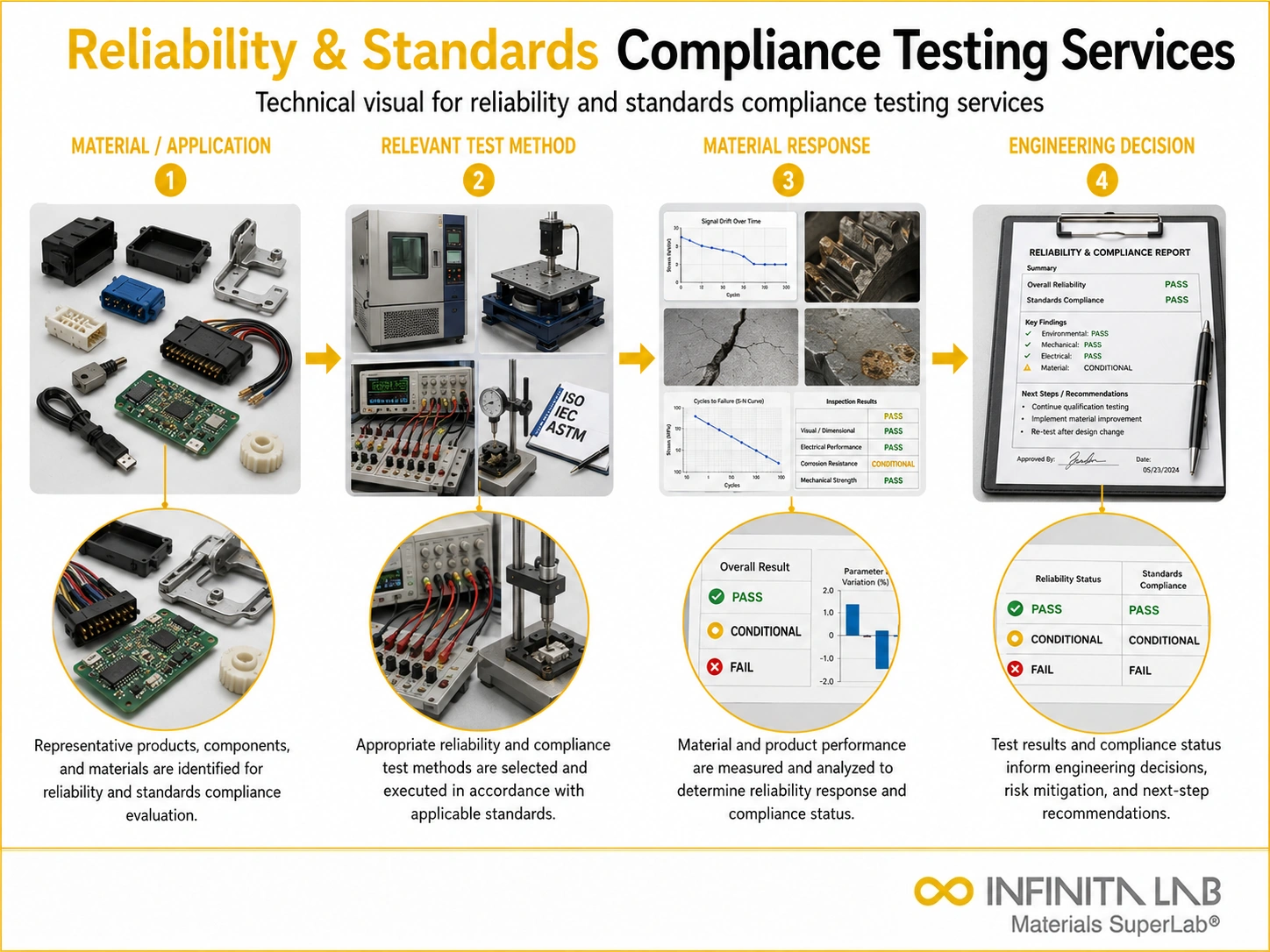
Our Testing Procedure
Test Planning
Product requirements, operating conditions, and applicable standards are defined.
1Stress Testing
Products are subjected to thermal, mechanical, electrical, and humidity stresses.
2Performance Monitoring
Product performance is monitored under simulated real-world conditions.
3Data Analysis
Failure modes, reliability trends, and compliance results are evaluated.
4Test parameters and requirements
| Parameter | Details |
|---|---|
| Standards | MIL-HDBK-781, IEC, ASTM, ISO |
| Stress Types | Thermal, vibration, electrical, humidity |
| Reliability Model | Bathtub curve (infant mortality, useful life, wear-out) |
| Test Methods | HALT, HASS, ESS, life cycle testing |
| Measured Outputs | Failure rate, durability, performance stability |
| Application | Product qualification and compliance |


- Environmental chambers (temperature, humidity)
- Vibration and shock testing systems
- Electrical stress testing equipment
- Data acquisition and monitoring systems
- Accelerated life testing systems
- Failure analysis tools
Equipment and Instrumentation Used for Testing
What You Receive: Test Report, Data, and Certification
- Reliability performance data
- Failure mode and root cause analysis
- Lifecycle and durability assessment
- Compliance evaluation with standards
- Test report and performance summary
Reliability Standard Compliance FAQs
Reliability testing evaluates whether a product can perform consistently under expected conditions over its lifecycle, ensuring compliance with standards and identifying potential failures before market release.
Products are exposed to thermal, mechanical, electrical, and humidity stresses to simulate real-world operating conditions and evaluate performance, durability, and reliability under different environmental scenarios.
The bathtub curve represents product failure rates over time, including early failures, stable operation period, and wear-out phase, helping predict reliability and maintenance needs.
Standards such as MIL-HDBK-781, IEC, ASTM, and ISO are commonly used to define testing procedures and ensure compliance with reliability and performance requirements.
It ensures product durability, reduces failure risk, improves quality, and helps meet regulatory requirements, enabling manufacturers to deliver safe, reliable, and high-performance products to the market.
Why Choose Infinita Lab for Reliability Standard Compliance Testing?
At the core of this breadth is our network of 2,000+ accredited laboratories across the USA, offering access to over 10,000 testing methods and analytical services. From advanced materials characterization (SEM, TEM, RBS, XPS) to mechanical, chemical, environmental, biological, and standardized ASTM/ISO-compliant testing, we deliver unmatched flexibility, specialization, and scale. You are never limited by geography, facility, or methodology — Infinita Lab connects you to the right expertise and testing solution, every time.

Looking for an Accredited Partner for Reliability Standard Compliance Testing?
Send query us at hello@infinitalab.com or call us at (888) 878-3090 to learn more about our services and how we can support you.



Request a Quote
Submit your material details and receive testing procedures, pricing, and turnaround time within 24 hours.
 Quick Turnaround and Hasslefree process
 Confidentiality Guarantee
 Free, No-obligation Consultation
 100% Customer Satisfaction
