


NFPA 259: Potential Heat Fire Testing Services
Accredited NFPA 259 potential heat fire testing from Infinita Lab, performed to the exact standard requirements - accurate, reproducible results with full documentation for compliance, R&D, and quality control programs.
TRUSTED BY


Get NFPA 259 compliant results - request your potential heat fire testing quote
- Overview
- Scope, Applications, and Benefits
- Test Process
- Specifications
- Instrumentation
- Results and Deliverables
What Is NFPA 259 Potential Heat Fire?
NFPA 259, Standard Test Method for Potential Heat of Building Materials, is a laboratory test method developed by the National Fire Protection Association to quantify the potential heat of a building material – the total heat energy the material can release when subjected to a defined high-temperature exposure. Rather than simply classifying a material as combustible or non-combustible, NFPA 259 produces a quantitative heat value, expressed in Btu/lb or kJ/kg, that describes how much thermal energy the material contributes to a fire scenario.
The test combines two measurements made with an oxygen bomb calorimeter. A representative specimen is first pelletized and combusted in a sealed bomb charged with high-pressure oxygen to determine its initial gross heat of combustion, with the heat released measured as a temperature rise in a surrounding water bath. A separate specimen is then exposed to 750°C for two hours in an electric muffle furnace under oxidising conditions, and the residue from that exposure is combusted in the same bomb calorimeter to determine its residual heat of combustion. The potential heat is calculated as the difference between the initial and residual values, representing the heat given off during the high-temperature exposure.
Potential heat data is an important input for fuel load and fire hazard assessments in building design. It is used alongside other fire performance tests, such as ASTM E136 non-combustibility testing, to support limited-combustible material classifications referenced in codes like NFPA 101 and NFPA 5000, and it is particularly relevant to roofing materials, insulation products, and interior finish systems where fire protection engineers need reliable, standardised fuel contribution data for building material selection and code compliance.

Applications and Benefits of NFPA 259 Potential Heat Fire Testing
Scope
- NFPA 259 measures the potential heat, or gross heat of combustion, of building materials under a defined high-temperature exposure condition.
- The test method is based on the principle of bomb calorimetry, in which a specimen is combusted in a sealed vessel filled with pressurised oxygen and the heat released is measured as a temperature rise in a surrounding water bath.
- Testing is performed under controlled laboratory conditions using an oxygen bomb calorimeter together with an electric muffle furnace for high-temperature specimen exposure.
- The method applies to homogeneous building materials and can be used to evaluate composite and layered products within the specimen thickness limits set by the standard.
- Industries served include roofing manufacturing, insulation manufacturing, building envelope and wall system design, and interior finish material production.
- Common use cases include supporting fire hazard evaluations, fuel load calculations, and material selection decisions for building envelope and interior applications.
- NFPA 259 is frequently used alongside ASTM E136 noncombustibility testing to support limited-combustible material classifications under codes such as NFPA 101 and NFPA 5000.
- The standard is a property-type test and does not measure heat release rate, flame spread, or overall fire hazard on its own.
- Results from NFPA 259 testing support building code compliance documentation, product listings, and fire protection engineering analyses.
- Testing supports manufacturers and specifiers seeking standardised, laboratory-verified potential heat data for building material fire safety documentation.
Applications
- Fire classification testing for roofing materials and roof assembly components.
- Fire performance evaluation of thermal and building insulation products.
- Interior finish material assessment for building fire safety classification.
- Fuel load calculations supporting fire protection engineering analyses.
- Supplementary testing for limited-combustible classification alongside ASTM E136.
- Building envelope and wall system material evaluation for code compliance.
- Product development and quality verification for manufacturers of construction materials.
Benefits
- Provides quantitative potential heat data rather than a simple pass/fail combustibility outcome.
- Supports limited-combustible classification pathways under NFPA 101 and NFPA 5000.
- Delivers standardised, repeatable data for fuel load and fire hazard assessments.
- Helps manufacturers document fire performance for code officials and specifiers.
- Provides comparative data for material selection and product development decisions.
- Complements other fire test methods to build a complete fire performance profile.
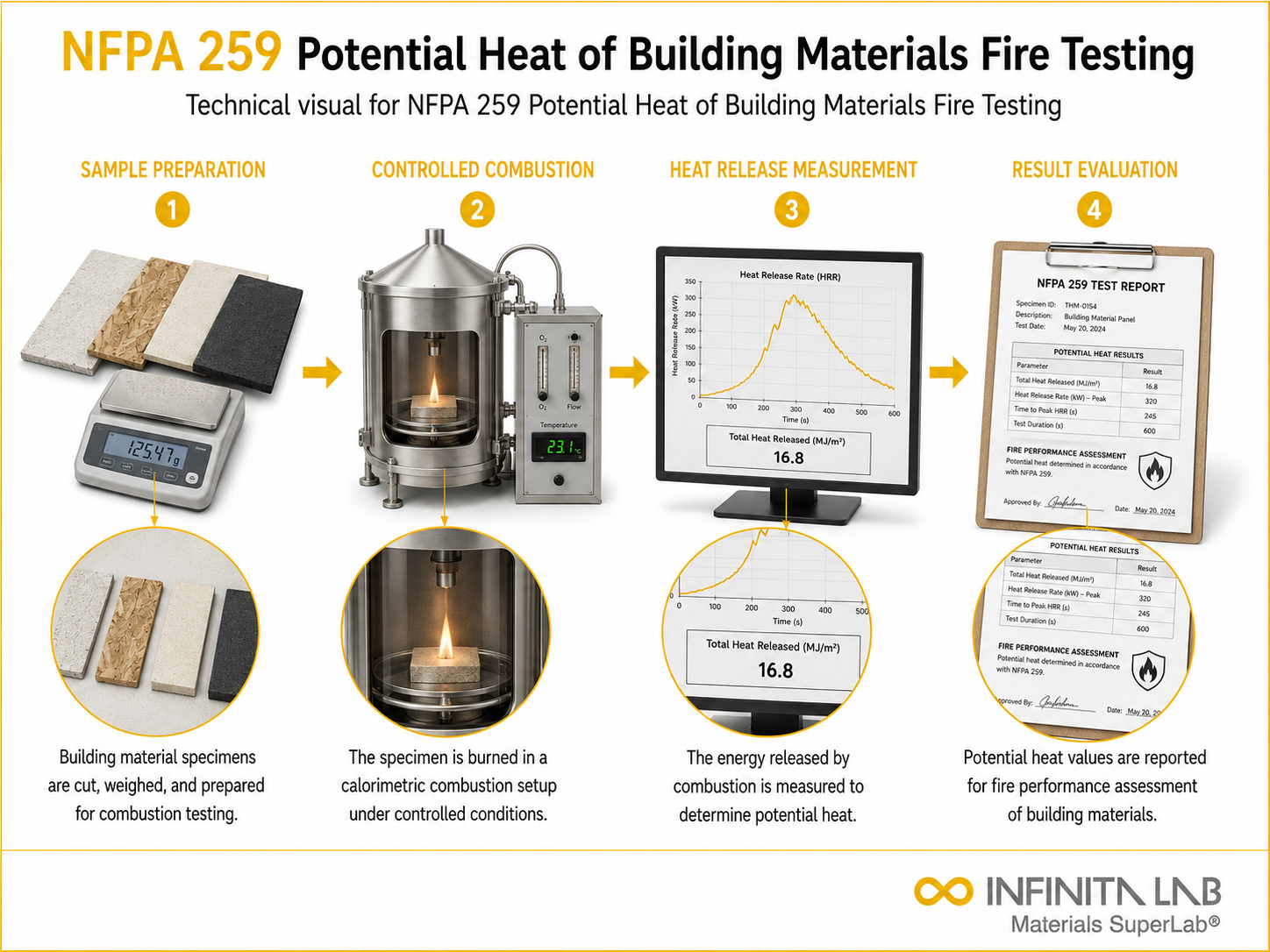
Our NFPA 259 Testing Procedure
Sample Preparation
Test specimens are prepared to the required size and conditioned under controlled temperature and humidity.
1Calorimeter Setup
The specimen is placed inside an oxygen bomb calorimeter for combustion testing.
2Combustion Process
Samples are subjected to high temperature (~750°C) in controlled conditions using calorimetric methods.
3Heat Measurement & Interpretation
The temperature rise is measured and used to calculate the potential heat of combustion.
4NFPA 259 Test Parameters and Requirements
| Parameter | Details |
|---|---|
| Applicable Materials | Building materials, insulation, wall systems, interior finish materials |
| Measurement Parameter | Potential heat of combustion |
| Temperature | ~750°C exposure condition |
| Output Units | Btu/lb or MJ/kg |
| Sample Mass | Typically small representative specimens (as specified by the standard) |


- Oxygen bomb calorimeter – combusts the pelletized specimen in a high-pressure oxygen atmosphere and measures the heat released.
- Electric muffle furnace – exposes the secondary specimen to the standard’s defined 750°C, two-hour oxidising condition.
- Precision temperature sensor – measures the water bath temperature rise generated during specimen combustion.
- Oxygen supply and pressurisation system – charges the bomb vessel with pure oxygen to the pressure required for complete combustion.
- Analytical balance – records specimen and residue mass before and after testing for accurate heat-of-combustion calculations.
- Specimen pelletizing equipment – compresses material samples into pellets suitable for bomb calorimeter combustion.
- Ignition system – provides the electrical fuse wire and electrodes used to initiate combustion within the sealed bomb.
Equipment and Instrumentation Used for NFPA 259 Testing
What You Receive: Test Report, Data, and Certification
- Initial and residual gross heat of combustion values for the tested material.
- Calculated potential heat result, reported in Btu/lb or kJ/kg.
- Detailed test report documenting specimen preparation, apparatus calibration, and test conditions.
- Supporting data suitable for fuel load calculations and fire hazard assessments.
- Documentation suitable for use alongside ASTM E136 results in limited-combustible classification submittals.
- Test records suitable for building code compliance documentation and product listing support.
NFPA 259 Potential Heat Fire FAQs
NFPA 259 is all about the potential heat of combustion for building materials. It calculates the total amount of energy that could be released if the material is burned completely, which can give an idea of the rate at which the fire might spread in the building.
The concept of potential heat is essentially the amount of energy that the material could provide for the fire. Materials that have high potential heat are the ones that could cause the fire to spread quickly, whereas materials that have lower potential heat are the safest ones for construction.
To calculate the potential heat value of the material, a small amount of the material is put into an oxygen bomb calorimeter and burned in an oxygen-rich environment. The amount of heat that is released during the burning is recorded and gives us the potential heat value of the material.
The results are typically expressed as: - Btu/pound (Btu/lb) - Megajoules/kilogram (MJ/kg) The figures indicate the total amount of heat that is released from the burning of the material.
NFPA 259 is often used for demonstrating compliance with various building and fire safety regulations, particularly for the evaluation of various types of insulation and composite buildings.
NFPA 259 is the Standard Test Method for Potential Heat of Building Materials. It determines the amount of heat that building materials can potentially release when exposed to a defined high-temperature condition under controlled laboratory conditions. The current edition is NFPA 259:2023.
NFPA 259 can be accessed online through NFPA LiNK®, NFPA’s digital standards platform. The platform lists the 2023 edition of NFPA 259 and provides access to NFPA publications through its available subscription options.
Why Choose Infinita Lab for Potential Heat Fire Testing
When your Potential Heat Fire results have to hold up - for compliance, a customer audit, or an engineering decision - NFPA 259 accuracy and an unbiased third-party report matter more than price. Infinita Lab routes your NFPA 259 potential heat fire testing to ISO/IEC 17025-accredited U.S. partner labs with hands-on method experience, so you get defensible data, transparent reporting, and turnaround times built around your project deadline - not ours.

Need NFPA 259 Potential Heat Fire Testing You Can Rely On?
Send query us at hello@infinitalab.com or call us at (888) 878-3090 to learn more about our services and how we can support you.



Request a Quote
Submit your material details and receive testing procedures, pricing, and turnaround time within 24 hours.
 Quick Turnaround and Hasslefree process
 Confidentiality Guarantee
 Free, No-obligation Consultation
 100% Customer Satisfaction
