


Micropore Measurement Testing Services
Explore cutting-edge methods that offer accurate insights into micropore size and distribution through Micropore Measurement.
TRUSTED BY


Get compliant results — request your micropore measurement testing quote
- Overview
- Scope, Applications, and Benefits
- Test Process
- Specifications
- Instrumentation
- Results and Deliverables
What Is Micropore Measurement?
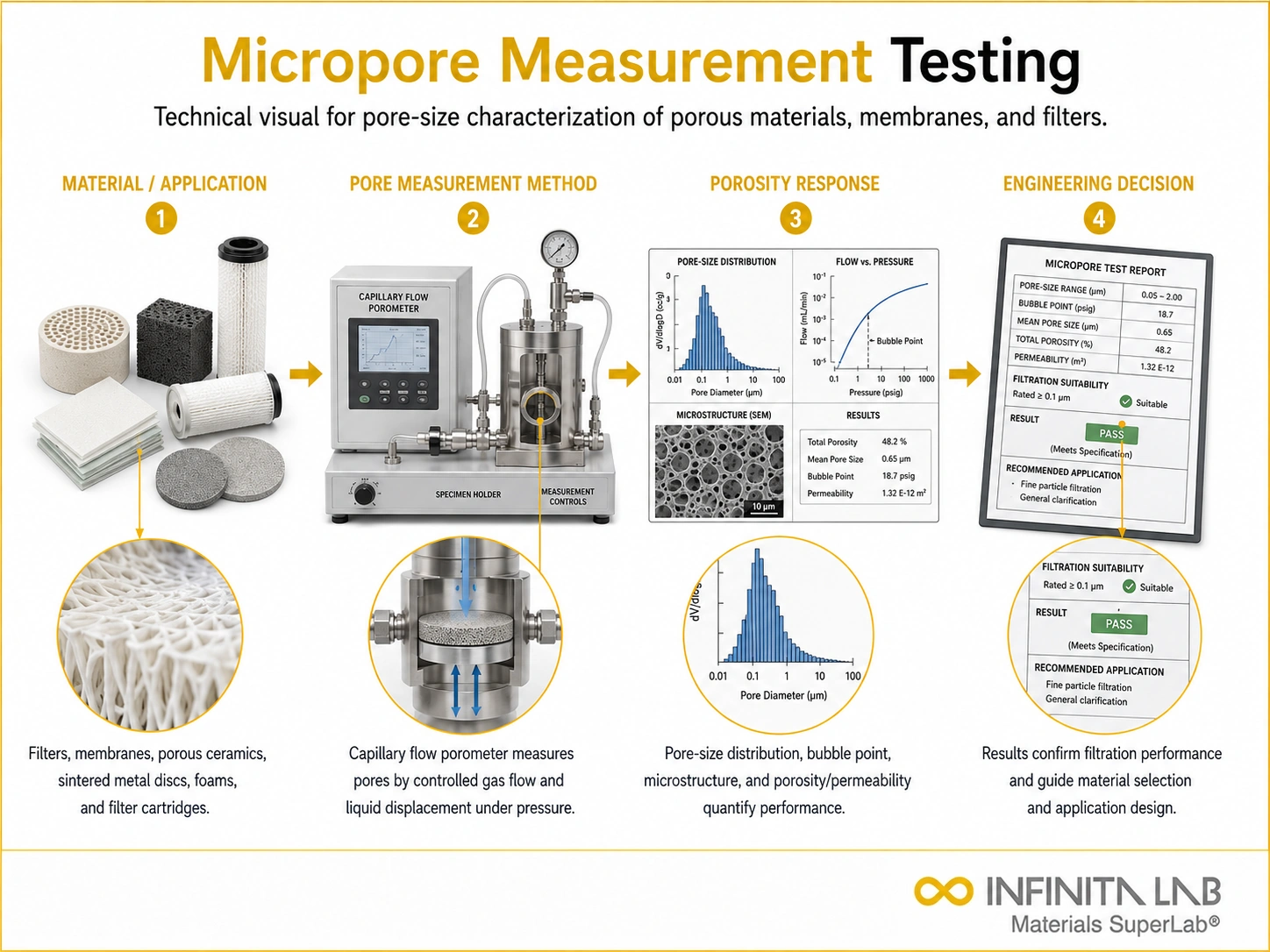
Micropore measurement is used to determine the size, distribution, and volume of extremely small pores present in materials, typically in the nanometer to micrometer range. It is essential for understanding porosity characteristics that influence permeability, adsorption, filtration efficiency, and overall material performance.
The technique involves gas adsorption, mercury intrusion, or advanced imaging methods to quantify pore structure and connectivity. By analyzing pore size distribution and surface area, micropore measurement provides critical insights into material behavior, enabling optimization of performance in applications requiring controlled porosity and fluid interaction.

Applications and Benefits of Micropore Measurement Testing
Scope
Micropore measurement focuses on evaluating fine pore structures within materials, enabling detailed characterization of porosity and its impact on functional performance under controlled analytical conditions.
- Determination of micropore size distribution
- Measurement of pore volume and surface area
- Analysis of pore connectivity and structure
- Evaluation of porous materials and coatings
- Comparison of porosity characteristics across samples
Applications
- Filtration media performance evaluation
- Adsorbent and catalyst characterization
- Porous coating and membrane analysis
- Material research and development
- Quality control of porous structures
- Permeability and diffusion studies
Benefits
- Provides precise pore size distribution data
- Enables optimization of material performance
- Supports design of high-efficiency filtration systems
- Improves understanding of adsorption behavior
- Assists in quality control and material comparison
- Enhances reliability of porous materials
Micropore Measurement – Test Process
Sample Preparation
The sample is cleaned and degassed to remove moisture and contaminants from pore structures.
1Measurement Setup
The prepared sample is placed in the analysis instrument under controlled temperature and pressure conditions.
2Pore Analysis Execution
Gas adsorption or intrusion method is applied to characterize pore size and volume distribution.
3Data Analysis & Interpretation
Results are processed to generate pore size distribution, surface area, and volume metrics.
4Micropore Measurement – Technical Specification
| Parameter | Details |
|---|---|
| Measurement Method | Gas adsorption (BET), mercury intrusion, or porosimetry techniques |
| Pore Size Range | Typically 0.5 nm to several micrometers depending on method used |
| Analysis Parameter | Adsorption–desorption isotherms or pressure–volume relationship |
| Surface Area Measurement | BET method for specific surface area determination |
| Pressure Range | Vacuum to high pressure depending on measurement technique |
| Sample Form | Powders, solids, coatings, or porous structures |
| Measurement Units | nm (pore size), m²/g (surface area), cm³/g (pore volume) |


- BET surface area analyzer
- Gas adsorption analyzer
- Mercury intrusion porosimeter
- Vacuum degassing system
- Pressure control unit
- Analytical balance
Equipment and Instrumentation Used for Testing
What You Receive: Test Report, Data, and Certification
- Pore size distribution curve
- Specific surface area values
- Total pore volume measurement
- Adsorption–desorption isotherm graphs
- Detailed analytical test report
- Interpretation with performance insights
Micropore Measurement FAQs
Micropore measurement determines the size, distribution, and volume of very small pores in materials. It is important because pore characteristics directly influence adsorption, permeability, filtration efficiency, and overall material performance in various engineering and scientific applications.
Micropores are typically less than 2 nm, mesopores range from 2–50 nm, and macropores are larger than 50 nm. Each category influences material behavior differently, particularly in adsorption, diffusion, and fluid transport processes.
BET analysis uses gas adsorption to calculate specific surface area based on adsorption isotherms. It is particularly useful for evaluating materials with high surface area and fine pore structures.
Accuracy depends on sample preparation, instrument calibration, temperature stability, and correct selection of measurement method. Improper handling or environmental variations can affect results significantly.
Pore size distribution influences how fluids or gases move through a material. Uniform distribution improves efficiency, while irregular pores can affect permeability and adsorption behavior.
Why Choose Infinita Lab for Micropore Measurement Testing
At the core of this breadth is our network of 2,000+ accredited laboratories across the USA, offering access to over 10,000 testing methods and analytical services. From advanced materials characterization (SEM, TEM, RBS, XPS) to mechanical, chemical, environmental, biological, and standardized ASTM/ISO-compliant testing, we deliver unmatched flexibility, specialization, and scale. You are never limited by geography, facility, or methodology — Infinita Lab connects you to the right expertise and testing solution, every time.

Looking for an Accredited Partner for Micropore Measurement Testing?
Send query us at hello@infinitalab.com or call us at (888) 878-3090 to learn more about our services and how we can support you.



Request a Quote
Submit your material details and receive testing procedures, pricing, and turnaround time within 24 hours.
 Quick Turnaround and Hasslefree process
 Confidentiality Guarantee
 Free, No-obligation Consultation
 100% Customer Satisfaction
