


Microbial Aerosol Fallout Challenge Testing Services
The Microbial Aerosol Fallout Challenge Test is a qualitative test that simulates a high microbial load on a sterile-barrier system. It evaluates the permeability of protective materials by measuring their resistance to airflow and mass extraction methods. This test is essential to ensure the integrity of packaging materials and give manufacturers a reliable indication of their product's shelf life.
TRUSTED BY


Get compliant results — request your microbial aerosol fallout challenge testing quote
- Overview
- Scope, Applications, and Benefits
- Test Process
- Specifications
- Instrumentation
- Results and Deliverables
What Is Microbial Aerosol Fallout Challenge?
The Microbial Aerosol Fallout Challenge Test evaluates the effectiveness of materials, surfaces, or systems in preventing or controlling contamination from airborne microorganisms. It simulates real-world conditions where microbial aerosols settle onto surfaces, helping assess contamination control and hygienic performance.
This test is widely used in cleanrooms, healthcare environments, packaging systems, and filtration applications. By exposing test samples to controlled microbial aerosols, it determines resistance to contamination, microbial survival, and deposition behavior, ensuring safety, hygiene, and regulatory compliance in critical environments.

Applications and Benefits of Microbial Aerosol Fallout Challenge Testing
Scope
The test focuses on assessing how airborne microorganisms deposit and survive on surfaces under controlled environmental conditions, supporting contamination control and hygiene validation.
- Applicable to surfaces, coatings, packaging materials, and air control systems
- Evaluates microbial deposition from aerosolized environments
- Assesses resistance to contamination and microbial growth
- Supports cleanroom and controlled environment validation
- Applicable to healthcare, pharmaceutical, and food-related environments
- Includes controlled aerosol generation and exposure conditions
- Evaluates effectiveness of antimicrobial treatments
- Supports environmental monitoring and risk assessment
- Ensures compliance with hygiene and safety standards
Applications
- Cleanroom contamination control validation
- Healthcare surface hygiene evaluation
- Packaging contamination resistance testing
- Air filtration and ventilation system assessment
- Antimicrobial coating performance testing
Benefits
- Simulates realistic contamination scenarios
- Evaluates surface resistance to airborne microbes
- Supports infection control strategies
- Helps improve product and environmental safety
- Ensures compliance with hygiene standards
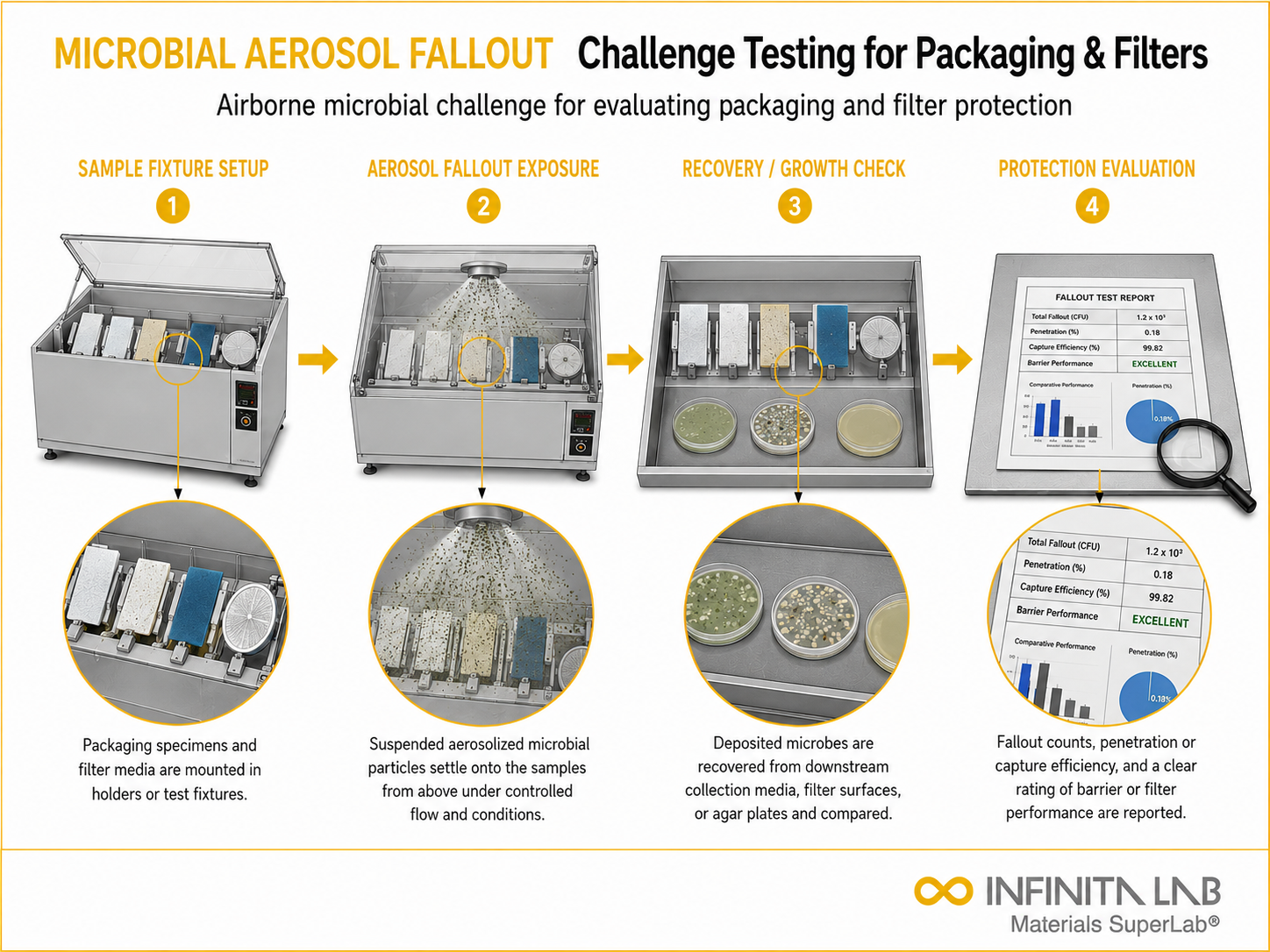
Our Testing Procedure
Sample Preparation
Test surfaces are sterilized and placed in a controlled chamber to eliminate pre-existing contamination.
1Aerosol Generation
A defined concentration of microbial aerosol is generated and dispersed uniformly in the chamber environment.
2Exposure and Deposition
Samples are exposed for a specified duration to allow microbial fallout and surface deposition under controlled airflow.
3Recovery and Analysis
Microorganisms are recovered from surfaces and quantified to assess contamination levels and resistance.
4Test parameters and requirements
| Parameter | Details |
|---|---|
| Method | Controlled aerosol exposure and surface deposition analysis |
| Measurement Type | Microbial deposition and survival assessment |
| Sample Type | Surfaces, coatings, packaging materials, filtration systems |
| Loading Type | Exposure to aerosolized microorganisms |
| Units | CFU/cm², CFU/sample |
| Environmental Conditions | Controlled temperature, humidity, and airflow |


- Aerosol generator/nebulizer
- Controlled environmental chamber
- Airflow and humidity control system
- Microbial culture media and incubator
- Colony counter
Equipment and Instrumentation Used for Testing
What You Receive: Test Report, Data, and Certification
- Microbial deposition counts (CFU)
- Surface contamination analysis
- Comparative performance evaluation
- Test conditions and exposure data
- Compliance and validation report
Microbial Aerosol Fallout Challenge FAQs
Particle size affects settling velocity and transport behavior. Larger particles settle quickly due to gravity, while smaller particles remain suspended longer, influencing deposition rates and contamination patterns on exposed surfaces.
Airflow determines particle distribution and deposition uniformity. Controlled airflow ensures reproducible exposure conditions and realistic simulation of contamination scenarios in cleanroom or indoor environments.
Aerosolization conditions such as humidity, temperature, and generation method are optimized to prevent desiccation or damage, ensuring microorganisms remain viable during exposure.
Surface texture, material type, and recovery method impact how effectively microorganisms can be retrieved, affecting accuracy of contamination measurements.
Humidity influences desiccation and viability of microorganisms. High humidity generally supports survival, while low humidity can reduce viability due to drying effects.
Why Choose Infinita Lab for Microbial Aerosol Fallout Challenge Testing?
At the core of this breadth is our network of 2,000+ accredited laboratories across the USA, offering access to over 10,000 testing methods and analytical services. From advanced materials characterization (SEM, TEM, RBS, XPS) to mechanical, chemical, environmental, biological, and standardized ASTM/ISO-compliant testing, we deliver unmatched flexibility, specialization, and scale. You are never limited by geography, facility, or methodology — Infinita Lab connects you to the right expertise and testing solution, every time.

Looking for an Accredited Partner for Microbial Aerosol Fallout Challenge Testing?
Send query us at hello@infinitalab.com or call us at (888) 878-3090 to learn more about our services and how we can support you.



Request a Quote
Submit your material details and receive testing procedures, pricing, and turnaround time within 24 hours.
 Quick Turnaround and Hasslefree process
 Confidentiality Guarantee
 Free, No-obligation Consultation
 100% Customer Satisfaction
