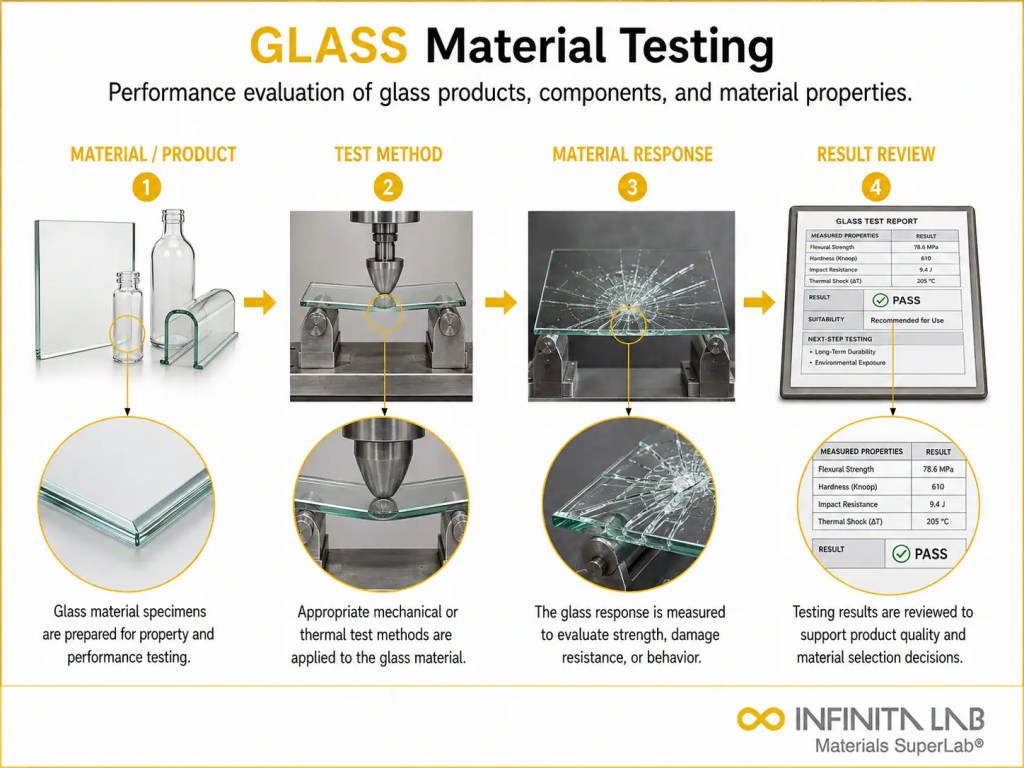


What Is Glass Material?
Glass material testing encompasses the mechanical, thermal, optical, and chemical characterisation of flat glass, container glass, technical glass, and speciality glass products. Testing verifies physical integrity, optical clarity, thermal stability, chemical durability, and compliance with relevant product and safety standards.
This service supports glass manufacturers, glazing specifiers, construction project teams, and glass product developers in qualifying materials, ensuring regulatory compliance, and characterising glass performance for structural, optical, and speciality applications.
Applications and Benefits of Glass Material Testing
Scope
Glass material testing involves a comprehensive evaluation of its mechanical, thermal, chemical, and optical characteristics to ensure performance, durability, and application suitability. These tests help determine how glass behaves under stress, temperature variations, and environmental exposure.
Key areas of evaluation include:
- Mechanical properties: Flexural strength, hardness, and fracture toughness
- Thermal properties: Coefficient of Thermal Expansion (CTE), softening point, annealing point, and glass transition temperature
- Chemical durability: Resistance to hydrolytic reactions and acid/alkali attack
- Optical properties: Transmittance, reflectance, haze, and refractive index
- Dimensional and surface quality: Thickness uniformity, flatness, and surface defects
Applications
- Architectural and safety glass qualification (EN 12150, ASTM C1048)
- Pharmaceutical glass container chemical durability (ISO 4802, USP <660>)
- Optical glass characterisation for lenses and windows
- Technical glass for electronics, solar, and display applications
- Speciality and borosilicate glass materials development
Benefits
- Ensures compliance with building codes and product standards
- Supports glass qualification for pharmaceutical and medical use
- Provides data for structural glass design
- Enables comparative assessment of different glass compositions
Our Testing Procedure
Specimen Preparation
Cut and polish samples; treat edges to avoid stress artifacts.
1Mechanical Testing
Measure strength, hardness, and fracture toughness.
2Thermal Analysis
Determine Tg, CTE, and softening/annealing points.
3Chemical & Optical Testing
Evaluate durability and optical properties.
4Glass Material Testing - Technical Specifications
| Parameter | Details |
|---|---|
| Mechanical Tests | Flexural strength, hardness (HV), fracture toughness (MPa√m) |
| Thermal Range | Tg typically 450–850 °C (composition dependent) |
| CTE Range | 3–10 × 10⁻⁶/°C |
| Optical Transmittance | UV-VIS-NIR range (200–2500 nm) |


- 4-point bending fixture and UTM
- Vickers hardness tester (microhardness)
- DSC, TMA, and dilatometer for thermal analysis
- UV-VIS-NIR spectrophotometer (transmittance, reflectance)
- Autoclave and chemical extraction apparatus (ISO 719/720)
- Abbe refractometer
Equipment and Instrumentation Used for Testing
What You Receive: Test Report, Data, and Certification
- Flexural strength, hardness, and fracture toughness values
- Glass transition temperature and CTE
- Hydrolytic resistance class (ISO 719/720 Grade HGB 1–5)
- Optical transmittance spectrum and haze value
- Refractive index (nd)
- Full glass material characterisation report
Glass Material FAQs
Under examination conditions, note any spots, pinholes, and scratches that are visually disturbing. For spots/pinholes, measure the size and note the number relative to the pane size. If any clusters are found, their position relative to the through-vision area shall be determined.
Two standard testing procedures for obtaining glass strength data are the four-point bending or coaxial double-ring tests on monolithic glass specimens. The tensile strength of a sample is then determined from the tension stresses at failure.
Heat-resistant glass is a widely used type that can retain its shape without breaking in temperatures up to approximately 932°F (500°C). Heat-resistant glass-ceramic materials can withstand temperatures up to approximately 1,800°F (1,000°C).
Annealed glass is standard float glass with no residual stress. Heat-strengthened glass (2–4× stronger than annealed) is partially thermally treated. Tempered (toughened) glass has high surface compressive stresses (3–5× stronger) and breaks into small, blunt fragments for safety.
Yes. Standard glass testing specimens are cut from flat glass panels, tubing, or containers using diamond-tipped tools. Edge quality after cutting is critical for mechanical testing — poorly cut edges introduce flaws that underestimate true material strength.
Glass testing evaluates the physical, mechanical, chemical, and optical properties of glass to determine its quality and suitability for specific applications. Depending on the product, tests may include flexural strength testing, impact resistance, thermal shock resistance, chemical durability, and optical measurements. Specimens are examined using appropriate laboratory equipment and standardized methods, and the results are compared with applicable specifications to assess performance, safety, and durability.
Why Choose Infinita Lab for Glass Material Testing
When your Glass Material results have to hold up - for compliance, a customer audit, or an engineering decision - accuracy and an unbiased third-party report matter more than price. Infinita Lab routes your glass material testing to ISO/IEC 17025-accredited U.S. partner labs with hands-on method experience, so you get defensible data, transparent reporting, and turnaround times built around your project deadline - not ours.

Looking for an Accredited Partner for Glass Material Testing?
Send query us at hello@infinitalab.com or call us at (888) 878-3090 to learn more about our services and how we can support you.



