

What Is California Bearing Ratio CBR?
California Bearing Ratio (CBR) testing evaluates the strength of subgrade soils and base materials by measuring their resistance to penetration under controlled conditions. It is a fundamental parameter for pavement design and load-bearing capacity assessment.
This test is widely used in road construction and geotechnical engineering to determine the suitability of soil for supporting traffic loads. It helps in selecting appropriate pavement thickness and improving foundation stability.

Applications and Benefits of California Bearing Ratio CBR Testing
Scope
CBR testing defines procedures to determine the penetration resistance of compacted soil or aggregate samples using a standard plunger under specified loading conditions. It evaluates load-bearing capacity and deformation behavior.
The method supports pavement design and soil classification.
- Measurement of penetration resistance of soil and base materials
- Evaluation of subgrade strength under load
- Assessment of soaked and unsoaked soil conditions
- Determination of load–penetration relationship
- Comparison with standard crushed stone reference values
- Standardized method for pavement design
Applications
- Road and highway pavement design
- Airport runway subgrade evaluation
- Railway track foundation analysis
- Embankment and sub-base material testing
- Soil stabilization studies
- Construction quality control
- Geotechnical investigations
Benefits
- Provides reliable soil strength evaluation
- Supports accurate pavement thickness design
- Reduces risk of structural failure
- Improves foundation stability and performance
- Enables comparison of different soil types
- Assists in material selection and optimization
Our Testing Procedure
Sample Preparation
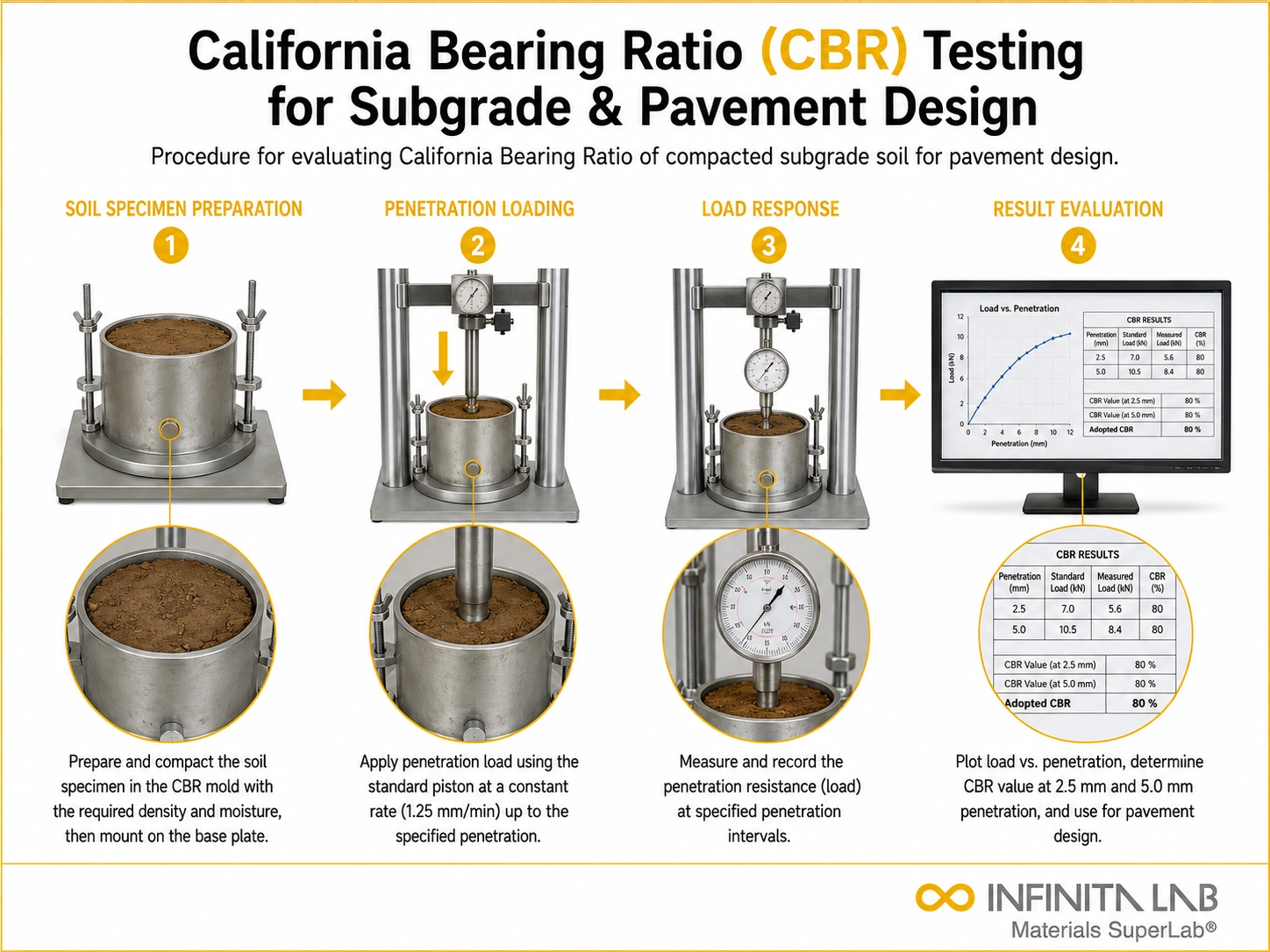
Soil is compacted into a mould at specified moisture content and density, with soaked or unsoaked conditions prepared based on test requirements.
1Conditioning
For soaked tests, the specimen is submerged for a defined period to simulate worst-case field moisture conditions before testing.
2Penetration Testing
A standard plunger penetrates the sample at a constant rate while load is recorded against penetration depth.
3Result Calculation
Measured load values are compared with standard values to calculate the CBR percentage representing soil strength.
4CBR Test – Technical Specification
| Parameter | Details |
|---|---|
| Standard | ASTM D1883 / IS 2720 (Part 16) |
| Sample Type | Soil, subgrade, and granular materials |
| Sample Condition | Compacted at specified moisture and density |
| Loading Type | Controlled penetration at constant rate |
| Environmental Conditions | Controlled moisture and temperature |
| Measurement Units | CBR (%), load (kN), penetration (mm) |


- CBR testing machine
- Penetration plunger
- Loading frame
- Dial gauges or displacement sensors
- Proving ring or load cell
- Soaking tank
- Compaction mould and rammer
- Weighing balance
- Moisture content apparatus
Equipment and Instrumentation Used for Testing
What You Receive: Test Report, Data, and Certification
- CBR value (%) for soaked and unsoaked conditions
- Load vs penetration curve
- Subgrade strength classification
- Pavement design input data
- Test report as per standards
- Soil performance evaluation
- Recommendations for stabilization or improvement
- Quality control documentation
California Bearing Ratio CBR FAQs
CBR quantifies soil resistance to penetration relative to a standard crushed stone, providing an empirical index that correlates with load-bearing capacity, enabling engineers to design pavement thickness based on expected traffic loads and subgrade strength.
Soaked conditions simulate worst-case field scenarios where soil strength reduces due to water saturation, ensuring conservative and safer pavement design against potential weakening during rainy or high-moisture conditions.
CBR is based on comparative penetration resistance rather than intrinsic soil mechanics parameters, making it a practical index rather than a fundamental material property.
The 2.5 mm penetration generally provides the most consistent and representative resistance value for most soils, though 5 mm values may be used if they are higher.
stress and shear strength, lowering CBR values, while optimum moisture enhances compaction efficiency and improves resistance to penetration.
The AASHTO California Bearing Ratio (CBR) test evaluates the strength of soil and aggregate materials used in road subgrades, subbases, and base courses. A compacted soil specimen is penetrated with a standard plunger, and the required load is compared with a reference load to calculate the CBR value.
ASTM D1883 determines the California Bearing Ratio (CBR) of laboratory-compacted soils. The specimen is compacted at a specified moisture content and density, soaked when required, and penetrated with a standard plunger. The measured load and penetration are used to calculate the CBR, indicating the material's suitability for pavement construction.
CBR compaction involves placing soil in a mold and compacting it to a specified dry density and moisture content. The prepared specimen is then tested for penetration resistance according to ASTM D1883. Compaction conditions are generally based on ASTM D698 or ASTM D1557, depending on the required compactive effort.
Why Choose Infinita Lab for California Bearing Ratio CBR Testing
When your California Bearing Ratio CBR results have to hold up - for compliance, a customer audit, or an engineering decision - accuracy and an unbiased third-party report matter more than price. Infinita Lab routes your california bearing ratio CBR testing to ISO/IEC 17025-accredited U.S. partner labs with hands-on method experience, so you get defensible data, transparent reporting, and turnaround times built around your project deadline - not ours.

Looking for an Accredited Partner for California Bearing Ratio CBR Testing?
Send query us at hello@infinitalab.com or call us at (888) 878-3090 to learn more about our services and how we can support you.