


ASTM E70: Aqueous Solution Ph Glass Electrode Testing Services
Accredited ASTM E70 aqueous solution ph glass electrode testing from Infinita Lab, performed to the exact standard requirements - accurate, reproducible results with full documentation for compliance, R&D, and quality control programs.
TRUSTED BY


Get ASTM E70 compliant results - request your aqueous solution ph glass electrode testing quote
- Overview
- Scope, Applications, and Benefits
- Test Process
- Specifications
- Instrumentation
- Results and Deliverables
What Is ASTM E70 Aqueous Solution Ph Glass Electrode?
ASTM E70, Standard Test Method for pH of Aqueous Solutions With the Glass Electrode, defines the apparatus, calibration requirements, and procedures for determining the pH of water-based solutions through electrometric measurement. The method relies on a glass membrane electrode that develops a small voltage in proportion to the hydrogen ion activity of the solution it contacts. The method measures this voltage against a stable reference electrode, and a pH meter converts the resulting electrical potential into a readable pH value on the familiar 0-14 scale. Because the glass electrode response is a well-characterised function of hydrogen ion activity, the method provides a reliable, reproducible way to quantify acidity or alkalinity without relying on colour-based indicators.
pH is one of the most fundamental parameters in chemistry, and it influences chemical reactivity, material corrosivity, solubility, and biological activity across nearly every industry that handles liquids or aqueous formulations. An inaccurate pH reading can lead to ineffective chemical reactions, accelerated equipment corrosion, unstable formulations, or noncompliant discharge of process water. ASTM E70 addresses these risks by standardising electrode calibration against buffer solutions of known pH, controlling for temperature effects on electrode response, and defining the conditions for accurate, defensible results.
Infinita Lab’s accredited testing network performs ASTM E70 pH testing for manufacturers, environmental programs, and quality control teams that need confidence in their aqueous solution chemistry. Whether the sample is a raw material, an in-process solution, a finished product, or an environmental water sample, our glass electrode testing delivers accurate, standardised pH data to support internal quality decisions and external regulatory reporting.

Applications and Benefits of ASTM E70 Aqueous Solution Ph Glass Electrode Testing
Scope
- ASTM E70 measures the pH of aqueous solutions using the electrometric glass electrode method rather than colorimetric indicators.
- The test relies on a glass membrane electrode that generates a voltage proportional to hydrogen ion activity when immersed in the test solution.
- That voltage is measured relative to a reference electrode, and a calibrated pH meter converts the potential difference into a pH value.
- Instrument calibration uses standard buffer solutions of known, traceable pH, typically selected to bracket the expected sample pH.
- Because electrode response and solution pH are both temperature-dependent, calibration and sample measurement are performed under controlled temperature conditions.
- The method is generally applicable to aqueous solutions, including those with colour, turbidity, or suspended matter that would interfere with colorimetric pH methods.
- ASTM E70 is used across water and wastewater testing, chemical manufacturing, industrial process monitoring, environmental testing, and raw material quality control.
- The standard does not govern how the test solution itself is prepared, only how its pH is measured once presented for testing.
- Reliable measurements depend on proper electrode conditioning, adequate sample volume, and stabilising the electrode signal before recording a reading.
- Results generated under this method support product release testing, process control decisions, regulatory compliance reporting, and formulation development.
Applications
- Determining the pH of drinking water, surface water, groundwater, and wastewater samples for quality and compliance monitoring.
- Verifying the pH of industrial process solutions used in manufacturing, plating, and chemical treatment operations.
- Supporting quality control testing of raw materials and finished products in chemical manufacturing.
- Testing aqueous raw materials and formulations used in paints, coatings, and related industrial products.
- Monitoring effluent and treated wastewater pH before discharge for environmental compliance.
- Assessing pH stability of aqueous solutions during product development and formulation work.
- Providing pH data to support corrosion control, treatment chemical dosing, and process troubleshooting.
Benefits
- Provides an accurate, electrode-based pH measurement unaffected by sample colour or turbidity.
- Delivers reproducible results through standardised calibration against traceable buffer solutions.
- Accounts for temperature effects on pH, reducing a common source of measurement error.
- Supports regulatory and quality documentation with a widely recognised, industry-accepted ASTM method.
- Applicable across a broad range of aqueous sample types and industries.
- Generates objective, quantitative data that supports process control and product quality decisions.
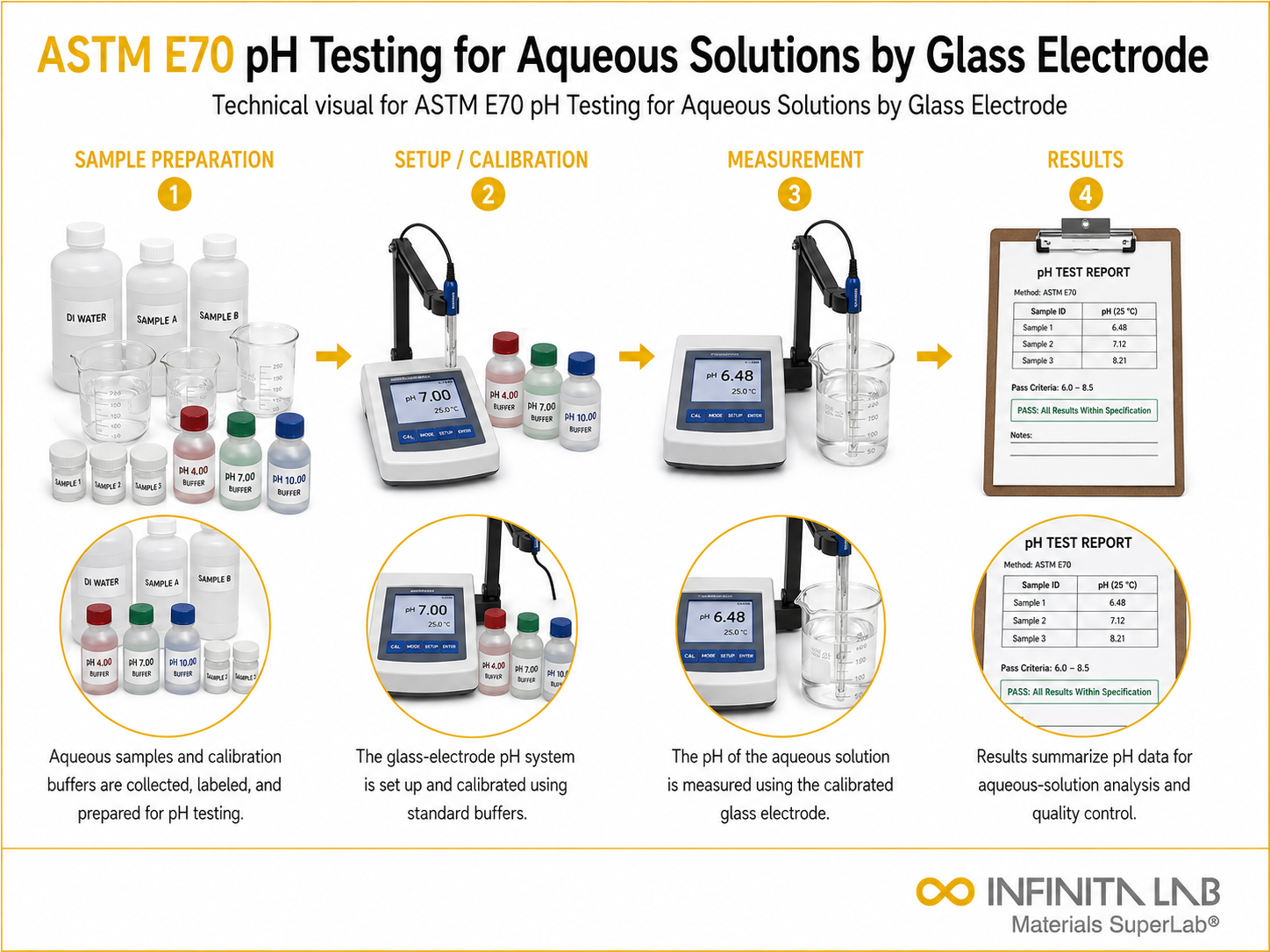
Our ASTM E70 Testing Procedure
Calibration
The pH meter is calibrated using two standard buffer solutions to ensure accuracy before testing.
1Electrode Preparation
The glass and reference electrodes are properly cleaned, dried, and prepared for immersion.
2Sample Measurement
The test solution is placed in a clean container, the electrodes are immersed, and a preliminary pH reading is obtained.
3Stabilization and Recording
The reading is allowed to stabilize (drift ≤ 0.01 pH units within 1–2 minutes), after which the final, stable pH value is recorded.
4ASTM E70 Test Parameters and Requirements
| Parameter | Details |
|---|---|
| Applicable Materials | Aqueous and slightly buffered solutions |
| Calibration Requirement | Two standard buffer solutions |
| Electrode Requirement | High-alkalinity glass electrode |
| Electrode Performance Criteria | Potential difference within ±3 mV at pH 12.8 compared to pH 9.18 |
| Repeatability | ±0.02 pH units |
| Drift Requirement | Less than 0.01 pH units in 1–2 minutes |
| Output Units | pH (reported to nearest 0.01 unit) |
| Temperature Reporting | Reported to nearest 1°C |


- Glass pH Electrode – Generates a voltage proportional to hydrogen ion activity in the sample solution.
- Reference Electrode – Provides a stable electrochemical reference against which the glass electrode’s potential is measured.
- pH Meter – Converts the measured voltage into a displayed pH value on the 0- 14 scale.
- Calibration Buffer Solutions – Standard solutions of known pH used to calibrate the electrode system before testing.
- Thermometer / Temperature Probe – Monitors sample and buffer temperature to account for pH’s temperature dependence.
- Magnetic Stirrer – Provides gentle, consistent agitation to promote a stable electrode reading.
- Laboratory Glassware – Beakers and sample containers used to hold buffer solutions and test samples during measurement.
Equipment and Instrumentation Used for ASTM E70 Testing
What You Receive: Test Report, Data, and Certification
- A formal test report documenting the measured pH value(s) of the submitted aqueous solution.
- Sample temperature recorded at the time of measurement, alongside the reported pH result.
- Calibration data confirming the buffer solutions and conditions used to standardise the electrode system.
- Replicate measurement results demonstrating the repeatability of the reported pH value.
- Clear reference to the ASTM E70 test method and the conditions under which testing was performed.
- Supporting documentation suitable for quality control records, regulatory submissions, or product specification files.
Frequently Asked Question
ASTM E70 describes detailed procedures for precise pH determination with glass electrodes. The standard outlines requirements for calibration, temperature control, and buffer solution use to ensure reliable pH information for important chemical processes in industry.
The response of a glass electrode depends on temperature, and this is based on electrochemical principles. The ASTM E70 standard requires temperature compensation, usually at 25 °C, to prevent any form of bias in the measurements.
ASTM E70 is designed for aqueous solutions and miscible systems with water. Non-aqueous or highly viscous samples may affect the electrode response, which may need different approaches or specific electrodes to prevent junction potential and instability in measurement.
ASTM E70 specifies multi-point calibration with standard buffer solutions that bracket the anticipated pH of the samples. Calibration of the electrode slope and offset is necessary to ensure that the sensitivity, stability, and repeatability of the measurements are correct.
For accurate results of ASTM E70 pH testing, it is important to maintain the electrodes properly. Drifting, slow response, and erroneous results are obtained when the glass membrane of the electrode is dehydrated or contaminated.
ASTM E70 is the Standard Test Method for pH of Aqueous Solutions With the Glass Electrode. It specifies electrometric procedures for measuring the pH of aqueous solutions using a glass electrode and suitable pH meter.
A calibrated glass electrode is immersed in the aqueous sample, and the resulting electrical potential is measured by a pH meter. The potential is converted into a pH value, indicating the solution’s acidity or alkalinity.
Why Choose Infinita Lab for Aqueous Solution Ph Glass Electrode Testing
When your Aqueous Solution Ph Glass Electrode results have to hold up - for compliance, a customer audit, or an engineering decision - ASTM E70 accuracy and an unbiased third-party report matter more than price. Infinita Lab routes your ASTM E70 aqueous solution ph glass electrode testing to ISO/IEC 17025-accredited U.S. partner labs with hands-on method experience, so you get defensible data, transparent reporting, and turnaround times built around your project deadline - not ours.

Need ASTM E70 Aqueous Solution Ph Glass Electrode Testing You Can Rely On?
Send query us at hello@infinitalab.com or call us at (888) 878-3090 to learn more about our services and how we can support you.



Request a Quote
Submit your material details and receive testing procedures, pricing, and turnaround time within 24 hours.
 Quick Turnaround and Hasslefree process
 Confidentiality Guarantee
 Free, No-obligation Consultation
 100% Customer Satisfaction
