


ASTM E643: Ball Punch Deformation Metal Sheet Testing Services
This test method ASTM E643 − 09 explains how to perform a ball punch deformation test on metallic sheet materials. It's designed for use in shaping applications. The test is applicable to a certain group of specimens with thicknesses ranging from 0.008 to 0.080 in. The figures given in inch-pound units are to be taken as the industry standard
TRUSTED BY


Get ASTM E643 compliant results — request your ball punch deformation metal sheet testing quote
- Overview
- Scope, Applications, and Benefits
- Test Process
- Specifications
- Instrumentation
- Results and Deliverables
What Is ASTM E643 Ball Punch Deformation Metal Sheet?
ASTM E643 – 09 defines a method for evaluating the deformation behavior of metallic sheet materials using a ball punch test. The method measures the force and displacement required to deform a sheet specimen until fracture, providing insight into formability and ductility.
This standard is widely used for thin sheet materials where conventional tensile testing is difficult or impractical. It helps characterize material response under biaxial stress conditions, making it highly relevant for forming operations, material selection, and failure analysis in sheet metal applications.

Applications and Benefits of ASTM E643 Ball Punch Deformation Metal Sheet Testing
Scope
ASTM E643 establishes procedures for determining the deformation characteristics of metallic sheet materials using a hemispherical punch. It evaluates material behavior under localized biaxial loading conditions.
The method is particularly useful for thin sheets and small samples where standard tensile testing cannot be applied. It provides information on ductility, strength, and fracture resistance during forming processes.
- Applicable to thin metallic sheet materials
- Evaluates deformation under biaxial stress conditions
- Measures load-displacement response during punching
- Suitable for small or irregular specimen sizes
- Supports assessment of formability and ductility
- Enables comparison of material performance in forming operations
Applications
- Sheet metal formability evaluation
- Automotive and aerospace sheet material testing
- Quality control of rolled metal sheets
- Failure analysis in forming operations
- Material selection for stamping processes
- Research on deformation behavior of thin metals
- Evaluation of anisotropy effects in sheets
- Process optimization in metal forming
Benefits
- Suitable for thin and small specimens
- Simulates biaxial deformation conditions
- Provides detailed load-displacement data
- Helps predict formability and fracture behavior
- Reduces material usage compared to tensile tests
- Enables evaluation of anisotropic properties
- Supports quality control and material comparison
- Improves reliability of forming process design
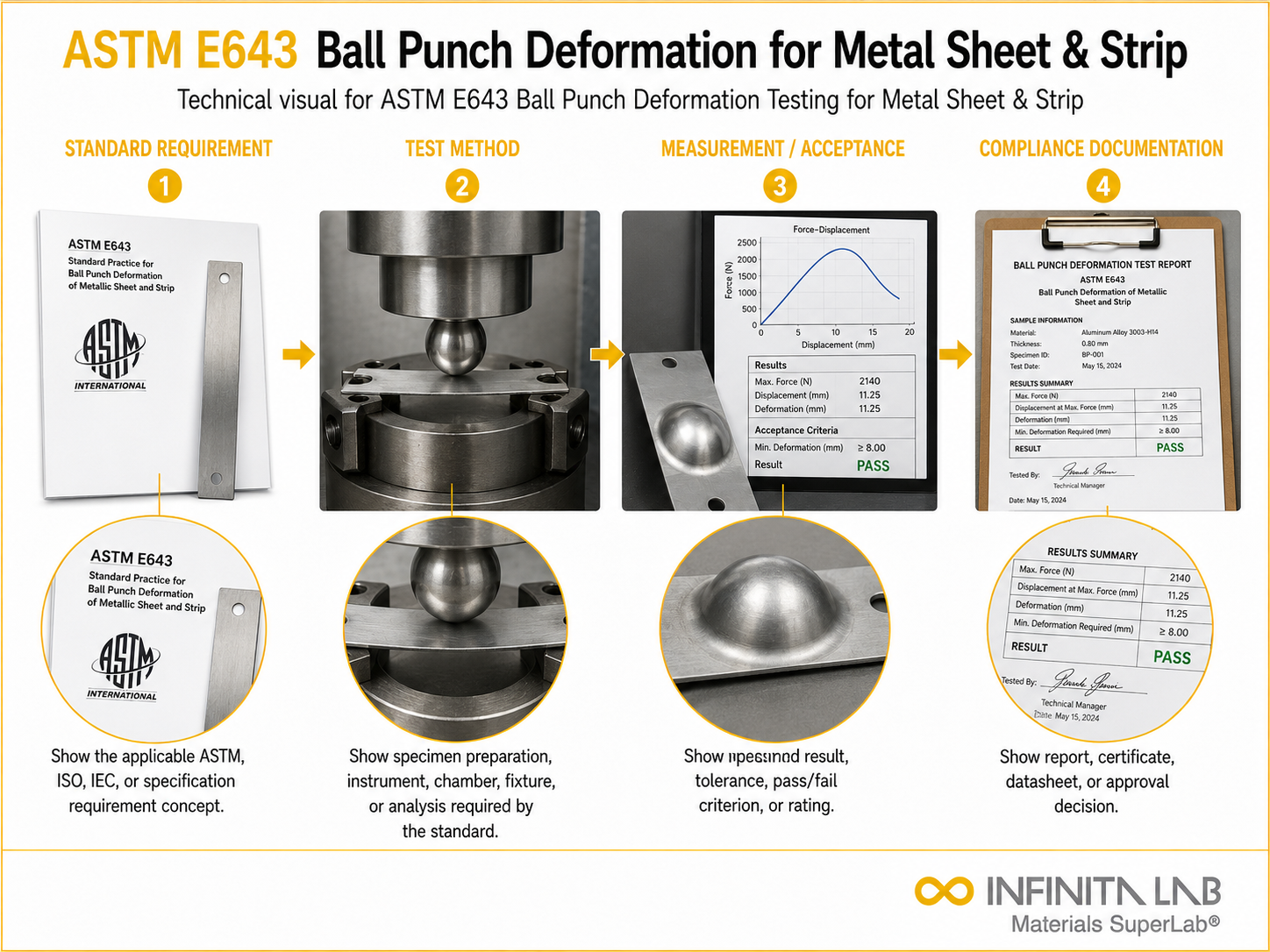
Our ASTM E643 Testing Procedure
Specimen Preparation
Prepare flat sheet specimens with defined dimensions ensuring smooth surfaces and absence of defects.
1Fixture Setup
Clamp specimen securely in test fixture with proper alignment of hemispherical punch.
2Punch Loading
Apply controlled force through ball punch to deform specimen until fracture while recording load and displacement.
3Data Analysis
Analyze load-displacement curve to determine deformation characteristics and fracture behavior.
4ASTM E643 Test Parameters and Requirements
| Parameter | Details |
|---|---|
| Standard | ASTM E643 – 09 |
| Method | Ball punch deformation testing |
| Measurement Type | Load vs displacement response |
| Sample Type | Thin metallic sheet specimens |
| Loading Type | Biaxial deformation using hemispherical punch |
| Units | Force (N), Displacement (mm) |


- Ball punch testing machine with controlled loading capability
- Hemispherical punch and die assembly
- Load cell for precise force measurement
- Displacement measurement device (LVDT or extensometer)
- Data acquisition system for recording load-displacement curves
- Specimen clamping fixture ensuring proper alignment
Equipment and Instrumentation Used for ASTM E643 Testing
What You Receive: Test Report, Data, and Certification
- Load versus displacement curve for each specimen
- Maximum load and corresponding displacement values
- Fracture point and deformation characteristics
- Comparative formability assessment of materials
- Test conditions and calibration details
- Final analytical test report
ASTM E643 Ball Punch Deformation Metal Sheet FAQs
ASTM E643 uses a hemispherical punch to deform the sheet in multiple directions simultaneously, creating a biaxial stress state that more closely represents real forming operations compared to uniaxial tensile loading conditions.
Thin sheets may be difficult to grip or may buckle during tensile testing, whereas the ball punch method provides stable deformation and reliable measurement of formability and ductility using small specimens.
The curve reflects elastic and plastic deformation behavior, with maximum load and displacement indicating material strength and ductility, helping assess forming limits and fracture resistance.
The hemispherical shape ensures uniform stress distribution and controlled deformation, influencing strain distribution and fracture characteristics in the specimen.
It helps identify deformation limits and fracture characteristics, supporting root cause analysis of forming failures.
Why Choose Infinita Lab for Ball Punch Deformation Metal Sheet Testing?
At the core of this breadth is our network of 2,000+ accredited laboratories across the USA, offering access to over 10,000 testing methods and analytical services. From advanced materials characterization (SEM, TEM, RBS, XPS) to mechanical, chemical, environmental, biological, and standardized ASTM/ISO-compliant testing, we deliver unmatched flexibility, specialization, and scale. You are never limited by geography, facility, or methodology — Infinita Lab connects you to the right expertise and testing solution, every time.

Need ASTM E643 Ball Punch Deformation Metal Sheet Testing You Can Rely On?
Send query us at hello@infinitalab.com or call us at (888) 878-3090 to learn more about our services and how we can support you.



Request a Quote
Submit your material details and receive testing procedures, pricing, and turnaround time within 24 hours.
 Quick Turnaround and Hasslefree process
 Confidentiality Guarantee
 Free, No-obligation Consultation
 100% Customer Satisfaction
