


ASTM E423: Spectral Emittance Testing Services
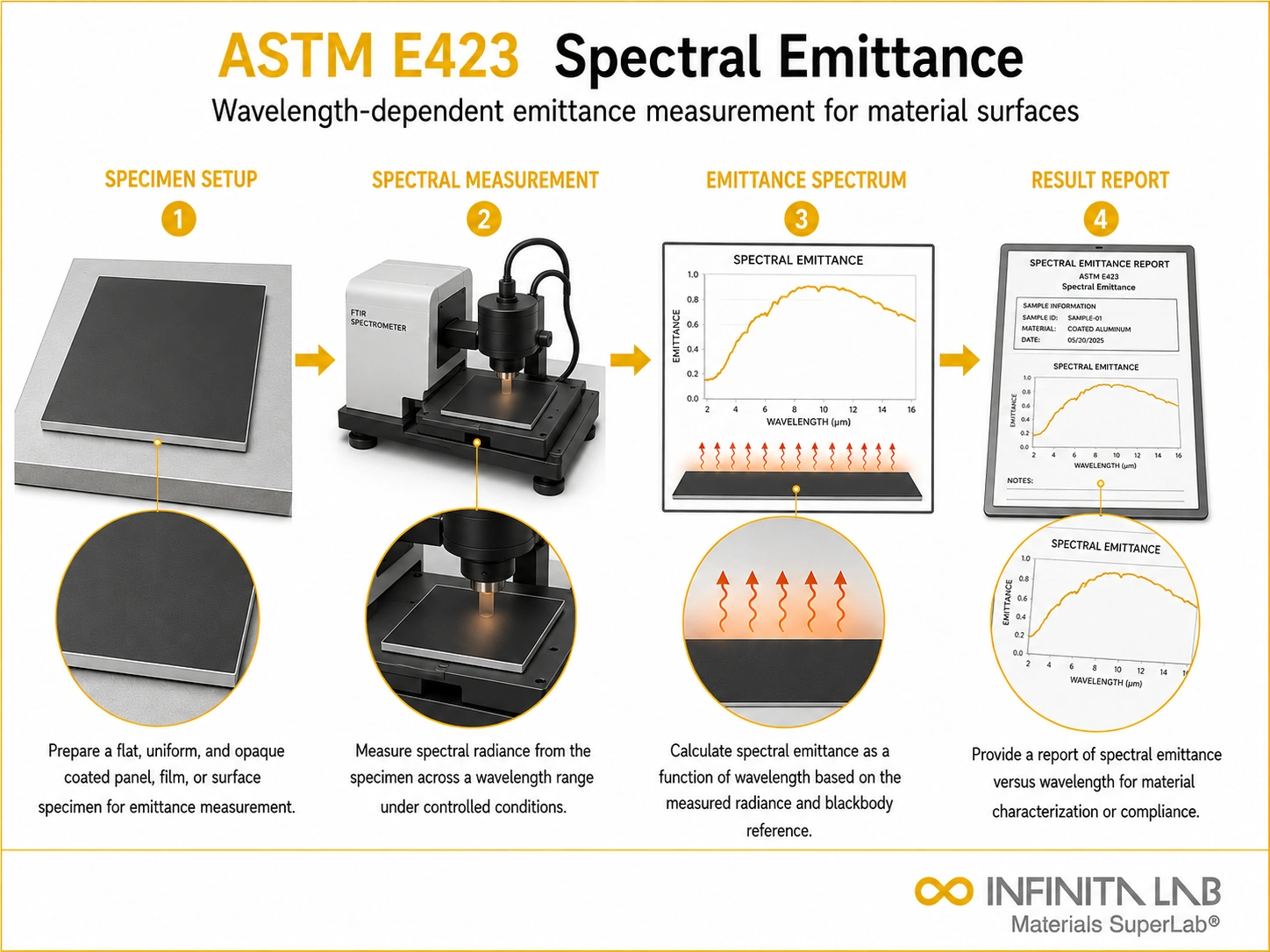
ASTM E423 test method specifies an accurate method for determining the normal spectral emittance of electrically nonconducting materials at temperatures ranging from 1000 to 1800 K and wavelengths ranging from 1 to 35 m. This test method necessitates the use of particular specimen size and design, as well as particular heating and viewing procedure.
TRUSTED BY


Get ASTM E423 compliant results — request your spectral emittance testing quote
- Overview
- Scope, Applications, and Benefits
- Test Process
- Specifications
- Instrumentation
- Results and Deliverables
What Is ASTM E423 Spectral Emittance?
ASTM E423 is the standard test method for determining the normal spectral emittance of electrically nonconducting materials at elevated temperatures. Spectral emittance is the ratio of the radiant energy emitted by a material at a specific wavelength and temperature to that emitted by a perfect blackbody under the same conditions. It is a fundamental thermal-optical property that governs how a material radiates heat – critical for any material used in high-temperature environments where radiative heat transfer is significant.
The method is specifically suited to electrically nonconducting materials, particularly ceramic oxides, which present unique measurement challenges due to their low thermal conductivity and partial transparency at certain wavelengths and depths. The test heats the specimen to a defined elevated temperature and measures the energy it radiates at specific wavelengths, comparing this to a reference blackbody at the same temperature to derive the normal spectral emittance.
ASTM E423 covers a temperature range of approximately 1000 to 1800 K and a wavelength range of 1 to 35 µm. It requires specific specimen geometry, controlled heating, and a defined viewing arrangement to obtain accurate results. The data is essential for thermal design and performance evaluation of refractory ceramics, thermal protection materials, and other nonconducting materials used at high temperatures.

Applications and Benefits of ASTM E423 Spectral Emittance Testing
Scope
ASTM E423 covers the determination of normal spectral emittance of electrically nonconducting specimens at elevated temperatures by comparing the radiant energy emitted by the heated specimen to that of a blackbody reference at the same temperature and wavelength.
Key aspects of the test scope include:
- Temperature range – approximately 1000 to 1800 K, covering the elevated-temperature regime where radiative heat transfer becomes a dominant mechanism
- Wavelength range – 1 to 35 µm, spanning the near- to far-infrared region where most thermal radiation from high-temperature surfaces occurs
- Measurement principle – the normal spectral emittance is determined by the ratio of the specimen’s spectral radiance to that of a blackbody at the same temperature and wavelength, viewed normal to the surface
- Material focus – specifically developed for electrically nonconducting materials, especially ceramic oxides, which have low thermal conductivity and may be partially transparent at certain wavelengths
- Specimen and setup requirements – the method requires specific specimen size and configuration, a defined heating arrangement, and a controlled viewing geometry to obtain valid results
- Blackbody reference – a reference blackbody source at the same temperature provides the comparison baseline for the emittance calculation
Applications
- Refractory and high-temperature ceramics – characterizing the radiative properties of ceramic oxides used in furnaces, kilns, and high-temperature process equipment where heat radiation governs performance
- Thermal protection systems – evaluating spectral emittance of ceramic thermal barrier and protection materials used in aerospace and re-entry applications, where radiative heat management is critical
- Thermal barrier coatings – measuring the emittance of ceramic coating materials that protect underlying components from high-temperature environments
- Furnace and kiln material selection – selecting nonconducting refractory materials based on their radiative behavior at operating temperature
- Energy and power generation – characterizing nonconducting components in high-temperature energy systems where radiative heat transfer affects efficiency and component life
- Materials research and development – generating fundamental spectral emittance data for new ceramic and nonconducting material compositions intended for high-temperature service
- Thermal modeling input – providing the emittance values needed for accurate radiative heat transfer modeling of systems operating at elevated temperatures
Benefits
- Provides emittance data specifically for nonconducting materials – the method is designed to handle the particular challenges of ceramic oxides, including low thermal conductivity and partial transparency, which general emittance methods may not address well
- Covers a wide, high-temperature range – spanning 1000 to 1800 K, the method addresses the temperature regime where radiative heat transfer dominates and accurate emittance data is most needed
- Broad wavelength coverage – the 1 to 35 µm range captures the thermal radiation spectrum relevant to high-temperature surfaces, giving wavelength-resolved emittance rather than a single averaged value
- Direct input to thermal design – spectral emittance values feed directly into radiative heat transfer calculations, enabling accurate thermal design of high-temperature systems and protection materials
- Supports material selection and development – comparative spectral emittance data allows engineers to select or develop nonconducting materials with the radiative behavior required for a given high-temperature application
Our ASTM E423 Testing Procedure
Prepare the Specimen
Size the nonconducting sample, document its surface condition, and position it in the test apparatus.
1Heat the Sample
Raise the specimen to the required temperature and allow it to reach thermal stability.
2Measure Radiance
Measure the specimen’s spectral radiance and compare it with a blackbody reference at the same temperature.
3Calculate and Report
Calculate normal spectral emittance and report it versus wavelength and test temperature.
4ASTM E423 Test Parameters and Requirements
| Parameter | Details |
|---|---|
| Temperature Range | Approximately 1000 to 1800 K |
| Wavelength Range | 1 to 35 µm |
| Material Type | Electrically nonconducting materials, especially ceramic oxides |
| Measurement Principle | Ratio of specimen spectral radiance to blackbody at same temperature/wavelength |
| Viewing Geometry | Normal to the specimen surface |
| Reference | Blackbody source at matched temperature |
| Specimen | Specific size and configuration per the standard |


- High-temperature specimen heating furnace/system
- Reference blackbody source with temperature control
- Spectroradiometer or infrared spectrometer (1–35 µm range)
- Temperature measurement and control instrumentation (optical pyrometer/thermocouples)
- Optical viewing and alignment system (normal-incidence geometry)
- Data acquisition and emittance calculation system
Equipment and Instrumentation Used for ASTM E423 Testing
What You Receive: Test Report, Data, and Certification
- Spectral emittance report – normal spectral emittance as a function of wavelength across the 1–35 µm range at the specified test temperature(s)
- Emittance versus wavelength curve – plotted spectral emittance data showing how emittance varies across the measured wavelength range
- Test temperature record – the elevated temperature(s) at which the emittance was measured, with confirmation of temperature stability
- Blackbody reference data – reference measurements supporting the emittance ratio calculation
- Specimen records – material description, specimen geometry, surface condition, and any preparation performed
- Measurement conditions – heating arrangement, viewing geometry, and instrument configuration used during the test
ASTM E423 Spectral Emittance FAQs
Normal spectral emittance is the ratio of radiation emitted by a material to that emitted by an ideal blackbody at the same temperature and wavelength. The measurement is made perpendicular to the specimen surface.
The method is intended for electrically nonconducting materials, particularly ceramics, refractory oxides and thermal-protection materials. It is especially useful for materials with low thermal conductivity that may be partially translucent.
ASTM E423 covers specimen temperatures from approximately 1000 K to 1800 K, equivalent to about 727°C to 1527°C. The material must remain stable throughout the selected test temperature.
The method measures spectral emittance over wavelengths from approximately 1 to 35 µm. This range covers much of the infrared radiation emitted by materials at elevated temperatures.
Radiation emitted by the heated specimen is compared with radiation from a reference blackbody at nearly the same temperature. A spectrometric system records the radiation intensity at selected wavelengths.
Why Choose Infinita Lab for Spectral Emittance Testing?
At the core of this breadth is our network of 2,000+ accredited laboratories across the USA, offering access to over 10,000 testing methods and analytical services. From advanced materials characterization (SEM, TEM, RBS, XPS) to mechanical, chemical, environmental, biological, and standardized ASTM/ISO-compliant testing, we deliver unmatched flexibility, specialization, and scale. You are never limited by geography, facility, or methodology — Infinita Lab connects you to the right expertise and testing solution, every time.

Looking for an Accredited Partner for ASTM E423 Spectral Emittance Testing?
Send query us at hello@infinitalab.com or call us at (888) 878-3090 to learn more about our services and how we can support you.



Request a Quote
Submit your material details and receive testing procedures, pricing, and turnaround time within 24 hours.
 Quick Turnaround and Hasslefree process
 Confidentiality Guarantee
 Free, No-obligation Consultation
 100% Customer Satisfaction
