


ASTM E3098: Shape Memory Alloy Pre Strain Thermal Recovery Testing Services
ASTM E3098 test method determines the heating and cooling effect of transformation on the Shape Memory Alloys. The calculation of residual strain after loading and unloading, recovered and unrecovered strain upon heating and cooling, and transformation temperatures are covered in this method. The SI units are considered to be the standard of measurement.
TRUSTED BY


Get ASTM E3098 compliant results — request your shape memory alloy pre strain thermal recovery testing quote
- Overview
- Scope, Applications, and Benefits
- Test Process
- Specifications
- Instrumentation
- Results and Deliverables
What Is ASTM E3098 Shape Memory Alloy Pre Strain Thermal Recovery?
ASTM E3098 describes a standard test method for evaluating the thermal recovery behavior of shape memory alloys (SMAs) after uniaxial pre-strain. This method assesses the material’s ability to recover its deformation upon heating, a fundamental characteristic of the shape memory effect.
Shape memory alloys, such as nickel-titanium (NiTi), are widely used in applications requiring controlled deformation and recovery. This standard provides a reliable approach to quantify recovery strain, transformation temperatures, and material performance under thermomechanical loading conditions.

Applications and Benefits of ASTM E3098 Shape Memory Alloy Pre Strain Thermal Recovery Testing
Scope
ASTM E3098 outlines procedures for applying pre-strain to SMAs followed by thermal recovery. It evaluates:
- Recoverable strain
- Residual strain after recovery
- Transformation temperatures (As, Af)
- Shape memory recovery behavior
Applications
ASTM E3098 outlines procedures for applying pre-strain to SMAs followed by thermal recovery. It evaluates:
- Recoverable strain
- Residual strain after recovery
- Transformation temperatures (As, Af)
- Shape memory recovery behavior
Benefits
- Quantifies shape memory recovery performance
- Supports material selection and design optimization
- Helps predict functional behavior in service
- Enables evaluation of residual deformation
- Ensures compliance with material testing standards
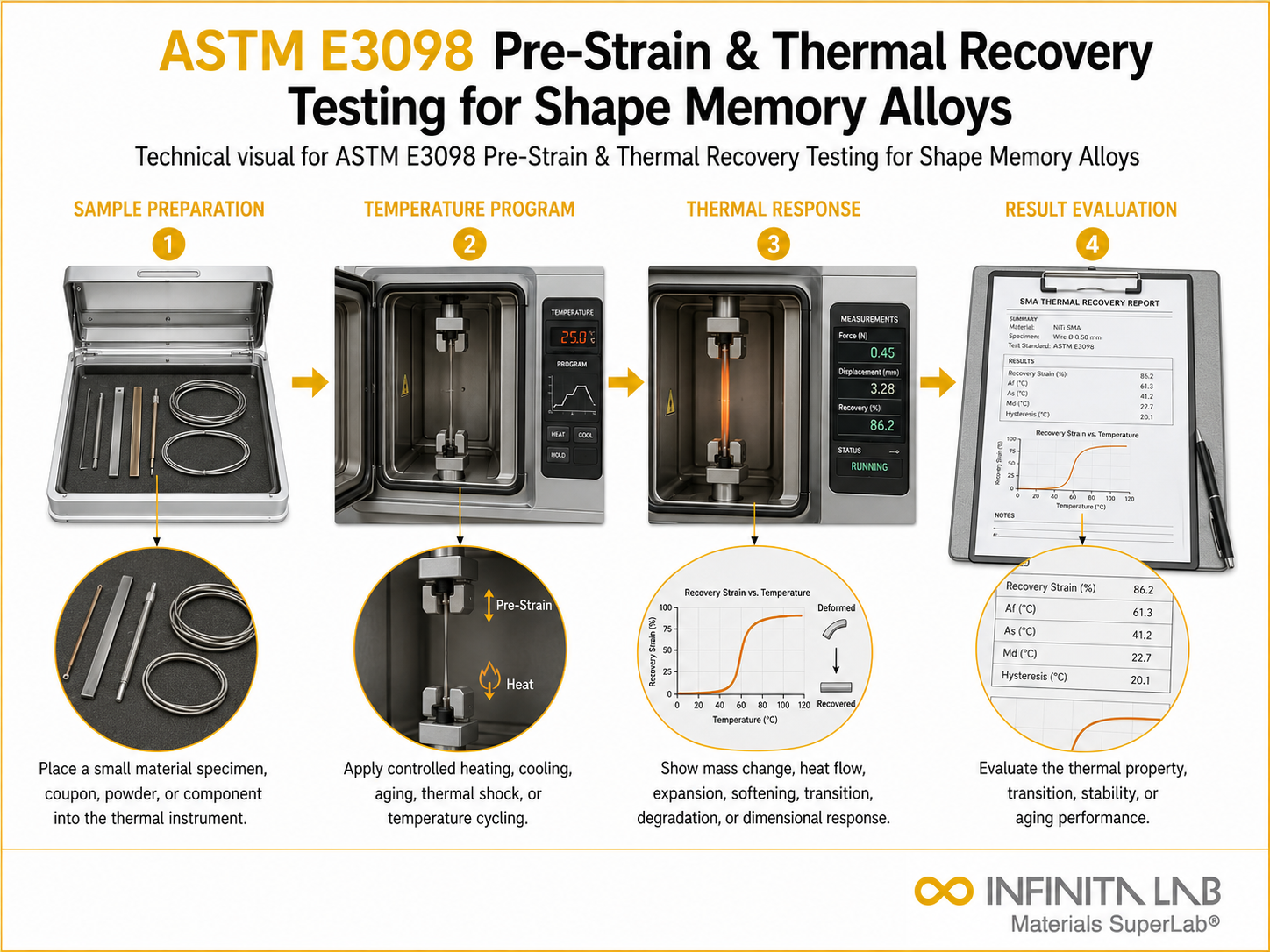
Our ASTM E3098 Testing Procedure
Specimen Preparation
SMA specimen is prepared with defined geometry and mounted in the testing system.
1Pre-strain Application
A controlled uniaxial strain is applied to deform the specimen to a specified level.
2Thermal Heating
The specimen is heated through transformation temperatures to initiate recovery.
3Measurement & Recording
Recovery strain and residual strain are measured and recorded during heating.
4ASTM E3098 Test Parameters and Requirements
| Parameter | Details |
|---|---|
| Applicable MaterialsShape memory alloys (e.g., NiTi and similar alloys) | Shape memory alloys (e.g., NiTi and similar alloys) |
| Pre-strain Level | Typically 1% to 8% depending on material and application |
| Temperature Range | Typically ambient to 150°C depending on alloy composition |
| Measured Outputs | Recovery strain, residual strain, transformation temperatures |
| Loading Type | Uniaxial tensile loading |


- Universal testing machine
- Load frame for controlled strain application
- Environmental chamber or furnace
- Extensometer or strain measurement device
- Thermocouples or temperature sensors
- Data acquisition system
Equipment and Instrumentation Used for ASTM E3098 Testing
What You Receive: Test Report, Data, and Certification
- Recovery strain vs temperature data
- Residual strain values
- Transformation temperature (As, Af)
- Shape memory performance evaluation
- Material behavior analysis reports
- Compliance reports
ASTM E3098 Shape Memory Alloy Pre Strain Thermal Recovery FAQs
It measures the ability of shape memory alloys to recover deformation after being pre-strained and heated, including recovery strain, residual strain, and transformation temperatures, helping evaluate shape memory performance and functional behavior under thermal activation conditions.
This test is important because it determines how effectively a shape memory alloy can return to its original shape after deformation, ensuring reliable performance in applications like biomedical devices, actuators, and smart systems exposed to thermal cycles.
ASTM E3098 is used for shape memory alloys such as nickel-titanium (NiTi) and similar materials that exhibit thermally activated recovery behavior, making them suitable for applications requiring controlled deformation and shape recovery under temperature changes.
The test provides recovery strain, residual strain, and transformation temperatures such as As and Af, which are essential for understanding material performance, deformation recovery capability, and suitability for applications involving repeated thermal activation and mechanical loading.
Industries such as biomedical, aerospace, automotive, and advanced materials use ASTM E3098 to evaluate shape memory alloys for applications including stents, actuators, sensors, and smart components requiring reliable recovery and performance under thermal conditions.
Why Choose Infinita Lab for Shape Memory Alloy Pre Strain Thermal Recovery Testing
At the core of this breadth is our network of 2,000+ accredited laboratories across the USA, offering access to over 10,000 testing methods and analytical services. From advanced materials characterization (SEM, TEM, RBS, XPS) to mechanical, chemical, environmental, biological, and standardized ASTM/ISO-compliant testing, we deliver unmatched flexibility, specialization, and scale. You are never limited by geography, facility, or methodology — Infinita Lab connects you to the right expertise and testing solution, every time.

Looking for an Accredited Partner for ASTM E3098 Shape Memory Alloy Pre Strain Thermal Recovery Testing?
Send query us at hello@infinitalab.com or call us at (888) 878-3090 to learn more about our services and how we can support you.



Request a Quote
Submit your material details and receive testing procedures, pricing, and turnaround time within 24 hours.
 Quick Turnaround and Hasslefree process
 Confidentiality Guarantee
 Free, No-obligation Consultation
 100% Customer Satisfaction
