


ASTM E1618: Fire Debris Ignitable Liquid GC MS Testing Services
ASTM E1618 test method determines the characteristics of extracts with high background levels of pyrolysis or combustion products. The method covers the identification of ignitable liquid residues in extracts from fire debris samples. The final results of this method are displayed keeping in view the international standards and inch-pound units.
TRUSTED BY


Get ASTM E1618 compliant results — request your fire debris ignitable liquid GC MS testing quote
- Overview
- Scope, Applications, and Benefits
- Test Process
- Specifications
- Instrumentation
- Results and Deliverables
What Is ASTM E1618 Fire Debris Ignitable Liquid GC MS?
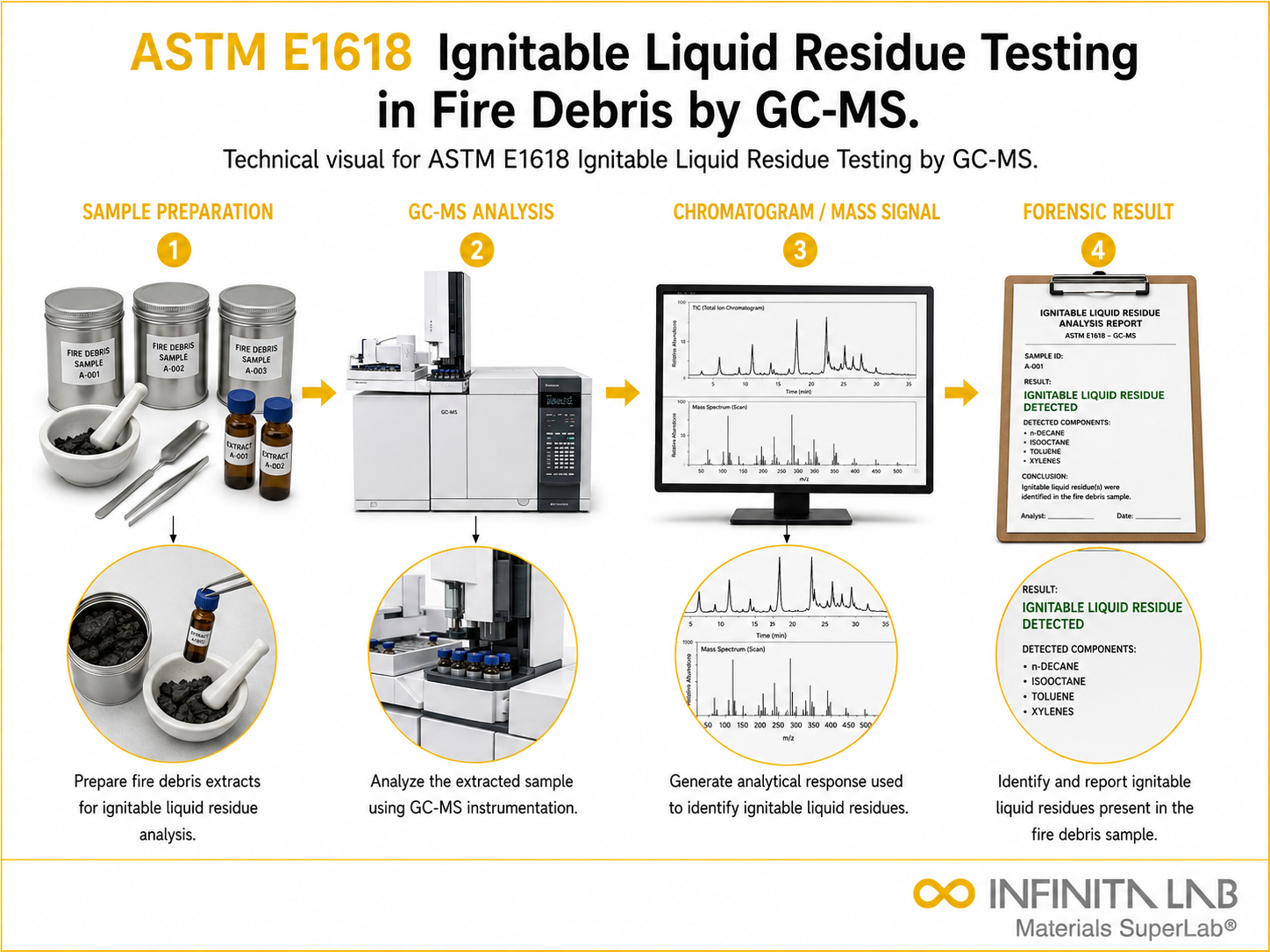
ASTM E1618 is a standard test procedure for the specification and identification of ignitable liquid residues, such as gasoline and kerosene, in fire debris samples. To identify ignitable liquid residues using different procedures, such as Gas Chromatography-Mass Spectrometry (GC-MS). It provides methods for extracting these liquids and analyzing their chemical profiles, including alkalines and aromatics, using GC-MS.
The purpose of this test is to detect and identify residues of flammable liquids in fire debris, which is vital to fire investigation and forensic science.

Applications and Benefits of ASTM E1618 Fire Debris Ignitable Liquid GC MS Testing
Scope
ASTM E1618 focuses on the qualitative analysis of ignitable liquid residues extracted from fire debris. It ensures reliable identification of volatile compounds using GC-MS.
The test evaluates:
- Presence of ignitable liquid residues
- Identification of fuel types
- Chemical composition of residues
- Evidence of accelerants
- Forensic relevance of findings
Applications
- Forensic analysis of fire scenes to detect accelerants (e.g., gasoline, kerosene).
- Supporting investigations into fire origin and cause determinations.
- Assisting with expert testimony in criminal and civil cases involving suspected arson.
- Differentiating between background combustion products and true ignitable liquid residues.
Benefits
- Ensures consistent, reproducible identification of ignitable liquid residues.
- Supports forensic integrity in fire investigations with recognized methodology.
- Helps distinguish fire-related residues from background pyrolysis products.
- Widely accepted in forensic laboratories and legal proceedings.
Our ASTM E1618 Testing Procedure
Sample Receipt
Collect and document fire debris samples in airtight containers
1Sample Preparation
Extract volatile residues using approved solvent or headspace techniques
2Instrument Setup
Configure GC-MS with an appropriate column, temperature program, and MS parameters
3Reporting
Document results, observations, and limitations in the final report
4ASTM E1618 Test Parameters and Requirements
| Parameter | Details |
|---|---|
| Sample Type | Fire debris extracts |
| Target Analytes | Ignitable liquid residues (petroleum & non-petroleum) |
| Extraction Techniques | Solvent extraction / Headspace methods |
| Ionization Energy | 70 eV |
| Identification Basis | Chromatographic pattern & mass spectral matching |
| Reporting Standard | ASTM E1618 guidelines |


- Gas Chromatograph (GC) with capillary column
- Mass Spectrometer (MS) detector
- Autosampler or manual injection system
- Sample preparation tools (e.g., headspace vials, sorbent tubes)
- Carrier gas supply (high-purity helium or nitrogen)
- Data acquisition and analysis software
Equipment and Instrumentation Used for ASTM E1618 Testing
What You Receive: Test Report, Data, and Certification
- ASTM E1618 is a critical standard for forensic fire debris examination
- GC-MS with an integrated data system is used to analyze fire debris extracts
- Extracted ion profiles are generated from chromatographic and mass spectral data
- Target compounds are identified based on characteristic ion patterns
- Profiles are compared with reference ignitable liquid classes
ASTM E1618 Fire Debris Ignitable Liquid GC MS FAQs
ASTM E1618 is a standard test method used to identify ignitable liquid residues in fire debris extracts using gas chromatography-mass spectrometry for forensic fire investigations.
The technique finds ASTM E1618 is important because it helps detect presence of accelerants, supporting determination of fire origin and cause, and providing reliable scientific evidence in forensic investigations. of ignitable liquids, including oxygenated solvents, gasoline, kerosene, and medium petroleum distillates.
ASTM E1618 uses gas chromatography to separate compounds and mass spectrometry to identify them based on molecular patterns, enabling detection of ignitable liquid residues in complex samples.
ASTM E1618 requires a GC-MS system, sample extraction tools, reference standards, and controlled laboratory conditions to ensure precise identification of residues.
Results are reported by comparing chromatographic patterns with known ignitable liquids, helping classify residues and support conclusions in fire investigation cases.
Why Choose Infinita Lab for Fire Debris Ignitable Liquid GC MS Testing?
At the core of this breadth is our network of 2,000+ accredited laboratories across the USA, offering access to over 10,000 testing methods and analytical services. From advanced materials characterization (SEM, TEM, RBS, XPS) to mechanical, chemical, environmental, biological, and standardized ASTM/ISO-compliant testing, we deliver unmatched flexibility, specialization, and scale. You are never limited by geography, facility, or methodology — Infinita Lab connects you to the right expertise and testing solution, every time.

Need ASTM E1618 Fire Debris Ignitable Liquid GC MS Testing You Can Rely On?
Send query us at hello@infinitalab.com or call us at (888) 878-3090 to learn more about our services and how we can support you.



Request a Quote
Submit your material details and receive testing procedures, pricing, and turnaround time within 24 hours.
 Quick Turnaround and Hasslefree process
 Confidentiality Guarantee
 Free, No-obligation Consultation
 100% Customer Satisfaction
