


ASTM E1521 Liquid Holding Capacity Testing for Granular Carriers
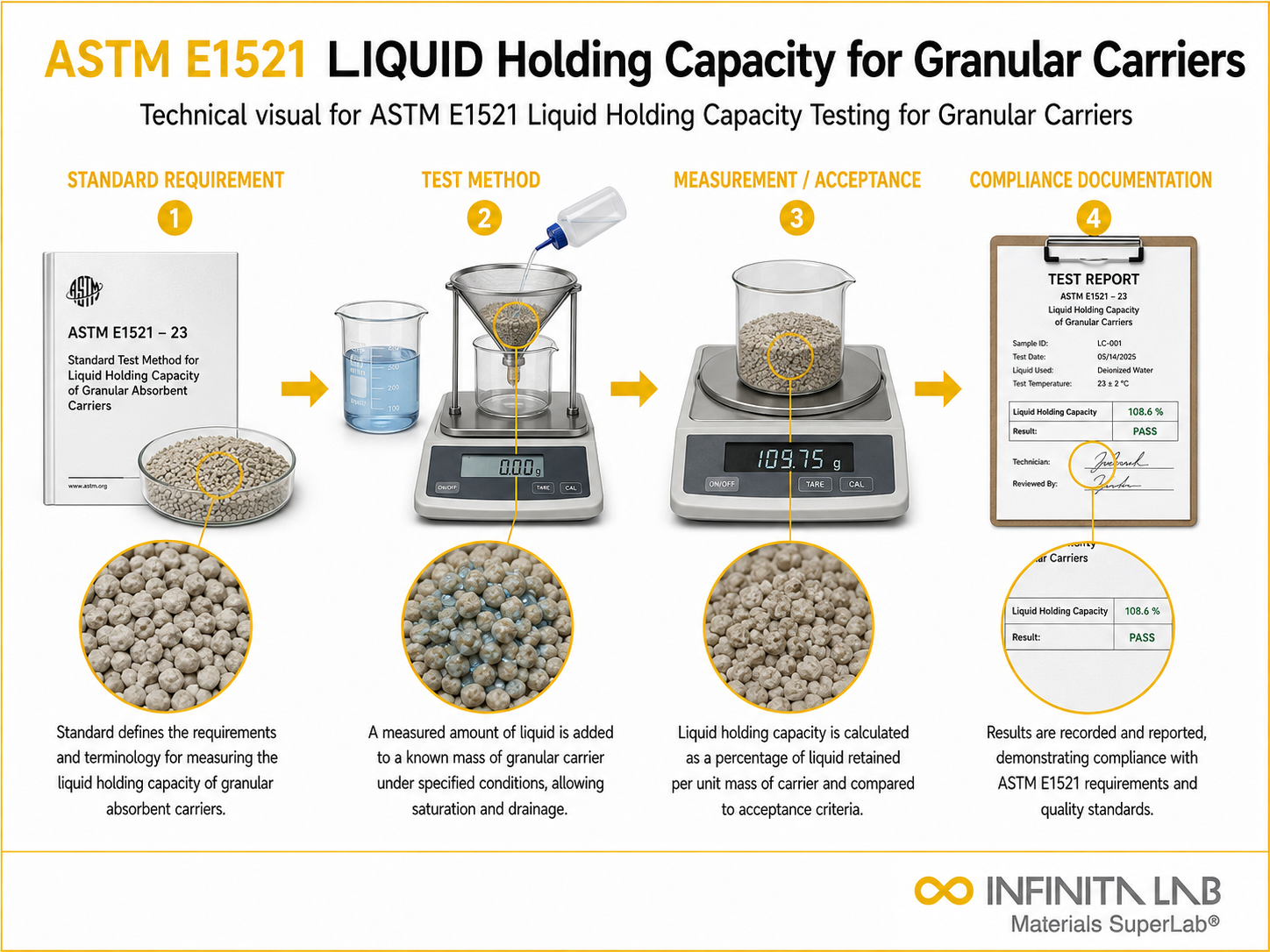
In ASTM E1521, the liquid holding capacity of granular carriers is determined. The values reported in SI or inch-pound units are considered as standard.
TRUSTED BY


Precision-driven testing for dimensional accuracy and compliance
- Overview
- Scope, Applications, and Benefits
- Test Process
- Specifications
- Instrumentation
- Results and Deliverables
Overview
ASTM E1521 defines a standardized method for determining the liquid holding capacity of granular carriers. This test evaluates how much liquid a granular material can absorb and retain without losing structural integrity. It is essential for applications where carriers are used to deliver active ingredients in liquid form.
The standard ensures accurate measurement of absorption and retention properties under controlled conditions. It is widely used in industries such as agriculture, chemicals, and materials science to assess carrier efficiency. By providing reliable data, ASTM E1521 helps in selecting appropriate materials for formulations where liquid retention and controlled release are critical for performance and effectiveness.

Scope, Applications, and Benefits
Scope
The scope of ASTM E1521 includes the determination of liquid holding capacity in granular carrier materials under controlled conditions. It focuses on absorption and retention characteristics of dry, porous materials.
- Determines liquid absorption and retention capacity
- Applicable to dry granular and porous carrier materials
- Evaluates capacity for water or other liquids
- Suitable for quality control and material comparison
- Used in formulation and product development
Applications
- Evaluation of agricultural carrier materials
- Testing of absorbent materials in chemical industries
- Quality control of granular formulations
- Research in liquid delivery systems
- Optimization of carrier-based product performance
Benefits
- Accurate measurement of liquid retention capacity
- Improves formulation efficiency and stability
- Ensures consistent material performance
- Helps in selecting suitable carrier materials
- Supports quality assurance and compliance
Test Process
Sample Preparation
The granular sample is dried and weighed to ensure accurate baseline measurement.
1Liquid Addition
A measured amount of liquid is gradually added to the sample under controlled conditions.
2Saturation Determination
The sample is monitored until it reaches maximum liquid retention without excess free liquid.
3Capacity Calculation
Liquid holding capacity is calculated based on the amount of liquid absorbed by the sample.
4Technical Specifications
| Parameter | Details |
|---|---|
| Liquid Type | Typically water or specified test liquid |
| Sample Condition | Dry, free-flowing granular material |
| Absorption Measurement | Based on weight increase after liquid addition |
| Environmental Conditions | Controlled temperature and humidity |
| Sample Size | Defined representative quantity for testing |
| Equilibrium Time | Time allowed for complete liquid absorption |
| Measurement Units | Expressed as weight or percentage of liquid held |


- Analytical Balance
- Liquid Dispensing System
- Graduated Pipettes or Burettes
- Sample Containers
- Mixing Equipment
- Drying Oven
- Environmental Chamber
- Data Recording System
Instrumentation Used for Testing
Results and Deliverables
- Liquid holding capacity expressed as weight or percentage
- Saturation level of granular material
- Test report with measurement conditions
- Comparison with specification limits
- Data supporting material selection and quality control
Frequently Asked Question
ASTM E1521 evaluates absorption as the initial uptake of liquid into pores, while retention measures the liquid held after excess drainage. This distinction is critical for applications requiring controlled release versus immediate saturation performance.
Capillary forces drive liquid into fine pores within the granular structure. The balance between surface tension and pore size determines how efficiently liquid is drawn in and retained, directly influencing the carrier’s holding capacity and uniformity.
Smaller particles increase surface area and pore accessibility, enhancing absorption, while larger particles improve void space but reduce surface interaction. A balanced distribution ensures optimal liquid retention and structural stability of the granular carrier.
Higher bulk density reduces void space, limiting liquid absorption, whereas lower bulk density increases porosity and retention capacity. Understanding this relationship helps in optimizing
It provides a standardized, reproducible, and quantitative approach to evaluating liquid retention. This is essential for ensuring that granular carriers meet performance requirements in critical applications such as controlled release systems and formulation technologies.
Why Choose Infinita Lab for Advanced Materials Testing and Characterization?
At the core of this breadth is our network of 2,000+ accredited laboratories across the USA, offering access to over 10,000 testing methods and analytical services. From advanced materials characterization (SEM, TEM, RBS, XPS) to mechanical, chemical, environmental, biological, and standardized ASTM/ISO-compliant testing, we deliver unmatched flexibility, specialization, and scale. You are never limited by geography, facility, or methodology — Infinita Lab connects you to the right expertise and testing solution, every time.

Looking for a Trusted Partner for Accurate and Reliable Testing Services?
Send query us at hello@infinitalab.com or call us at (888) 878-3090 to learn more about our services and how we can support you.



Request a Quote
Submit your material details and receive testing procedures, pricing, and turnaround time within 24 hours.
 Quick Turnaround and Hasslefree process
 Confidentiality Guarantee
 Free, No-obligation Consultation
 100% Customer Satisfaction
