


ASTM E1447: Titanium Hydrogen Content Testing Services
Accredited ASTM E1447 titanium hydrogen content testing from Infinita Lab, performed to the exact standard requirements - accurate, reproducible results with full documentation for compliance, R&D, and quality control programs.
TRUSTED BY


Get ASTM E1447 compliant results - request your titanium hydrogen content testing quote
- Overview
- Scope, Applications, and Benefits
- Test Process
- Specifications
- Instrumentation
- Results and Deliverables
What Is ASTM E1447 Titanium Hydrogen Content?
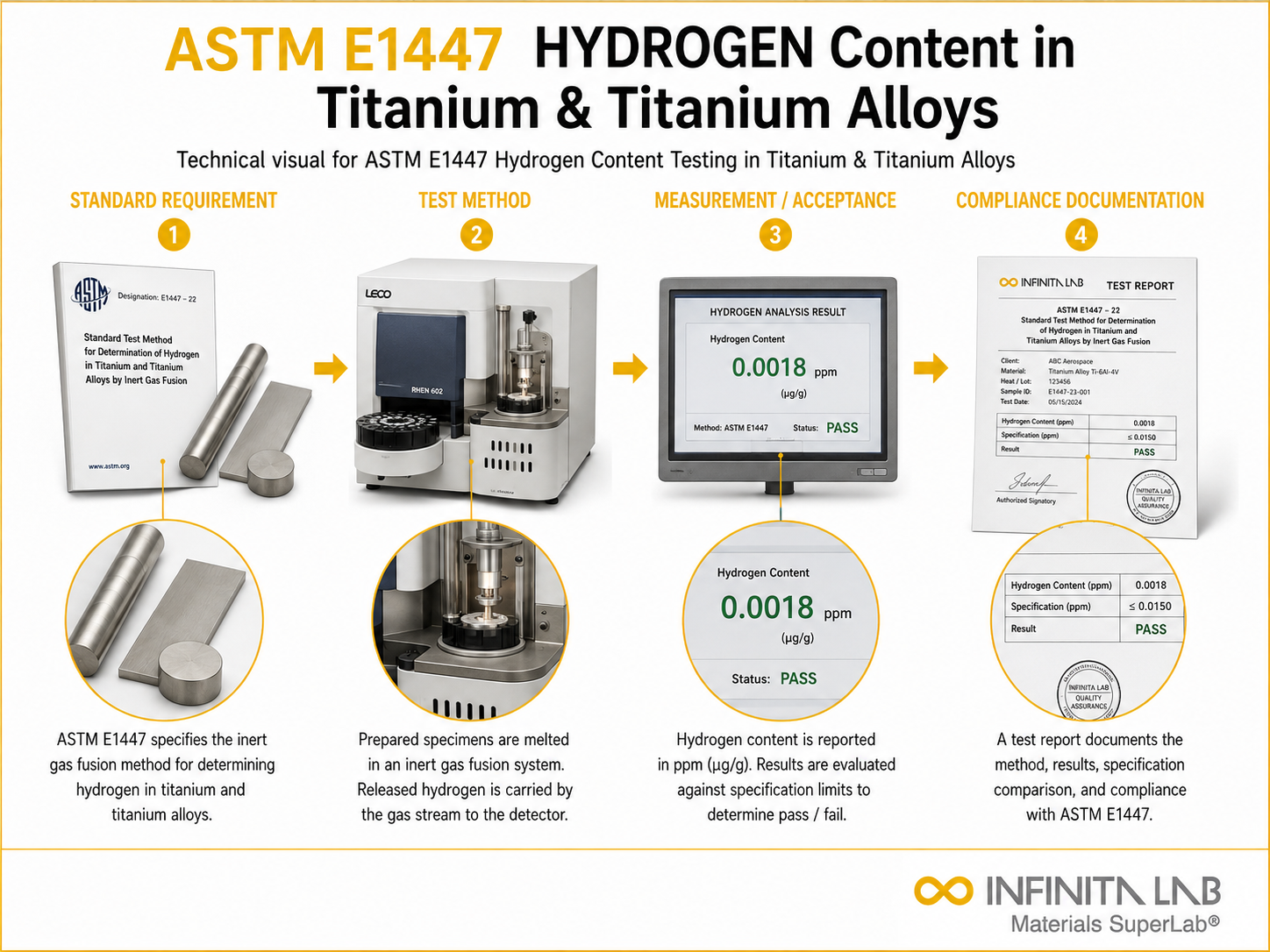
ASTM E1447 is the standard test method for determining hydrogen content in titanium and titanium alloys, using inert gas fusion paired with thermal conductivity or infrared detection. Hydrogen matters a lot in titanium metallurgy – even trace amounts, usually measured in parts per million, can dissolve into the metal’s lattice and, past a certain concentration, precipitate out as brittle titanium hydride. That hydride formation isn’t a minor cosmetic issue: it cuts ductility, lowers fracture toughness, and leaves the material more prone to delayed or sustained-load cracking. In flight-critical aerospace structures, surgical implants, and pressure-boundary components, that’s exactly the failure mode engineers design against – part of why titanium gets specified for its corrosion resistance and strength-to-weight ratio in the first place. Hydrogen can work its way into the metal at several points – melting, hot working, chemical milling, pickling, welding – so manufacturers lean on ASTM E1447 to confirm finished titanium products stay within the low-hydrogen limits their specifications demand.
The test itself is fairly direct: a small solid specimen is fused inside a graphite crucible under a flowing stream of helium or argon at high temperature. That heat breaks down the metal matrix and drives off dissolved hydrogen as gas, swept by the carrier stream into a detection cell. From there, quantification depends on instrument configuration – either the system measures the thermal conductivity difference between the carrier gas and the liberated hydrogen, or it converts the hydrogen to water vapour and reads it by infrared absorption. It’s fast, sensitive down to parts-per-million levels, and closely related to ASTM E1409, which relies on the same fusion principle to quantify oxygen and nitrogen instead. Run together, the two standards give manufacturers a full interstitial-gas picture, confirming raw materials, forgings, castings, and finished parts meet aerospace, medical, and industrial specifications before entering service.

Applications and Benefits of ASTM E1447 Titanium Hydrogen Content Testing
Scope
- ASTM E1447 covers the determination of hydrogen in titanium and titanium alloys by inert gas fusion with thermal conductivity and/or infrared detection.
- It’s applicable across a quantitative hydrogen range of roughly 9 to 320 mg/kg (parts per million) by mass.
- Solid specimens of titanium and titanium alloys – chips, turnings, castings, forgings, and wrought mill products – all fall within scope.
- Hydrogen gets liberated from the sample matrix by fusing the specimen in a graphite crucible under an inert carrier gas atmosphere.
- Detection happens by thermal conductivity measurement, infrared absorption of hydrogen converted to water vapour, or a combination of both, depending on how the instrument is set up.
- The method supports compliance verification against the compositional limits found in governing titanium mill and product specifications.
- Interlaboratory precision and bias data are already established for the titanium and titanium alloy matrices the standard covers.
- With appropriate method validation, the technique can extend to additional reactive metal alloys and to ranges outside the standard scope.
- Sample preparation needs to minimize surface contamination and moisture pickup – both can bias the reported hydrogen result.
- Results come back as hydrogen content in parts per million (ppm) or mg/kg on a mass-fraction basis.
Applications
- Verifying that titanium mill products – sheet, plate, bar, tube, forgings – meet the hydrogen limits set for aerospace-grade material.
- Certifying titanium raw material and finished components against the low-hydrogen specifications that surgical and orthopaedic implants require.
- Confirming that welded and post-weld heat-treated assemblies haven’t picked up excess hydrogen during joining.
- Screening incoming ingot, sponge, and mill product lots for interstitial hydrogen before they’re accepted or processed further.
- Supporting failure analysis when hydrogen embrittlement or delayed cracking is suspected as a contributing factor.
- Qualifying components for chemical processing, marine, and pressure-vessel service, where hydrogen-assisted cracking is a real risk.
- Checking hydrogen levels after pickling, chemical milling, or acid cleaning – all known sources of hydrogen pickup.
Benefits
- Fast, sensitive, repeatable measurement of hydrogen at the low parts-per-million levels that matter in titanium metallurgy.
- Cuts the risk of in-service hydrogen embrittlement by catching problem material before it goes into critical service.
- Backs the material certification and traceability documentation aerospace, defence, and medical-device customers ask for.
- Relies on a well-established ASTM method that’s recognised across titanium supply chains and specification bodies.
- Pairs naturally with ASTM E1409 oxygen and nitrogen testing for a complete interstitial-element profile.
- Helps manufacturers pinpoint and fix the process steps introducing hydrogen contamination before it snowballs downstream.
Our ASTM E1447 Testing Procedure
Sample Preparation
Clean and weigh the titanium specimen to eliminate surface contaminants.
1Furnace Heating
Place the sample in a high-temperature furnace under inert or vacuum conditions.
2Hydrogen Release
Heat the sample to release hydrogen from the material structure.
3Detection and Quantification
Measure released hydrogen using detection systems and calculate concentration.
4Equipment and Instrumentation Used for ASTM E1447 Testing
| Parameter | Details |
|---|---|
| Test Method | Inert gas fusion or vacuum extraction |
| Element Measured | Hydrogen |
| Material Type | Titanium and titanium alloys |
| Detection Range | Low ppm to higher concentrations |
| Furnace Temperature | High-temperature extraction |
| Carrier Gas | Inert gas such as helium or argon |
| Detection Method | Thermal conductivity or infrared detection |
| Output | Hydrogen concentration in material |


- Inert Gas Fusion Analyser (e.g., LECO ONH-series) – An integrated fusion furnace and detection system that melts specimens and measures the hydrogen released.
- Graphite Fusion Crucibles – Single-use crucibles that hold the specimen during high-temperature fusion under an inert atmosphere.
- Resistance or Impulse Furnace – Brings the crucible and specimen up to fusion temperature quickly, fast enough to liberate the dissolved hydrogen.
- Thermal Conductivity Detector (TCD) – Reads hydrogen concentration from the thermal conductivity difference between the carrier gas and the released hydrogen.
- Infrared Detection Cell – Quantifies hydrogen once it’s converted to water vapour, for instrument configurations built around infrared detection.
- Analytical Balance – A precision balance for weighing specimens accurately before fusion analysis.
- Certified Reference Materials (CRMs) – Titanium standards with known hydrogen content, used throughout testing to calibrate and verify instrument accuracy.
Equipment and Instrumentation Used for ASTM E1447 Testing
What You Receive: Test Report, Data, and Certification
- A detailed test report stating hydrogen content in ppm or mg/kg on a mass-fraction basis for each specimen tested.
- Specimen identification, sample preparation method, and the test conditions used during the inert gas fusion analysis.
- Results checked against applicable specification limits whenever a governing titanium material specification is provided.
- Calibration and reference material verification data, so the reported results are traceable.
- A certificate of analysis you can drop straight into material certification packages and quality documentation.
- Help interpreting the results, plus coordination of complementary interstitial-gas testing like ASTM E1409 when you need it.
ASTM E1447 Titanium Hydrogen Content FAQs
Hydrogen significantly affects titanium by causing embrittlement, reducing ductility and toughness. Even small hydrogen concentrations can lead to delayed cracking and catastrophic failure, especially in high-stress applications such as aerospace components, making precise measurement essential for material reliability.
Hydrogen diffuses into the titanium lattice and forms brittle hydride phases. These phases weaken the material structure, causing reduced ductility and increased susceptibility to cracking under stress, particularly in low-temperature or cyclic loading conditions.
Aerospace components require high strength and reliability. ASTM E1447 ensures hydrogen levels remain within strict limits, preventing embrittlement and ensuring structural integrity of critical components exposed to extreme conditions.
Inert gas fusion involves heating the sample in a controlled inert atmosphere, releasing hydrogen gas, which is then measured. This method minimizes contamination and provides accurate hydrogen quantification.
Limitations include potential surface contamination, instrument sensitivity limits, and interference from other gases. Accurate calibration and careful sample handling are required to minimize errors.
ASTM E1447 is a test method for determining hydrogen in reactive metals and alloys, particularly titanium and zirconium, using inert gas fusion with thermal conductivity or infrared detection.
ASTM E1447 determines hydrogen content in titanium and titanium alloys by inert gas fusion, followed by detection using thermal conductivity or infrared spectrometry.
A titanium analysis facility prepares and analyzes titanium samples using appropriate chemical or spectrometric methods to determine elemental composition and verify compliance with specified requirements.
Why Choose Infinita Lab for Titanium Hydrogen Content Testing
When your Titanium Hydrogen Content results have to hold up - for compliance, a customer audit, or an engineering decision - ASTM E1447 accuracy and an unbiased third-party report matter more than price. Infinita Lab routes your ASTM E1447 titanium hydrogen content testing to ISO/IEC 17025-accredited U.S. partner labs with hands-on method experience, so you get defensible data, transparent reporting, and turnaround times built around your project deadline - not ours.

Need ASTM E1447 Titanium Hydrogen Content Testing You Can Rely On?
Send query us at hello@infinitalab.com or call us at (888) 878-3090 to learn more about our services and how we can support you.



Request a Quote
Submit your material details and receive testing procedures, pricing, and turnaround time within 24 hours.
 Quick Turnaround and Hasslefree process
 Confidentiality Guarantee
 Free, No-obligation Consultation
 100% Customer Satisfaction
