


ASTM E1331: Hemispherical Reflectance Color Testing Services
Accredited ASTM E1331 hemispherical reflectance color testing from Infinita Lab, performed to the exact standard requirements - accurate, reproducible results with full documentation for compliance, R&D, and quality control programs.
TRUSTED BY


Get ASTM E1331 compliant results - request your hemispherical reflectance color testing quote
- Overview
- Scope, Applications, and Benefits
- Test Process
- Specifications
- Instrumentation
- Results and Deliverables
What Is ASTM E1331 Hemispherical Reflectance Color?
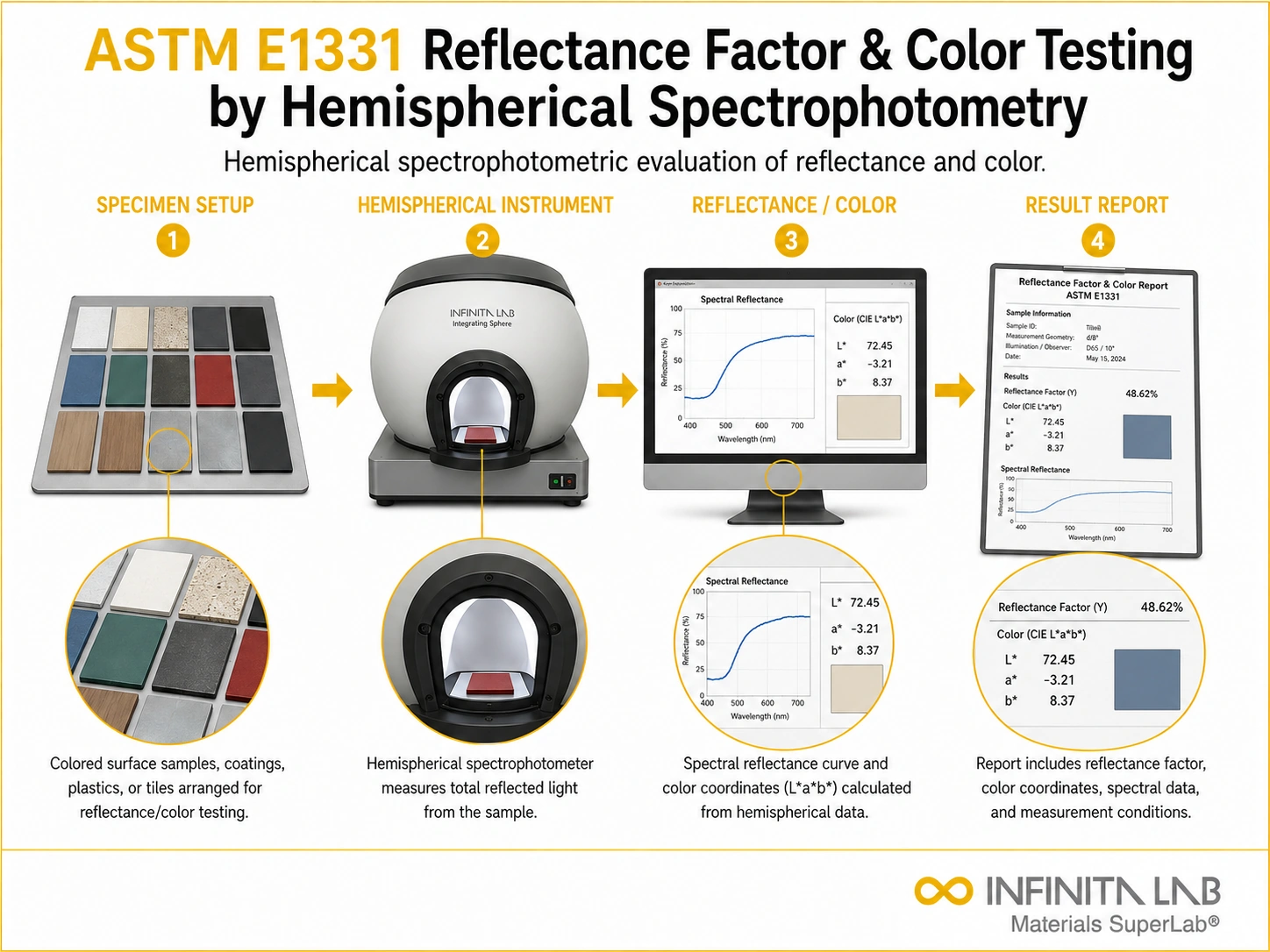
ASTM E1331, the Standard Test Method for Reflectance Factor and Color by Spectrophotometry Using Hemispherical Geometry, lays out a standardized procedure for determining the reflectance factor and the resulting color coordinates of object-color specimens. The instrument doing the work is a spectrophotometer or spectrocolorimeter fitted with a hemispherical optical measuring system – usually an integrating sphere. Geometry is diffuse/normal (d/0) or normal/diffuse (0/d): the specimen is illuminated (or viewed) diffusely from every angle within a hemisphere, while measurement (or illumination) runs along the normal. Operators can run the test in specular-component-included (SCI) or specular-component-excluded (SCE) mode, depending on whether surface gloss should factor into the reported color. The instrument scans the specimen’s spectral reflectance across the visible range against a calibrated white reflectance standard traceable to a national metrology body. That spectral data then combines with a CIE standard illuminant and standard observer function, per companion colorimetric practices, to compute tristimulus values and color-space coordinates like CIELAB. E1331 is written to apply broadly: high-gloss, low-gloss (matte), textured, and bare-metal surfaces all fall within its scope, which makes it one of the more universally applicable reflectance methods in the ASTM color and appearance family. It isn’t recommended for retroreflective or fluorescent specimens, though, nor for most intermediate-gloss specimens; those are better served by bidirectional (0/45 or 45/0) geometry methods. The current active version is ASTM E1331-15, reapproved in 2023, maintained under ASTM Committee E12 on Color and Appearance. This standard underpins instrumental color measurement and the data used for computerized colorant formulation across manufacturing industries that need consistent, repeatable, instrument-independent color communication.

Applications and Benefits of ASTM E1331 Hemispherical Reflectance Color Testing
Scope
ASTM E1331 covers measuring the reflectance factor and color using integrating sphere (hemispherical) geometry. It applies to both opaque and translucent materials.
- Covers measurement of reflectance factor and the color coordinates derived from it, for object-color specimens tested under hemispherical-geometry spectrophotometry.
- Applies to instruments built around an integrating sphere or an equivalent hemispherical optical system, in either diffuse-illumination/normal-viewing or the reverse (0/d) arrangement.
- Measurements can run with the specular component included (SCI) or excluded (SCE); the standard explains how each mode shifts the reported reflectance and color values.
- Works across high-gloss, low-gloss (matte), and textured plane-surface specimens, as well as bare and coated metal surfaces.
- Not recommended for retroreflective specimens, fluorescent specimens, or intermediate-gloss specimens – those are better handled by bidirectional (0/45 or 45/0) geometry methods.
- Calibration happens first. The instrument is checked against a white reflectance standard with known, traceable spectral reflectance characteristics before measuring any specimen.
- Spectral reflectance data, paired with a specified CIE illuminant and standard observer, produce tristimulus values and color-space coordinates like CIELAB.
- Sources of measurement variability get specific attention: specimen positioning, instrument geometry, aperture size, sample uniformity, and how each should be controlled or documented.
- Results should line up between properly calibrated instruments sharing the same general geometry, which is what makes interlab and instrument-to-instrument correlation possible.
- Supports single-point reflectance factor determination and full spectral curve generation alike, feeding later colorimetric and colorant-formulation calculations.
Applications
- Instrumental color quality control for painted, coated, and plastic parts on the production line.
- Matching and tolerancing color between production batches, vendor-supplied components, and the approved master standard.
- Computerized colorant and pigment formulation work for paints, inks, plastics, and coatings.
- Checking textile, paper, and packaging materials for color consistency across production lots.
- Verifying color stability and uniformity in architectural and industrial coating systems.
- Comparing bare and coated metal surfaces across automotive, appliance, and general metal-finishing applications.
- Supplier qualification and incoming-material inspection, wherever color conformance is a contractual requirement.
Benefits
- Takes the guesswork out of color assessment. One instrument-based reading replaces the usual observer-to-observer variation.
- Lets you compare specimens directly across different gloss levels, surface textures, and substrate types, all under one general test approach.
- Produces spectral and colorimetric data that feeds straight into computerized color formulation and batch-to-batch correction.
- Closes the gap between a manufacturer’s internal color measurements and what suppliers or customers are seeing on their end.
- Catches color drift early, before it turns into rework, scrap, or a customer rejection.
- Gives purchasing and quality teams a documented, standardized basis for writing color specifications into agreements.
Our ASTM E1331 Testing Procedure
Sample Preparation
Prepare and condition the sample with a uniform, clean surface.
1Instrument Calibration
Calibrate the spectrophotometer using standard reference materials.
2Measurement
Place the sample in the integrating sphere and record reflectance values.
3Data Analysis
Analyze spectral data to determine reflectance factor and color coordinates.
4ASTM E1331 Test Parameters and Requirements
| Parameter | Details |
|---|---|
| Measurement Method | Spectrophotometry with hemispherical geometry |
| Geometry Type | Integrating sphere (d/8 or equivalent) |
| Parameter Measured | Reflectance factor and color coordinates |
| Light Source | Standard illuminants |
| Wavelength Range | Typically 400–700 nm (visible spectrum) |
| Measurement Modes | Specular included or excluded |
| Detector Type | Photodiode or array-based spectrophotometer |
| Color Spaces | CIE Lab*, XYZ, or similar |


- Integrating-Sphere Spectrophotometer – Delivers the hemispherical diffuse illumination or viewing geometry the standard calls for, and captures the spectral reflectance data itself.
- Spectrocolorimeter – Pairs spectral measurement with built-in colorimetric calculation, so tristimulus and color-space values come out directly.
- Certified White Reflectance Standard – Calibrates the instrument against a known, traceable reflectance baseline before any specimen testing starts.
- Black-Trap/Zero Reference – Sets the low-reflectance end of the calibration range, where the instrument design requires it.
- Specimen Holder/Backing Plate – Keeps specimen positioning, backing, and presentation consistent at the measurement port.
- Color Data Management Software – Turns spectral reflectance curves into CIE tristimulus values and color-space coordinates, and handles pass/fail comparison against spec.
Equipment and Instrumentation Used for ASTM E1331 Testing
What You Receive: Test Report, Data, and Certification
- Spectral reflectance factor curves for each specimen location tested, across the full measured wavelength range.
- CIE tristimulus values and color-space coordinates (CIELAB among them), calculated under the specified illuminant and observer.
- Color-difference data measured against a reference standard or customer spec, when that’s requested.
- A documented test report naming instrument geometry, measurement mode (SCI/SCE), calibration references, and specimen details.
- Data formatted for computerized colorant formulation or production color-correction work.
- A technical read on the results, useful for quality control calls, specification compliance, or product development decisions.
ASTM E1331 Hemispherical Reflectance Color FAQs
Reflectance factor is the ratio of reflected light from a sample to that from a perfect reflecting diffuser under identical conditions. It provides a quantitative measure of how much light a material reflects, which directly influences perceived color and visual appearance.
Hemispherical geometry ensures uniform illumination from all directions, reducing directional bias in measurements. This setup captures both diffuse and specular reflection components, providing a more comprehensive evaluation of surface reflectance and color characteristics.
By providing precise spectral data, ASTM E1331 allows manufacturers to control and monitor color variations. It ensures consistent formulation, reduces batch-to-batch variation, and enables accurate color matching in production environments.
Specular reflection can significantly influence measured reflectance values, especially for glossy surfaces. Including or excluding specular reflection allows flexibility in evaluating either total appearance or diffuse-only reflectance characteristics.
Spectral data provides objective, quantifiable information, eliminating human subjectivity. It enables precise color matching, detection of subtle differences, and ensures repeatability across different testing environments.
Why Choose Infinita Lab for Hemispherical Reflectance Color Testing
When your Hemispherical Reflectance Color results have to hold up - for compliance, a customer audit, or an engineering decision - ASTM E1331 accuracy and an unbiased third-party report matter more than price. Infinita Lab routes your ASTM E1331 hemispherical reflectance color testing to ISO/IEC 17025-accredited U.S. partner labs with hands-on method experience, so you get defensible data, transparent reporting, and turnaround times built around your project deadline - not ours.

Need ASTM E1331 Hemispherical Reflectance Color Testing You Can Rely On?
Send query us at hello@infinitalab.com or call us at (888) 878-3090 to learn more about our services and how we can support you.



Request a Quote
Submit your material details and receive testing procedures, pricing, and turnaround time within 24 hours.
 Quick Turnaround and Hasslefree process
 Confidentiality Guarantee
 Free, No-obligation Consultation
 100% Customer Satisfaction
