


ASTM D7723: Filler Macro Dispersion Compound Testing Services
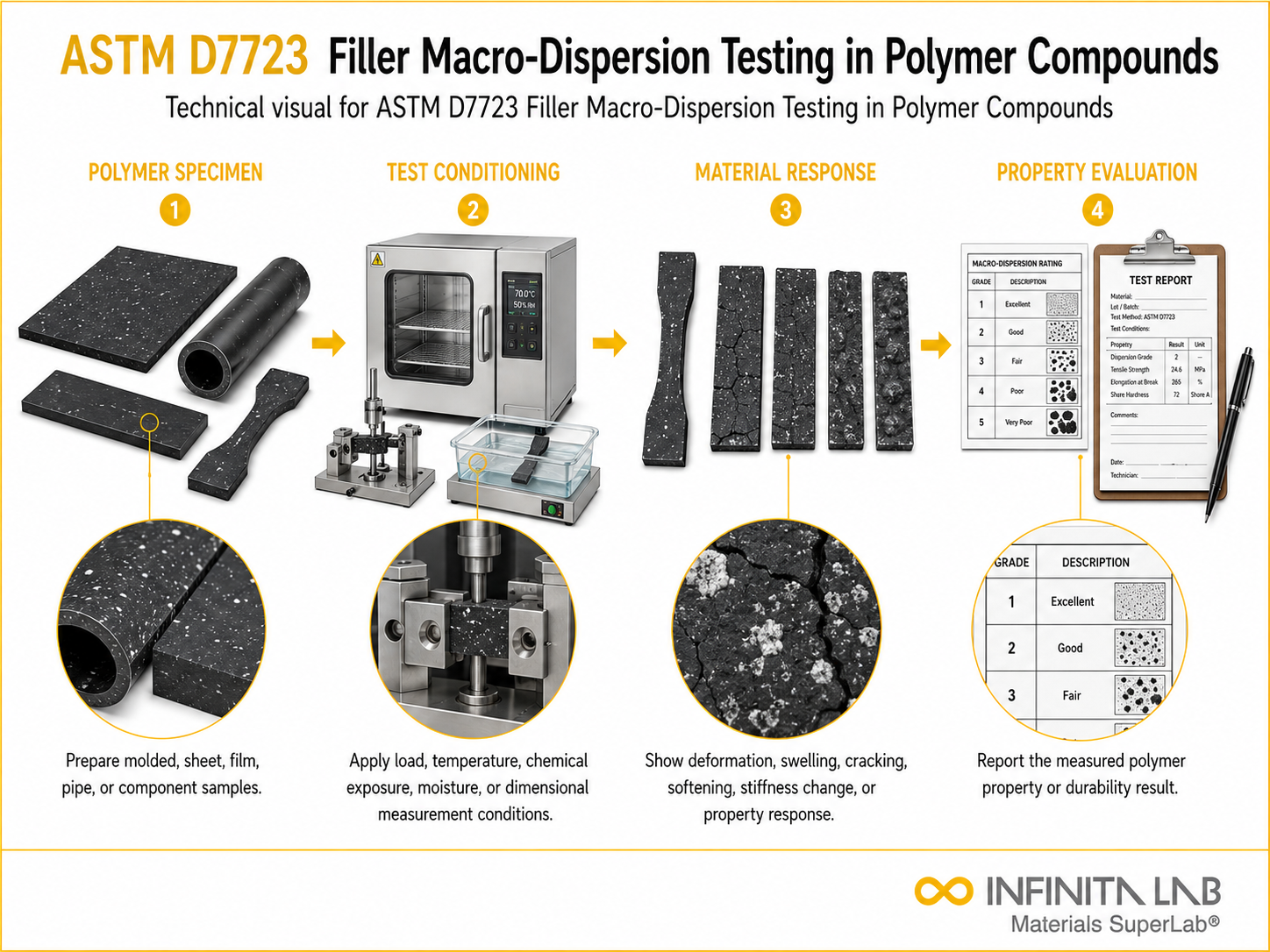
This test technique, ASTM D7723, describes how to assess the surface roughness of a freshly cut specimen to determine the macro-dispersion of fillers in a rubber matrix. The approach outlines a procedure for assessing the quality of a product by combining reinforcing fillers like silica and carbon black. Inert fillers like chalk, clay, and other substances are also used.
TRUSTED BY


Get ASTM D7723 compliant results — request your filler macro dispersion compound testing quote
- Overview
- Scope, Applications, and Benefits
- Test Process
- Specifications
- Instrumentation
- Results and Deliverables
What Is ASTM D7723 Filler Macro Dispersion Compound?
ASTM D7723 provides a standard test method for evaluating the macrodispersion quality of fillers—particularly carbon black and mineral fillers—within rubber and polymer compounds. Poor filler dispersion leads to agglomerates that act as stress concentrators, reducing mechanical performance, surface quality, and product consistency.
This test is widely used in rubber compounding, tire manufacturing, and masterbatch production to quantify dispersion quality and ensure that mixing processes deliver homogeneously distributed filler throughout the compound matrix.

Applications and Benefits of ASTM D7723 Filler Macro Dispersion Compound Testing
Scope
ASTM D7723 evaluates:
- Macro dispersion rating of fillers in vulcanized or unvulcanized compounds
- Agglomerate count and size distribution on cut surfaces
- Dispersion index (D%) or dispersion rating scale
- Effect of mixing parameters (time, temperature, rotor speed) on dispersion quality
Applications
- Carbon black dispersion in rubber tire compounds
- Mineral filler dispersion in rubber seals and hoses
- Masterbatch quality control
- Mixing process optimization and scale-up validation
- Incoming filler quality inspection
Benefits
- Rapid, quantitative dispersion quality assessment
- Identifies mixing process deficiencies before vulcanization
- Correlates dispersion quality with mechanical performance
- Supports batch-to-batch consistency control
- Enables supplier qualification for fillers and masterbatches
Our ASTM D7723 Testing Procedure
Specimen Preparation
A fresh, undisturbed cut surface is prepared by slicing the compound with a sharp blade or microtome to expose the internal filler distribution.
1Surface Examination
The cut surface is examined under reflected light or a calibrated optical system at defined magnification; agglomerates larger than the threshold size are identified.
2Dispersion Rating
The number and size of agglomerates per unit area are counted; a dispersion index (D%) or rating (1–5 scale) is assigned per the ASTM D7723 classification.
3Reporting
The dispersion rating, agglomerate data, and test conditions are documented; results are compared to acceptance criteria and reported.
4ASTM D7723 Test Parameters and Requirements
| Parameter | Details |
|---|---|
| Test Principle | Optical examination of compound cut surface for filler agglomerates |
| Applicable Materials | Carbon black-filled and mineral-filled rubber compounds |
| Rating Scale | Dispersion index (D%) or 1–5 visual rating |
| Agglomerate Threshold | ≥10 µm (typical) |
| Magnification | 100×–400× (optical microscope) |


- Sharp blade or microtome for specimen preparation
- Calibrated optical microscope with reflected light
- Image analysis software for agglomerate counting
- Calibration graticule
- Digital camera for documentation
Equipment and Instrumentation Used for ASTM D7723 Testing
What You Receive: Test Report, Data, and Certification
- Dispersion index (D%) or dispersion rating (1–5)
- Agglomerate count and size distribution
- Microscopic images of the cut surface
- Comparison to the specification or reference standard
- Full test report per ASTM D7723
ASTM D7723 Filler Macro Dispersion Compound FAQs
Macro dispersion refers to the distribution of filler agglomerates visible at low-to-medium magnification (>10 µm). Micro dispersion refers to the dispersion of filler at the nanometer or primary aggregate scale, typically assessed by electron microscopy or X-ray techniques.
For most tire tread and carcass compounds, a dispersion rating of ≥95 D% (or ASTM visual rating 3–5) is typically required. Critical compounds may require ≥98 D% to meet performance and durability targets.
Poor dispersion results in agglomerates that act as stress concentrators, reducing tensile strength, fatigue life, and abrasion resistance. Well-dispersed carbon black provides maximum reinforcement through uniform stress transfer.
ASTM D7723 is primarily designed for rubber compounds, but the general optical examination approach can be adapted for thermoplastic composites. Specific thermoplastic filler dispersion methods may be referenced in ISO 11420 or ASTM D5630.
A minimum of 3–5 independent cut surfaces from different locations in the compound batch are recommended to account for spatial variability in filler distribution.
Why Choose Infinita Lab for Filler Macro Dispersion Compound Testing?
At the core of this breadth is our network of 2,000+ accredited laboratories across the USA, offering access to over 10,000 testing methods and analytical services. From advanced materials characterization (SEM, TEM, RBS, XPS) to mechanical, chemical, environmental, biological, and standardized ASTM/ISO-compliant testing, we deliver unmatched flexibility, specialization, and scale. You are never limited by geography, facility, or methodology — Infinita Lab connects you to the right expertise and testing solution, every time.

Need ASTM D7723 Filler Macro Dispersion Compound Testing You Can Rely On?
Send query us at hello@infinitalab.com or call us at (888) 878-3090 to learn more about our services and how we can support you.



Request a Quote
Submit your material details and receive testing procedures, pricing, and turnaround time within 24 hours.
 Quick Turnaround and Hasslefree process
 Confidentiality Guarantee
 Free, No-obligation Consultation
 100% Customer Satisfaction
