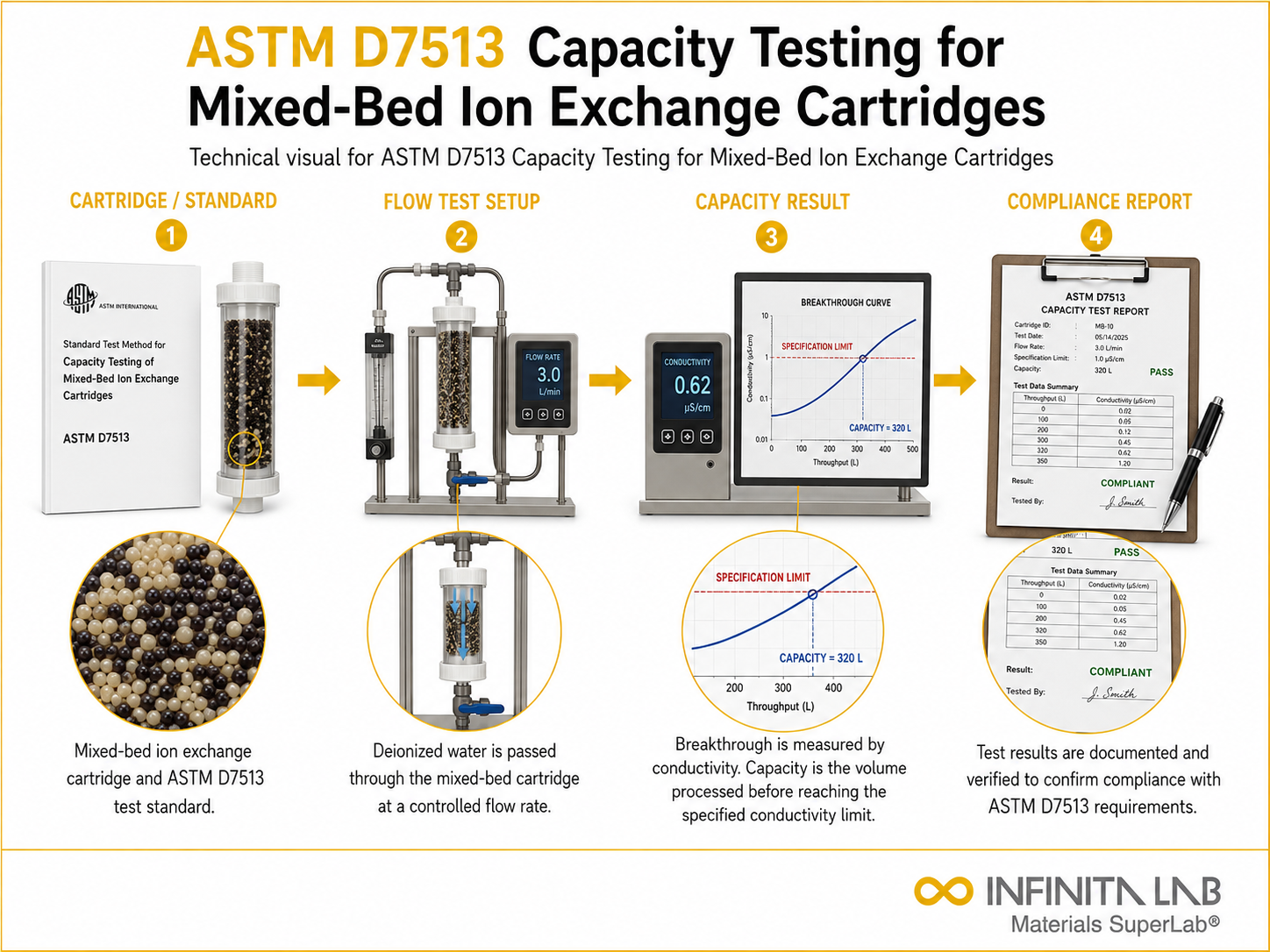


What Is ASTM D7513 Mixed Bed Ion Exchange Cartridge Capacity?
ASTM D7513 describes a standard test method for determining the ion exchange capacity of mixed bed ion exchange cartridges used for water purification. Mixed bed cartridges contain both cation and anion exchange resins, providing a single-pass, comprehensive water demineralization capability.
This test method is essential for quality assurance of water purification cartridges used in analytical laboratories, semiconductor manufacturing, pharmaceutical water systems, and other applications requiring ultrapure water. Capacity determination ensures that cartridges meet performance specifications before use.

Applications and Benefits of ASTM D7513 Mixed Bed Ion Exchange Cartridge Capacity Testing
Scope
ASTM D7513 covers the determination of:
- Total ion exchange capacity of mixed bed cartridges
- Service life estimation under specified influent conditions
- Breakthrough point detection for capacity limits
- Performance consistency between cartridge batches
Applications
- Analytical laboratory water purification system qualification
- Semiconductor ultrapure water system validation
- Pharmaceutical water purification cartridge testing
- Industrial process water treatment cartridge QC
- Research and development of ion exchange materials
Benefits
- Quantifies cartridge capacity for accurate service life prediction
- Ensures water quality compliance throughout cartridge life
- Enables batch-to-batch QC for cartridge manufacturers
- Supports cost-effective cartridge replacement scheduling
- Applicable to a range of cartridge sizes and resin combinations
Our ASTM D7513 Testing Procedure
System Setup
Connect the mixed bed cartridge to the test apparatus; prepare challenge water with defined ionic concentration and conductivity.
1Capacity Challenge
Pass water through the cartridge at controlled flow and monitor effluent conductivity or ion levels.
2Breakthrough Detection
Record processed volume at breakthrough conductivity to determine capacity exhaustion.
3Capacity Calculation
Calculate ion exchange capacity from breakthrough volume and influent load, expressed in meq or treated water volume.
4ASTM D7513 Test Parameters and Requirements
| Parameter | Details |
|---|---|
| Standard | ASTM D7513-09 |
| Test Principle | Flow-through capacity challenge test |
| Applicable Materials | Mixed bed ion exchange cartridges |
| Measured Output | Total exchange capacity (meq or liters) |
| Breakthrough Indicator | Effluent conductivity or specific ion concentration |
| Challenge Water | Defined ionic strength per method |


- Cartridge test stand with flow control
- Inline conductivity meter
- Ion chromatograph (for specific ion monitoring, if required)
- Flow meter and totalizer
- Challenge water preparation system
- Data logging system for continuous monitoring
Equipment and Instrumentation Used for ASTM D7513 Testing
What You Receive: Test Report, Data, and Certification
- Total ion exchange capacity value (meq or liters of treated water)
- Effluent conductivity vs. volume treated profile
- Breakthrough point determination
- Batch-to-batch capacity comparison data
- Pass/fail assessment against cartridge specifications
- Service life estimation under specified application conditions
ASTM D7513 Mixed Bed Ion Exchange Cartridge Capacity FAQs
A mixed bed cartridge contains both cation exchange resin (H⁺ form) and anion exchange resin (OH⁻ form) intimately mixed together. This allows simultaneous removal of all cations and anions from water in a single pass, producing high-purity demineralized water.
Capacity refers to the total amount of ionic contaminants (expressed in milliequivalents) that the cartridge can remove before breakthrough occurs. Higher capacity means longer service life.
Breakthrough is defined as the point at which effluent conductivity rises above a specified threshold (e.g., 0.1 µS/cm for ultrapure water applications), indicating that ion exchange capacity is exhausted and water quality is no longer acceptable.
Yes, higher flow rates can reduce the effective capacity of a cartridge because contact time between water and the resin is reduced. ASTM D7513 specifies flow rate conditions to ensure reproducible capacity measurements.
ASTM D7513 is specifically designed for mixed bed cartridges. Separate test methods are available for evaluating single-bed ion exchange systems.
Why Choose Infinita Lab for Mixed Bed Ion Exchange Cartridge Capacity Testing
At the core of this breadth is our network of 2,000+ accredited laboratories across the USA, offering access to over 10,000 testing methods and analytical services. From advanced materials characterization (SEM, TEM, RBS, XPS) to mechanical, chemical, environmental, biological, and standardized ASTM/ISO-compliant testing, we deliver unmatched flexibility, specialization, and scale. You are never limited by geography, facility, or methodology — Infinita Lab connects you to the right expertise and testing solution, every time.

Looking for an Accredited Partner for ASTM D7513 Mixed Bed Ion Exchange Cartridge Capacity Testing?
Send query us at hello@infinitalab.com or call us at (888) 878-3090 to learn more about our services and how we can support you.





