


ASTM D6975: Engine Oil Oxidation Soot Testing Services
Accredited ASTM D6975 engine oil oxidation soot testing from Infinita Lab, performed to the exact standard requirements - accurate, reproducible results with full documentation for compliance, R&D, and quality control programs.
TRUSTED BY


Get ASTM D6975 compliant results - request your engine oil oxidation soot testing quote
- Overview
- Scope, Applications, and Benefits
- Test Process
- Specifications
- Instrumentation
- Results and Deliverables
What Is ASTM D6975 Engine Oil Oxidation Soot?
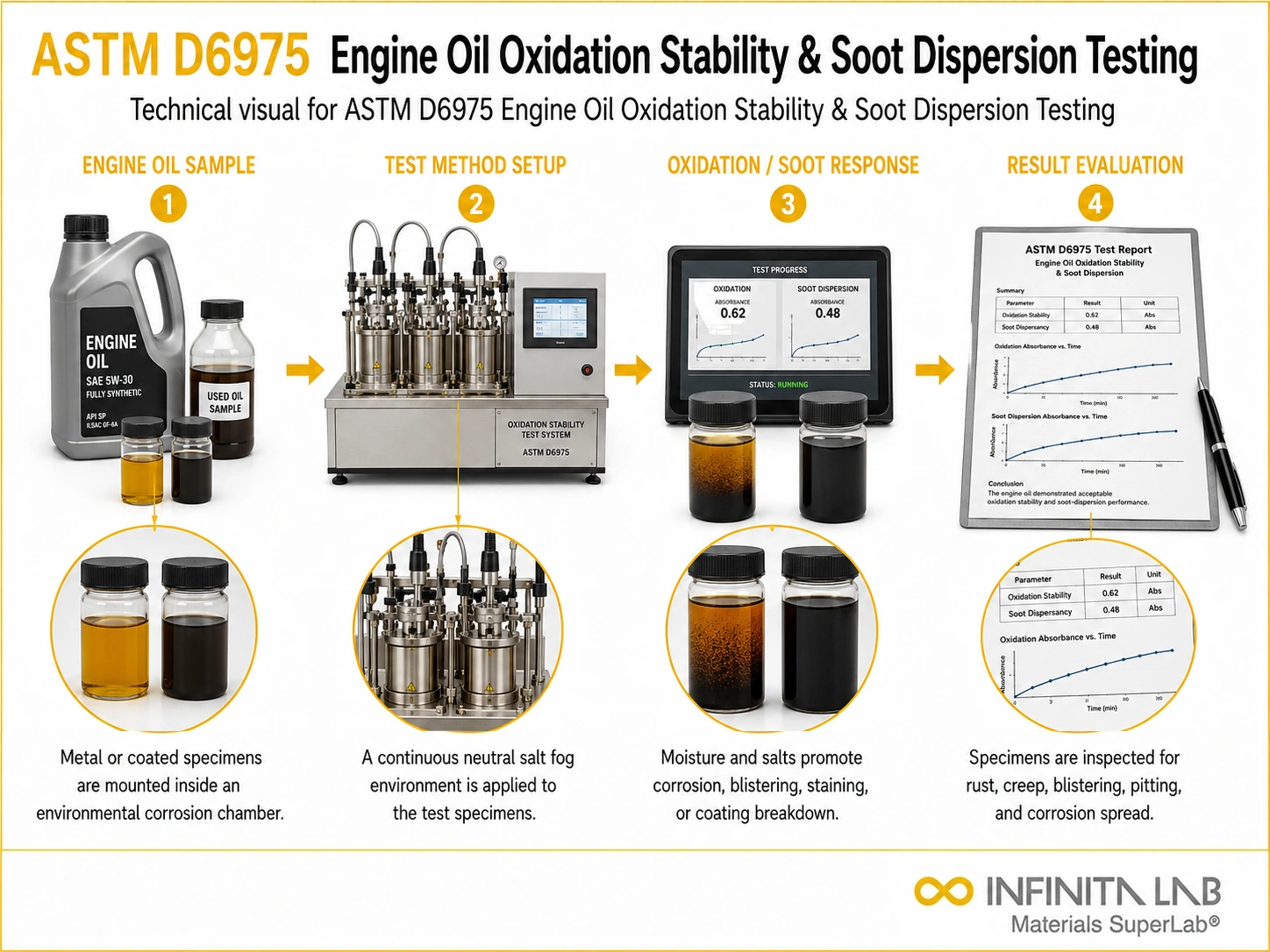
ASTM D6975-04 describes a test method for evaluating the oxidation stability of heavy-duty diesel engine oils at elevated temperatures. As engine oils circulate through high-temperature operating environments, oxidation degrades the oil, increasing viscosity, forming deposits, and reducing lubricant effectiveness. This test provides data on an oil’s resistance to oxidative breakdown.
The method supports engine oil formulation development, quality assurance, and compliance with OEM lubrication specifications in the heavy-duty diesel sector.

Applications and Benefits of ASTM D6975 Engine Oil Oxidation Soot Testing
Scope
ASTM D6975-04 applies to heavy-duty diesel engine oils and determines:
- Change in viscosity after controlled oxidation exposure
- Acid number increases as a measure of oxidative byproduct formation
- Insoluble deposit formation
- Overall oxidative stability as a function of temperature and time
Applications
- Heavy-duty diesel engine oil formulation development
- API and OEM engine oil specification compliance testing
- Comparative evaluation of base oil and additive combinations
- Quality control for lubricant manufacturers
- Research on antioxidant package effectiveness
Benefits
- Predicts oil degradation under severe engine operating conditions
- Enables selection of more oxidation-stable formulations
- Supports extended oil drain interval development
- Provides data for API engine oil certification
- Reproducible bench test correlated to field experience
Our ASTM D6975 Testing Procedure
Sample Setup
A measured oil sample is placed in a test tube or oxidation cell with metal catalyst specimens.
1Oxidation Conditioning
The oil is subjected to a controlled temperature (typically 170°C) with a defined air flow rate for a specified duration.
2Post-Test Analysis
The oxidized oil is analyzed for viscosity increase, acid number, and insoluble content.
3Reporting
Results are compared to acceptance limits specified by the relevant API or OEM standard.
4ASTM D6975 Test Parameters and Requirements
| Parameter | Details |
|---|---|
| Test Principle | Controlled oxidation with metal catalyst at elevated temperature |
| Applicable Materials | Heavy-duty diesel engine oils (SAE 10W-30, 15W-40, etc.) |
| Test Temperature | 170°C (338°F) |
| Measured Outputs | Viscosity increase (%), acid number change, insoluble content |
| Catalyst | Iron and copper catalyst strips |


- Oxidation stability test apparatus (tube furnace or block heater)
- Air supply with a controlled flow rate
- Kinematic viscometer (per ASTM D445)
- Potentiometric titrator for acid number (per ASTM D664)
- Filtration apparatus for insoluble content
- Analytical balance
Equipment and Instrumentation Used for ASTM D6975 Testing
What You Receive: Test Report, Data, and Certification
- Kinematic viscosity change (%) after oxidation
- Total acid number (TAN) before and after
- Insoluble content by filtration
- Comparison to API CJ-4 or relevant OEM limits
- Full oxidation stability test report
ASTM D6975 Engine Oil Oxidation Soot FAQs
Oil oxidation increases viscosity and acidity, leading to sludge and deposit formation, increased wear, and reduced engine protection — ultimately shortening engine life.
Iron and copper strips simulate catalytic activity from engine metal surfaces, which accelerate real-world oil oxidation.
D6975 results are used as one criterion in API CJ-4 and related specifications for heavy-duty diesel engine oil approval.
While not directly predictive, the test provides relative oxidation stability data that, combined with field data, supports extended drain interval claims.
ASTM D6975 is specifically designed for heavy-duty diesel engine oils; separate methods (e.g., ASTM D4742) are used for passenger car and gasoline engine oils.
Why Choose Infinita Lab for Engine Oil Oxidation Soot Testing?
When your Engine Oil Oxidation Soot results have to hold up - for compliance, a customer audit, or an engineering decision - ASTM D6975 accuracy and an unbiased third-party report matter more than price. Infinita Lab routes your ASTM D6975 engine oil oxidation soot testing to ISO/IEC 17025-accredited U.S. partner labs with hands-on method experience, so you get defensible data, transparent reporting, and turnaround times built around your project deadline - not ours.

Looking for an Accredited Partner for ASTM D6975 Engine Oil Oxidation Soot Testing?
Send query us at hello@infinitalab.com or call us at (888) 878-3090 to learn more about our services and how we can support you.



Request a Quote
Submit your material details and receive testing procedures, pricing, and turnaround time within 24 hours.
 Quick Turnaround and Hasslefree process
 Confidentiality Guarantee
 Free, No-obligation Consultation
 100% Customer Satisfaction
