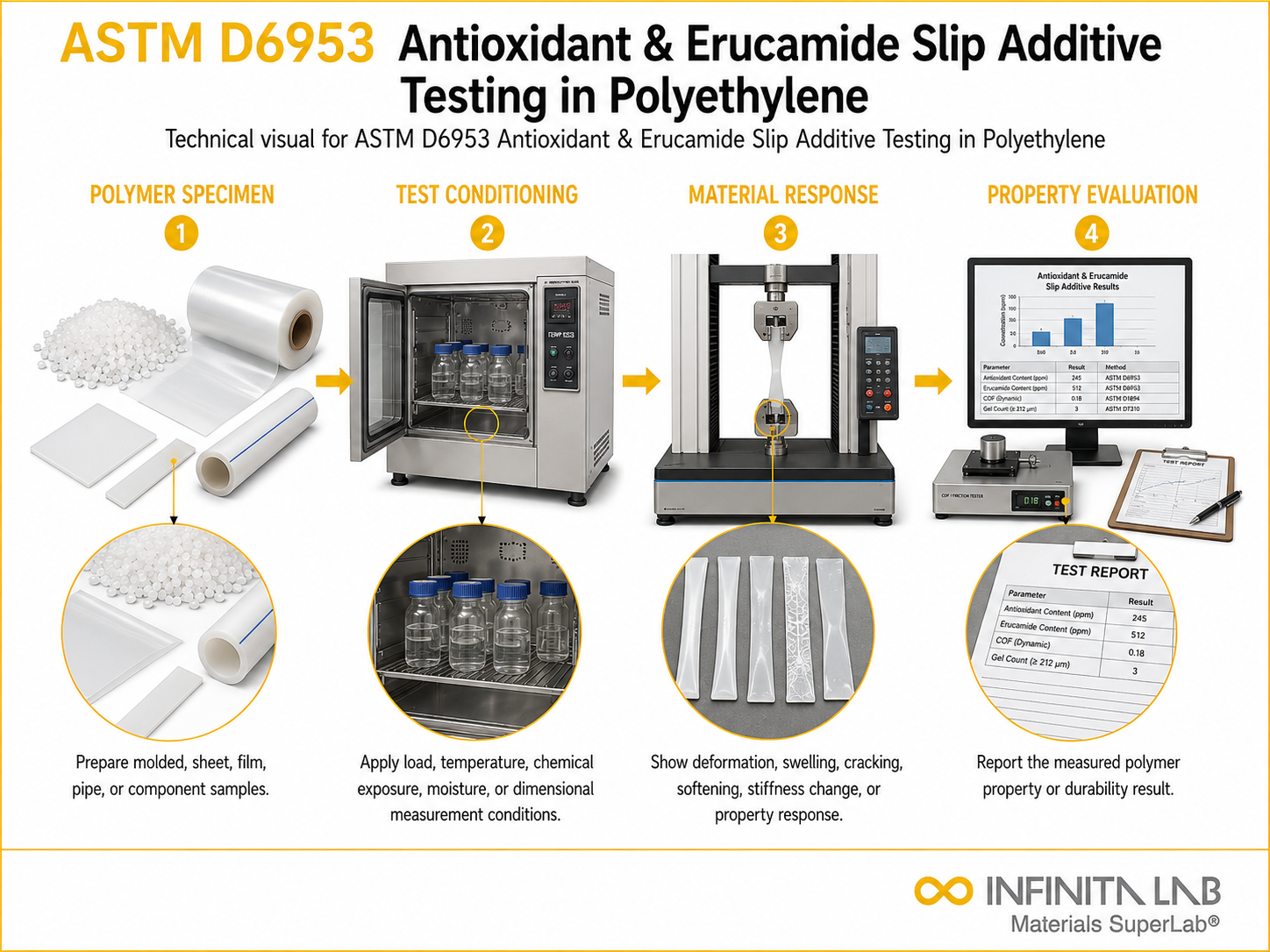


What Is ASTM D6953 Polyethylene Antioxidant Erucamide?
ASTM D6953-18 describes a test method for determining antioxidants and erucamide slip additives in polyethylene (PE) films and resins using high-performance liquid chromatography (HPLC). These additives are critical for controlling PE oxidative stability and surface friction in packaging and agricultural film applications.
Accurate quantification of these additives ensures that PE products meet processing, shelf-life, and performance requirements, thereby supporting quality control and incoming inspection in the plastics industry.

Applications and Benefits of ASTM D6953 Polyethylene Antioxidant Erucamide Testing
Scope
ASTM D6953-18 covers the extraction and HPLC quantification of:
- Hindered phenolic antioxidants (e.g., Irganox 1010, 1076)
- Phosphite co-antioxidants (e.g., Irgafos 168)
- Erucamide slip agents
- Other UV stabilizers present in PE formulations
Applications
- Polyethylene film and sheet quality control
- Additive package verification for PE compounders
- Shelf life and oxidative stability prediction
- Agricultural film and greenhouse cover performance assurance
- Packaging film specification compliance testing
Benefits
- Quantifies multiple additive species simultaneously
- Detects under- or over-dosing of antioxidants in production
- Enables comparison of additive levels across suppliers or batches
- Supports product performance consistency
- Provides data for regulatory and food contact compliance
Our ASTM D6953 Testing Procedure
Extraction
PE sample is dissolved or extracted in an appropriate solvent to dissolve the additive components from the polymer matrix.
1HPLC Analysis
The extract is injected into an HPLC system with UV detection; chromatographic separation resolves individual additive peaks.
2Quantification
Peak areas are compared to external calibration standards for each target additive to determine concentration.
3Reporting
Results are expressed as ppm or mg/kg in the PE sample and compared to specification limits.
4ASTM D6953 Test Parameters and Requirements
| Parameter | Details |
|---|---|
| Test Principle | Solvent extraction followed by HPLC-UV analysis |
| Applicable Materials | Polyethylene films, resins, and compounds |
| Target Additives | Hindered phenolics, phosphites, erucamide |
| Detection | UV/Vis (typically 205–280 nm) |
| Measured Output | Additive concentration in ppm or mg/kg |


- High-performance liquid chromatograph (HPLC) with UV detector
- Reverse-phase C18 analytical column
- Solvent extraction system (reflux or ultrasonic bath)
- Analytical balance and volumetric glassware
- Certified reference standards for each target additive
Equipment and Instrumentation Used for ASTM D6953 Testing
What You Receive: Test Report, Data, and Certification
- Concentration of each identified additive (ppm)
- HPLC chromatogram with labeled peaks
- Calibration curve data and linearity
- Comparison to specification or nominal additive levels
- full test report
ASTM D6953 Polyethylene Antioxidant Erucamide FAQs
PE oxidizes during melt processing and in service, leading to chain scission and property degradation; antioxidants inhibit these reactions to preserve performance and extend service life.
Erucamide is a fatty acid amide slip agent that migrates to the film surface to reduce friction, improving processability and preventing film blocking during roll storage.
Yes — comparing antioxidant levels in aged or used PE samples to fresh material reveals additive consumption, providing insight into remaining protective capacity.
Typically 0.5–2 grams of film or resin, depending on the expected additive concentration level.
The extraction and HPLC principles are transferable, but ASTM D6953-18 is specifically validated for polyethylene; separate method validation would be needed for PP or other polyolefins.
Why Choose Infinita Lab for Polyethylene Antioxidant Erucamide Testing?
At the core of this breadth is our network of 2,000+ accredited laboratories across the USA, offering access to over 10,000 testing methods and analytical services. From advanced materials characterization (SEM, TEM, RBS, XPS) to mechanical, chemical, environmental, biological, and standardized ASTM/ISO-compliant testing, we deliver unmatched flexibility, specialization, and scale. You are never limited by geography, facility, or methodology — Infinita Lab connects you to the right expertise and testing solution, every time.

Need ASTM D6953 Polyethylene Antioxidant Erucamide Testing You Can Rely On?
Send query us at hello@infinitalab.com or call us at (888) 878-3090 to learn more about our services and how we can support you.





