

What Is ASTM D6827 Zinc Analysis Floor Polish?
ASTM D6827-02(2023), Standard Test Method for Zinc Analysis of Floor Polishes and Floor Polish Polymers by Flame Atomic Absorption (A.A.), sets out the ASTM International procedure for determining total zinc content in floor polish formulations and in the polymer emulsions used to make them. It’s issued under ASTM Committee D21 on Polishes and Related Materials, with Subcommittee D21.03 on Chemical and Physical Properties handling the technical development. Why does this matter? Many acrylic floor finish polymers depend on zinc compounds, usually zinc oxide or zinc ammonium carbonate complexes, as crosslinking agents. These bind polymer chains together. The payoff is harder film, better gloss retention, water resistance, and scuff resistance. A finished floor polish’s performance hinges on exactly how much zinc crosslinker made it into the formula, and how well it was incorporated. So manufacturers and formulators need a dependable, standardized way to check zinc levels across production batches and incoming raw material lots.
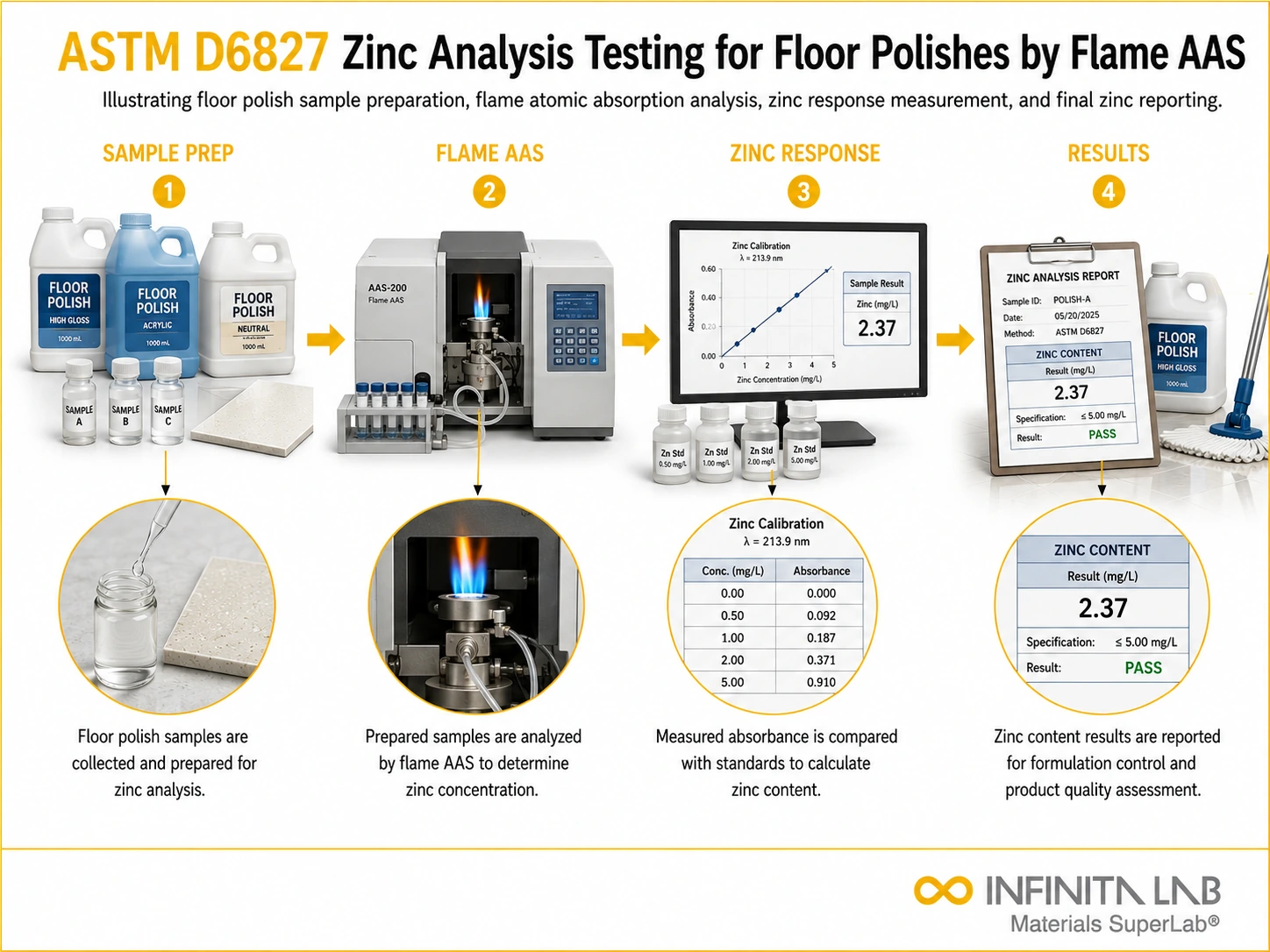
How does it work? The method converts zinc bound within the polish or polymer matrix into a solubilized form fit for instrumental measurement, usually through acid digestion. That solution then goes into a flame atomic absorption spectrophotometer. A zinc-specific hollow-cathode lamp supplies light at the metal’s characteristic resonance wavelength, and the amount of that light absorbed by the flame-atomized sample is proportional to how much zinc is present. Analysts calculate results against a calibration curve built from certified zinc reference standards, then report total zinc content on a weight or concentration basis. Like other ASTM polish standards, D6827 doesn’t try to cover every safety consideration. The analyst and testing facility handle digestion acids and lab reagents safely.

Applications and Benefits of ASTM D6827 Zinc Analysis Floor Polish Testing
Scope
ASTM D6827 evaluates:
- Sets a standardized lab procedure for determining total zinc content in floor polish formulations and floor polish polymers.
- Covers both finished liquid floor polish products and the raw polymer emulsions or dispersions used to make them.
- Zinc introduced as zinc oxide, zinc ammonium carbonate complexes, or other soluble zinc compounds used as crosslinking agents falls within scope.
- Sample digestion, or an equivalent prep step, is required to convert bound and complexed zinc into a measurable form.
- Quantification runs on flame atomic absorption spectroscopy, comparing sample absorbance against a calibration curve built from zinc reference standards.
- Falls under ASTM Committee D21 on Polishes and Related Materials, specifically Subcommittee D21.03 on Chemical and Physical Properties.
- Results are reported as total zinc content, on a weight or concentration basis, for the sample tested.
- Doesn’t address every safety concern tied to reagents, acids, or instrumentation; that responsibility sits with the user, who must establish appropriate safety practices.
- Meant for quality control, formulation verification, and related assessment work on zinc-containing floor finish products and their raw materials.
- D6827 remains active as an ASTM designation. Its subcommittee reviews and reapproves it periodically.
Applications
- Verifying zinc crosslinker content in acrylic floor finish polymer emulsions during manufacturing
- Release testing for quality control on finished floor polish and floor finish products
- Confirming formulation compliance against manufacturer specs or customer requirements
- Raw material qualification for zinc oxide or zinc-complex crosslinking agents
- Characterizing zinc-containing floor finish waste before disposal decisions get made
- Comparing production batches or supplier lots against each other
- R&D and formulation work aimed at dialing in crosslink density and film performance
Benefits
- An objective, reproducible read on total zinc content in floor polish systems
- Links measured zinc levels to crosslink-dependent properties like hardness and gloss retention, supporting consistent product performance
- Helps manufacturers confirm products meet internal specs or customer-defined requirements
- Generates documentation that’s useful for formulation records and disposal assessments
- Built on a widely recognized ASTM method, accepted across the floor care and polish industry
- Runs on accessible, well-established flame AA instrumentation, which keeps turnaround steady for routine testing
Our ASTM D6827 Testing Procedure
Sample Preparation & Acid Digestion
Samples are homogenized, dried, ground, and digested with nitric acid.
1Dilution
The digest solution is diluted to fall within the calibration range.
2Instrument Calibration & Measurement
FAAS is calibrated with zinc standards, and absorbance is measured at 213.9 nm.
3Data Analysis
Zinc concentration is determined from the calibration curve.
4ASTM D6827 Test Parameters and Requirements
| Parameter | Details |
|---|---|
| Applicable Materials | Floor polishes and polymer compounds |
| Liquid Sample Size | 5–10 mL |
| Solid Sample Size | 0.5–1.0 g |
| Measurement Wavelength | 213.9 nm |
| Output Units | mg/L or % by weight |


- Flame Atomic Absorption Spectrophotometer (FAAS) – the core instrument; it measures zinc absorbance and determines concentration
- Zinc Hollow-Cathode Lamp – supplies the element-specific wavelength needed for zinc detection
- Analytical Balance – for precise weighing of polymer samples and reference standards
- Digestion Apparatus / Hot Plate – breaks down the polish or polymer matrix so bound zinc goes into solution
- Volumetric Glassware – keeps dilution and calibration-standard prep accurate
- Fume Hood – safe handling of digestion acids and reagents happens here
- Certified Zinc Reference Standards – the basis for traceable, quantitative calibration
Equipment and Instrumentation Used for ASTM D6827 Testing
What You Receive: Test Report, Data, and Certification
- A Certificate of Analysis reporting total zinc content for each sample tested
- Calibration data and instrumental parameters, summarized and available on request
- Results evaluated against customer-specified or internal formulation targets
- Batch-to-batch or lot-to-lot comparison data for quality trending
- Technical consultation when you need help reading results in the context of product performance
- Proprietary formulation and test data handled securely and confidentially throughout
ASTM D6827 Zinc Analysis Floor Polish FAQs
Zinc compounds improve floor polishes' durability, wear resistance, and film integrity. Monitoring zinc content ensures product performance and regulatory compliance.
While ASTM D6827 focuses on zinc, FAAS can be adapted to measure other metals by selecting appropriate wavelengths and conditions.
Matrix effects, spectral overlaps, and ionization can interfere with zinc measurement. Background correction and matrix matching minimize these issues.
The detection limit for zinc by FAAS is typically in the low μg/L range, making it suitable for trace-level analysis.
Inductively Coupled Plasma-Optical Emission Spectroscopy (ICP-OES) or ICP-Mass Spectrometry (ICP-MS) provide higher sensitivity and multi-element analysis but are more expensive.
Why Choose Infinita Lab for Zinc Analysis Floor Polish Testing
When your Zinc Analysis Floor Polish results have to hold up - for compliance, a customer audit, or an engineering decision - ASTM D6827 accuracy and an unbiased third-party report matter more than price. Infinita Lab routes your ASTM D6827 zinc analysis floor polish testing to ISO/IEC 17025-accredited U.S. partner labs with hands-on method experience, so you get defensible data, transparent reporting, and turnaround times built around your project deadline - not ours.

Need ASTM D6827 Zinc Analysis Floor Polish Testing You Can Rely On?
Send query us at hello@infinitalab.com or call us at (888) 878-3090 to learn more about our services and how we can support you.





