


ASTM D6290: Plastic Pellet Color Testing Services
Accredited ASTM D6290 plastic pellet color testing from Infinita Lab, performed to the exact standard requirements - accurate, reproducible results with full documentation for compliance, R&D, and quality control programs.
TRUSTED BY


Get ASTM D6290 compliant results - request your plastic pellet color testing quote
- Overview
- Scope, Applications, and Benefits
- Test Process
- Specifications
- Instrumentation
- Results and Deliverables
What Is ASTM D6290 Plastic Pellet Color?
ASTM D6290, Standard Test Method for Color Determination of Plastic Pellets, lays out a repeatable instrumental procedure for measuring the color of nearly colorless, transparent, or nearly white, translucent-to-opaque plastic pellets with a spectrophotometer or tristimulus colorimeter. No inspector squinting under a light box here. Instead, the method captures tristimulus data and converts it into recognized color scales, most often CIE L*, a*, b* or Hunter L, a, b coordinates, along with a Yellowness Index that flags the subtle amber or straw tint that heat history, additive packages, or resin degradation can leave behind. Because the test runs directly on pellets, there’s no specimen preparation, no molding, no extrusion. That keeps the procedure quick and keeps the resin’s as-received condition front and center.
The standard is explicit on one point: comparisons only hold up between pellet lots that share similar shape, size, surface texture, and degree of translucency. Geometry matters. So does light scatter. Both affect how a sample fills the measurement cup and how light interacts with it. The measurement geometry used, whether 0/45, 45/0, or diffuse illumination with an integrating sphere, has to be reported alongside the data, and the instrument gets checked against calibration tiles before each run. A clear glass sample cup of adequate depth, paired with an opaque cover that blocks stray light, rounds out the standard apparatus. D6290 also notes that pellet-level color readings shouldn’t be assumed to predict the appearance of a finished, processed part, since molding or extrusion conditions can shift the final color. In practice, the method gives resin producers, compounders, and converters a fast, numerical, repeatable way to flag yellowing, confirm consistency between batches, and verify that incoming pellets match an agreed color target before the material ever reaches a production line.

Applications and Benefits of ASTM D6290 Plastic Pellet Color Testing
Scope
ASTM D6290-98e1 specifies procedures for measuring the color of plastic pellets using spectrophotometric methods under controlled conditions. It applies to virgin, recycled, and compounded plastic pellets and ensures repeatable and comparable color evaluation results.
Key scope elements include:
- Plastic pellets that are nearly colorless and transparent, or nearly white and translucent to opaque, fall under this standard.
- Only homogeneous, nonfluorescent pellets qualify. Fluorescence or internal inconsistency would distort instrumental readings.
- Measurements happen under daylight-equivalent illumination, so every lab views the sample under the same lighting condition.
- Comparisons are restricted to pellet lots of similar shape, size, surface texture, and translucency.
- A spectrophotometer or tristimulus colorimeter is required, fitted with 0/45, 45/0, or diffuse-with-integrating-sphere optical geometry.
- The sample cup has to be clear glass, of sufficient depth, and packed with enough pellets that whatever’s beneath the sample has zero influence on the reading.
- An opaque cover excludes ambient light during measurement, since stray light would otherwise skew the tristimulus data.
- Results get reported as CIE tristimulus values, CIE L*, a*, b* coordinates, Hunter L, a, b values, or Yellowness Index, depending on what the governing specification requires.
- Pellet color data isn’t a direct predictor of the final color of a molded or extruded part. The standard says so plainly.
- Color variation caused by additive dispersion, filler loading, or pigment mixing isn’t addressed here, beyond whatever shows up in the measured tristimulus values themselves.
Applications
- Incoming raw material inspection: confirming that received pellets match an approved color reference before they’re released to production.
- Batch-to-batch quality control during ongoing or campaign production runs at a resin or compounding facility.
- Vendor qualification. Comparing pellet shipments from different suppliers against a common color baseline.
- Troubleshooting unexpected yellowing or discoloration tied to thermal history, drying conditions, or additive changes.
- Color specification compliance testing, spanning virgin, recycled, and reprocessed pellet streams.
- Pre-shipment verification, done before pellets leave a producer’s facility and head to a converter or molder.
- Additive-package and formulation development work, where color is a critical product attribute.
Benefits
- Objective, repeatable numeric data replaces subjective visual color grading, so different teams can interpret results the same way.
- No molding, extrusion, or other specimen prep needed. Results come back fast.
- Producers get an early warning on yellowing or off-color trends before pellets ever reach downstream processing.
- Multiple recognized color scales mean data travels easily across suppliers, customers, and internal QC teams.
- Batch-to-batch consistency gets tighter, protecting the finished product’s appearance further down the line.
- Accepting or rejecting incoming pellet lots now has a documented, standardized basis behind it.
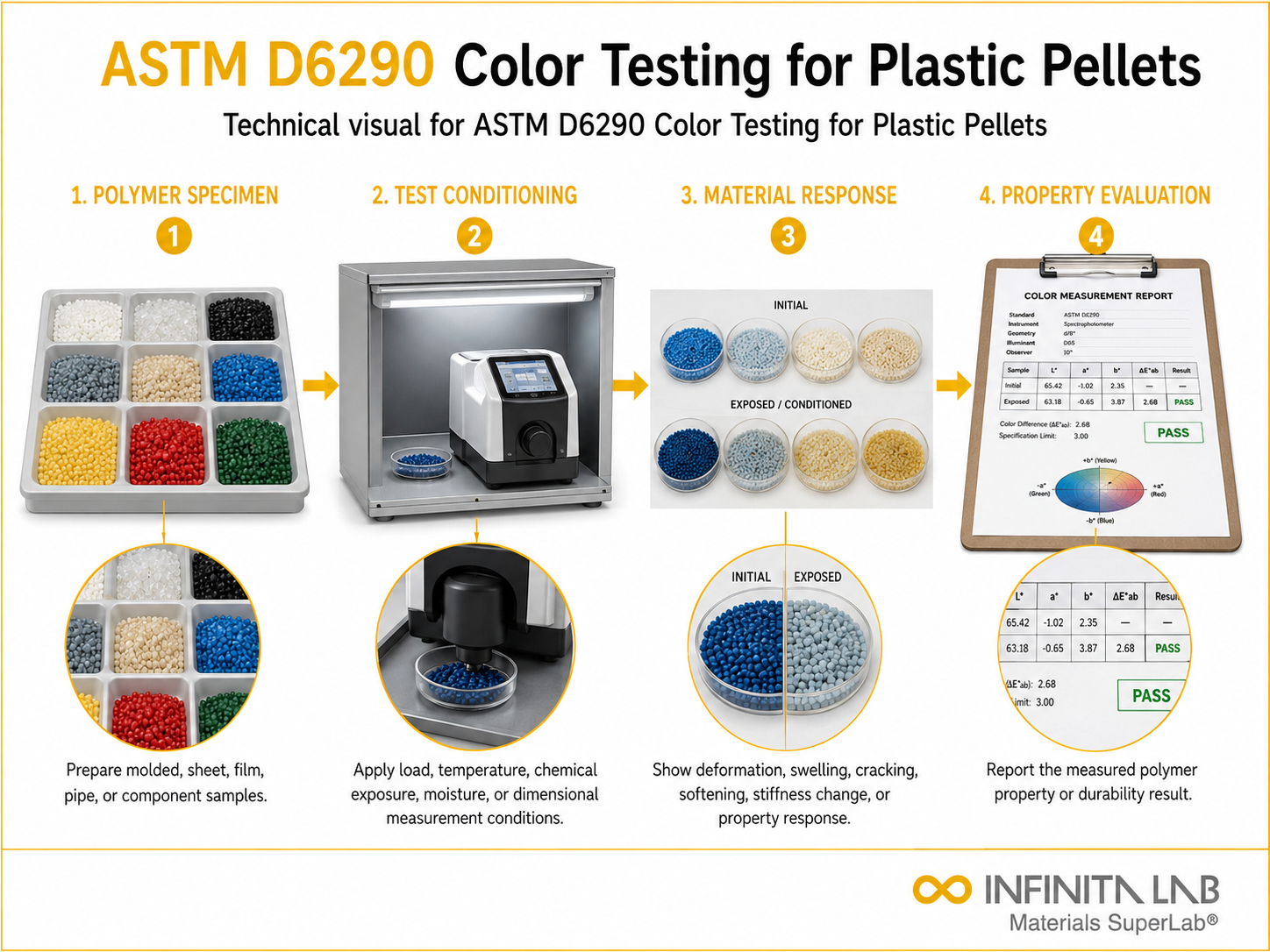
Our ASTM D6290 Testing Procedure
Sample Preparation
Plastic pellets are cleaned and uniformly arranged to ensure consistent surface presentation for measurement.
1Instrument Calibration
Spectrophotometer is calibrated using standard references to ensure accurate color readings.
2Color Measurement
Pellets are measured under controlled lighting and geometry to capture precise color values.
3Data Analysis
Color parameters are calculated and compared against specifications or reference standards.
4ASTM D6290 Test Parameters and Requirements
| Parameter | Details |
|---|---|
| Material Type | Plastic pellets (virgin, recycled, compounded) |
| Method Type | Instrumental color measurement |
| Light Source | Standardized illumination |
| Geometry | Defined viewing/measurement geometry |
| Output Parameters | L*, a*, b*, ΔE values |
| Sample Form | Uniform pellet surface arrangement |


- Spectrophotometer – Measures spectral reflectance or transmittance across the visible range to generate full tristimulus and derived color data.
- Tristimulus Colorimeter – A faster alternative, using filtered red, green, and blue sensors for a simplified color reading.
- White and Black Calibration Tiles – Verify the instrument’s accuracy before each testing session starts.
- Clear Glass Sample Cup – Holds the pellet specimen at a consistent depth, so the reading reflects the pellets, not the container or background.
- Opaque Light-Exclusion Cover – Shields the loaded sample from ambient light, keeping readings consistent run to run.
- Integrating Sphere Accessory – Pairs with diffuse-geometry instruments to capture light scattered in all directions from translucent or opaque pellets.
- Color Data Software – Converts raw tristimulus output into CIE L*, a*, b*, Hunter, or Yellowness Index values, formatted for reporting.
Equipment and Instrumentation Used for ASTM D6290 Testing
What You Receive: Test Report, Data, and Certification
- A detailed test report, stating the color values obtained (CIE L*, a*, b*, Hunter L, a, b, CIE X, Y, Z, and/or Yellowness Index) along with the geometry and illuminant used.
- Side-by-side comparison data, measured against a customer-supplied reference pellet or an agreed color standard.
- Documentation that fits incoming material acceptance, vendor qualification, or internal quality records.
- Traceable calibration records, confirming the instrument was verified before your samples were tested.
- Interpretive notes that flag any color drift, yellowing trend, or out-of-specification result worth a closer look.
- Raw data, retained for batch-to-batch trending, so patterns over time are easy to spot and troubleshoot.
ASTM D6290 Plastic Pellet Color FAQs
ASTM D6290-98e1 ensures objective and consistent color measurement of plastic pellets using instrumental methods. It helps manufacturers maintain uniform appearance, meet customer specifications, and avoid subjective errors associated with visual color assessment during production and quality control processes.
Instrumental measurement eliminates human perception variability by quantifying color using numerical values. This ensures repeatable and precise results, enabling accurate comparison between batches and maintaining consistent color quality across different production lots and testing environments
Factors include lighting conditions, instrument calibration, sample preparation, and pellet surface characteristics. Controlling these variables ensures accurate and repeatable color measurements.
Challenges include achieving uniform sample presentation, minimizing surface reflection variations, and maintaining instrument calibration. Proper procedures help overcome these issues and ensure accurate results.
Standardized lighting ensures consistent measurement conditions. Different light sources can alter perceived color, so controlled illumination is essential for obtaining reliable and comparable results.
Plastic pellets are placed in a calibrated color measurement instrument, such as a spectrophotometer. The instrument measures reflected light and reports color values such as L*, a*, and b* to evaluate color consistency and batch uniformity.
Why Choose Infinita Lab for Plastic Pellet Color Testing
When your Plastic Pellet Color results have to hold up - for compliance, a customer audit, or an engineering decision - ASTM D6290 accuracy and an unbiased third-party report matter more than price. Infinita Lab routes your ASTM D6290 plastic pellet color testing to ISO/IEC 17025-accredited U.S. partner labs with hands-on method experience, so you get defensible data, transparent reporting, and turnaround times built around your project deadline - not ours.

Need ASTM D6290 Plastic Pellet Color Testing You Can Rely On?
Send query us at hello@infinitalab.com or call us at (888) 878-3090 to learn more about our services and how we can support you.



Request a Quote
Submit your material details and receive testing procedures, pricing, and turnaround time within 24 hours.
 Quick Turnaround and Hasslefree process
 Confidentiality Guarantee
 Free, No-obligation Consultation
 100% Customer Satisfaction
