


ASTM D6191: Formaldehyde Emission Coating Testing Services
ASTM D6191-97 measures the amount of formaldehyde evolved from air-dry water-reducible coatings. Samples containing organic solvents are not compatible with this test method.
TRUSTED BY


Get ASTM D6191 compliant results — request your formaldehyde emission coating testing quote
- Overview
- Scope, Applications, and Benefits
- Test Process
- Specifications
- Instrumentation
- Results and Deliverables
What Is ASTM D6191 Formaldehyde Emission Coating?
ASTM D6191-97 is a standardized method used to measure the amount of formaldehyde released from water-reducible air-dry coatings under controlled conditions. Formaldehyde emissions are a critical concern due to their impact on indoor air quality, safety, and regulatory compliance in coating applications.
This method quantifies the evolved formaldehyde over a specified period, providing reliable data on emission levels from coatings during drying and curing. It is essential for evaluating formulation safety, ensuring compliance with environmental standards, and improving product quality by minimizing harmful emissions.

Applications and Benefits of ASTM D6191 Formaldehyde Emission Coating Testing
Scope
This test method determines the quantity of formaldehyde evolved from water-reducible air-dry coatings under controlled environmental conditions.
Includes:
- Measurement of formaldehyde emissions
- Applicability to water-reducible air-dry coatings
- Evaluation during drying and curing stages
- Quantitative emission analysis
- Support for safety and regulatory compliance
Applications
- Paints and coatings industry
- Indoor air quality assessment
- Product safety evaluation
- Regulatory compliance testing
- Coating formulation development
- Environmental testing laboratories
Benefits
- Ensures low formaldehyde emissions
- Supports compliance with environmental standards
- Improves indoor air safety
- Helps optimize coating formulations
- Enhances product acceptance
- Reduces health-related risks
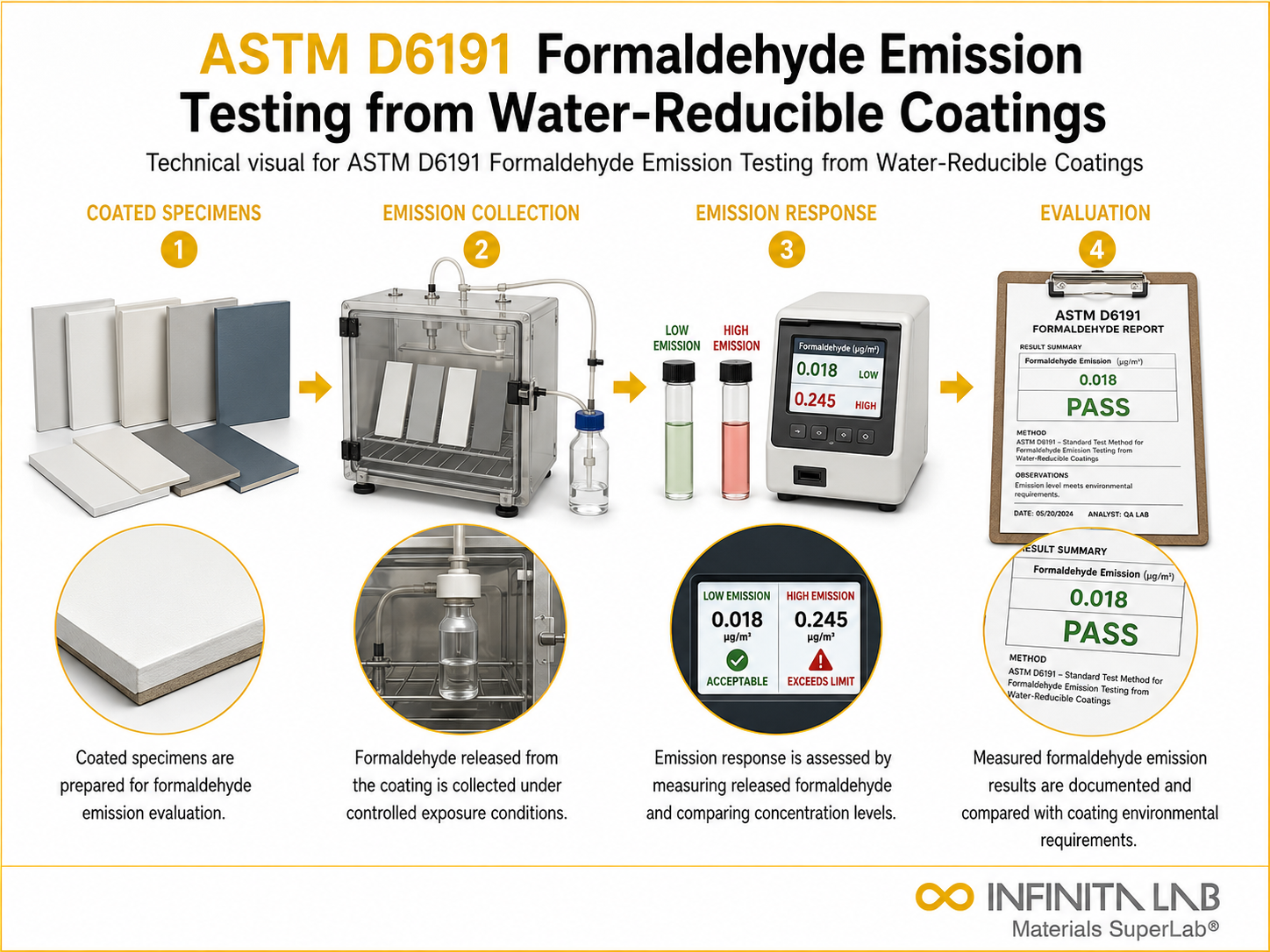
Our ASTM D6191 Testing Procedure
Sample Application
The coating is applied to a substrate and allowed to dry under specified conditions.
1Emission Collection
Evolved formaldehyde is captured using an appropriate collection system.
2Chemical Analysis
The collected formaldehyde is analyzed using suitable analytical techniques.
3Quantification
Formaldehyde emission is calculated based on collected sample and calibration data.
4ASTM D6191 Test Parameters and Requirements
| Parameter | Details |
|---|---|
| Property Measured | Formaldehyde emission |
| Material Type | Water-reducible air-dry coatings |
| Method | Emission collection and chemical analysis |
| Measurement Unit: | µg/m³ or mg/L |
| Test Condition | Controlled drying environment |
| Output | Quantitative emission value |
| Sensitivity | Trace-level detection |


- Emission test chamber or collection setup
- Sampling tubes or absorption media
- Spectrophotometer or chromatographic system
- Analytical balance
- Temperature and humidity control system
- Data acquisition system
Equipment and Instrumentation Used for ASTM D6191 Testing
What You Receive: Test Report, Data, and Certification
- Formaldehyde emission values
- Sampling and analysis data
- Test conditions and parameters
- Compliance with emission standards
- Product safety evaluation
- Detailed analytical report
ASTM D6191 Formaldehyde Emission Coating FAQs
Formaldehyde emissions can negatively impact indoor air quality and pose health risks. Measuring emissions helps ensure coatings are safe for use, comply with environmental regulations, and meet consumer expectations for low-emission products.
ASTM D6191-97 provides standardized and reliable data on formaldehyde release, enabling manufacturers to verify that their products meet regulatory limits and environmental safety requirements.
In enclosed spaces, even low formaldehyde emissions can accumulate and impact air quality. ASTM D6191-97 helps quantify emissions under realistic drying conditions, ensuring coatings meet safety expectations for residential, commercial, and institutional indoor applications.
Results highlight emission levels linked to specific additives or resins, enabling formulators to replace high-emission components. This supports development of low-emission coatings without compromising drying performance, adhesion, or durability.
The method provides quantifiable emission data required for comparison with regulatory limits. This helps manufacturers demonstrate compliance with environmental and safety standards applicable to coatings used in indoor applications.
Why Choose Infinita Lab for Formaldehyde Emission Coating Testing?
At the core of this breadth is our network of 2,000+ accredited laboratories across the USA, offering access to over 10,000 testing methods and analytical services. From advanced materials characterization (SEM, TEM, RBS, XPS) to mechanical, chemical, environmental, biological, and standardized ASTM/ISO-compliant testing, we deliver unmatched flexibility, specialization, and scale. You are never limited by geography, facility, or methodology — Infinita Lab connects you to the right expertise and testing solution, every time.

Looking for an Accredited Partner for ASTM D6191 Formaldehyde Emission Coating Testing?
Send query us at hello@infinitalab.com or call us at (888) 878-3090 to learn more about our services and how we can support you.



Request a Quote
Submit your material details and receive testing procedures, pricing, and turnaround time within 24 hours.
 Quick Turnaround and Hasslefree process
 Confidentiality Guarantee
 Free, No-obligation Consultation
 100% Customer Satisfaction
