

What Is ASTM D6137 Polymer Lining Sulfuric Acid Resistance?
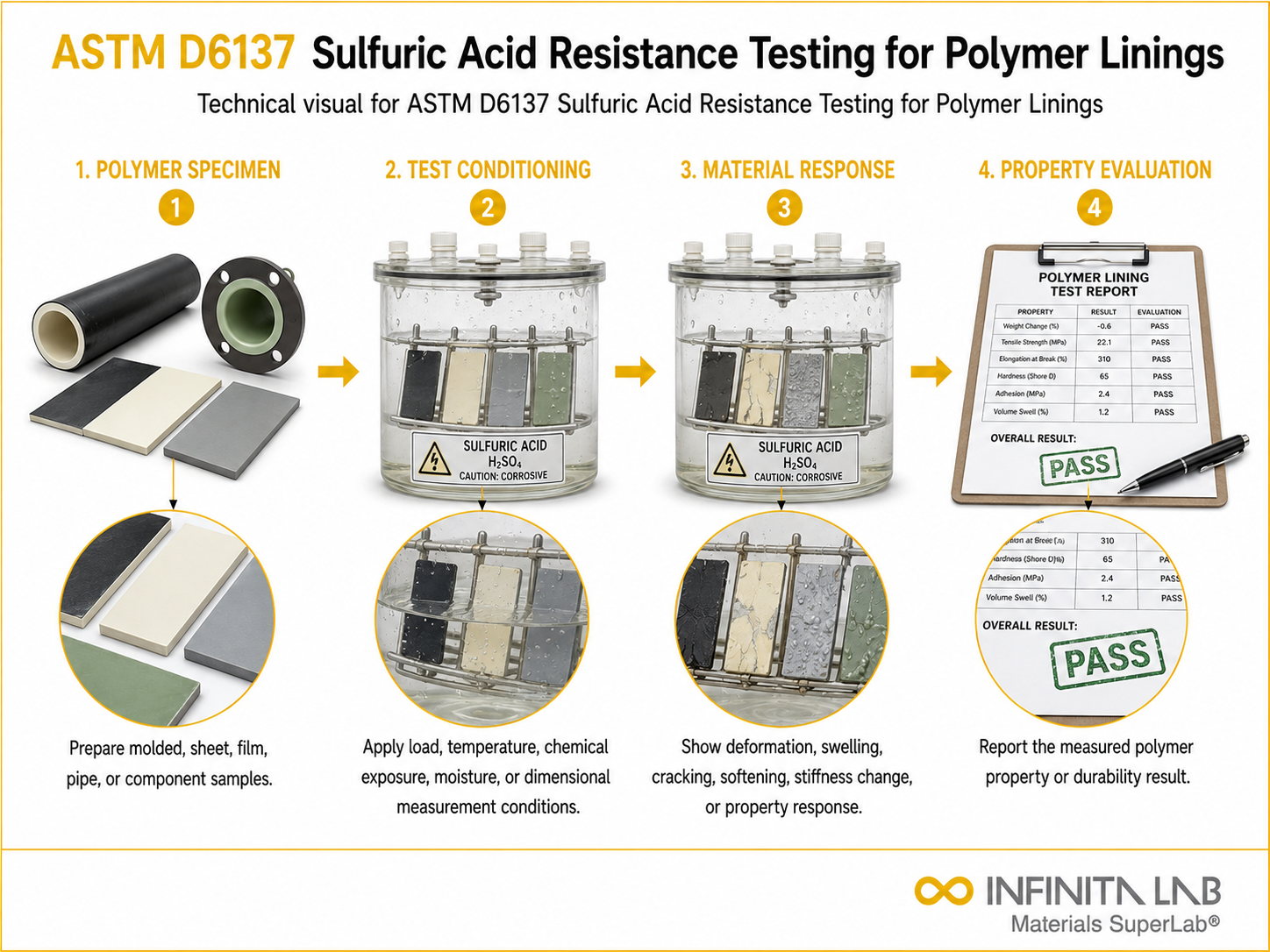
ASTM D6137 evaluates the resistance of polymer linings when exposed to sulfuric acid under controlled conditions. It determines how well protective linings withstand chemical attack, which is critical for maintaining integrity in corrosive environments.
This test is essential for assessing durability, chemical compatibility, and long-term performance of polymer linings used in storage tanks, pipelines, and process equipment. It helps ensure materials can resist degradation, swelling, or failure when exposed to aggressive acidic conditions.

Applications and Benefits of ASTM D6137 Polymer Lining Sulfuric Acid Resistance Testing
Scope
This test method determines the resistance of polymer linings to sulfuric acid exposure by evaluating physical and visual changes after immersion under specified conditions. It supports material selection and performance validation in corrosive environments.
Includes:
- Exposure of polymer linings to sulfuric acid
- Evaluation of physical and visual degradation
- Measurement of weight or dimensional changes
- Assessment of chemical compatibility
- Suitability for protective lining applications
Applications
- Chemical storage tanks and vessels
- Industrial pipelines and process equipment
- Waste treatment systems
- Acid handling and containment systems
- Protective linings in manufacturing plants
- Corrosion-resistant coating systems
Benefits
- Ensures resistance to aggressive chemical environments
- Supports material selection for corrosion protection
- Helps prevent premature failure of linings
- Improves safety and reliability of equipment
- Reduces maintenance and replacement costs
- Enables performance comparison of materials
Our ASTM D6137 Testing Procedure
Specimen Preparation
Polymer lining samples are prepared, cleaned, and conditioned according to standard requirements.
1Acid Exposure
Specimens are immersed in sulfuric acid at specified concentration and temperature for a defined period.
2Condition Evaluation
Samples are examined for physical changes such as swelling, cracking, or discoloration.
3Result Analysis
Changes in weight, dimensions, and appearance are recorded to assess resistance performance.
4ASTM D6137 Test Parameters and Requirements
| Parameter | Details |
|---|---|
| Property Measured | Chemical resistance |
| Test Medium | Sulfuric acid solution |
| Material Type | Polymer linings |
| Evaluation | Visual and physical changes |
| Measurement | Weight and dimensional variation |
| Exposure Condition | Controlled temperature and time |
| Output | Resistance rating |


- Chemical-resistant immersion containers
- Analytical balance
- Vernier calipers or micrometer
- Temperature-controlled bath or chamber
- Drying and conditioning equipment
- Inspection tools (visual and optical)
Equipment and Instrumentation Used for ASTM D6137 Testing
What You Receive: Test Report, Data, and Certification
- Weight change data
- Dimensional change measurements
- Visual degradation observations
- Chemical resistance evaluation
- Comparative material performance
- Detailed test report with compliance
ASTM D6137 Polymer Lining Sulfuric Acid Resistance FAQs
The ASTM D6137 test method is intended to evaluate the sulfuric acid resistance at elevated temperatures of polymer linings applied to carbon steel substrates subject to a sulfuric acid attack.
ASTM D6137 provides direct evidence of how polymer linings behave when exposed to sulfuric acid. This helps engineers select materials that resist degradation, ensuring long-term protection of equipment operating in highly corrosive industrial environments.
The test can reveal failures such as swelling, cracking, blistering, softening, or surface degradation. These issues indicate poor chemical resistance and can lead to leakage, contamination, or structural failure in real applications.
The test cannot evaluate the area inside the scrubbed gas streams at temperatures below the water dew point. The physical or mechanical effects and chemicals present in the flue gas can affect actual lining performance.
Higher acid concentrations typically increase the severity of chemical attack, leading to faster degradation. Testing at relevant concentrations ensures realistic evaluation of material performance under actual service conditions.
According to ASTM D6137, polymer linings applied to carbon steel panels are exposed to sulfuric acid at elevated temperatures. The specimens are evaluated for cracking, blistering, and other signs of deterioration to determine acid resistance.
According to ASTM D6137, polymer-coated steel panels are subjected to sulfuric acid exposure and controlled temperature cycles. The coatings are inspected for blistering, cracking, adhesion failure, and other damage to assess their chemical resistance.
Why Choose Infinita Lab for Polymer Lining Sulfuric Acid Resistance Testing
When your Polymer Lining Sulfuric Acid Resistance results have to hold up - for compliance, a customer audit, or an engineering decision - ASTM D6137 accuracy and an unbiased third-party report matter more than price. Infinita Lab routes your ASTM D6137 polymer lining sulfuric acid resistance testing to ISO/IEC 17025-accredited U.S. partner labs with hands-on method experience, so you get defensible data, transparent reporting, and turnaround times built around your project deadline - not ours.

Looking for an Accredited Partner for ASTM D6137 Polymer Lining Sulfuric Acid Resistance Testing?
Send query us at hello@infinitalab.com or call us at (888) 878-3090 to learn more about our services and how we can support you.