


ASTM D6095: Volume Resistivity Conductor Insulation Testing Services
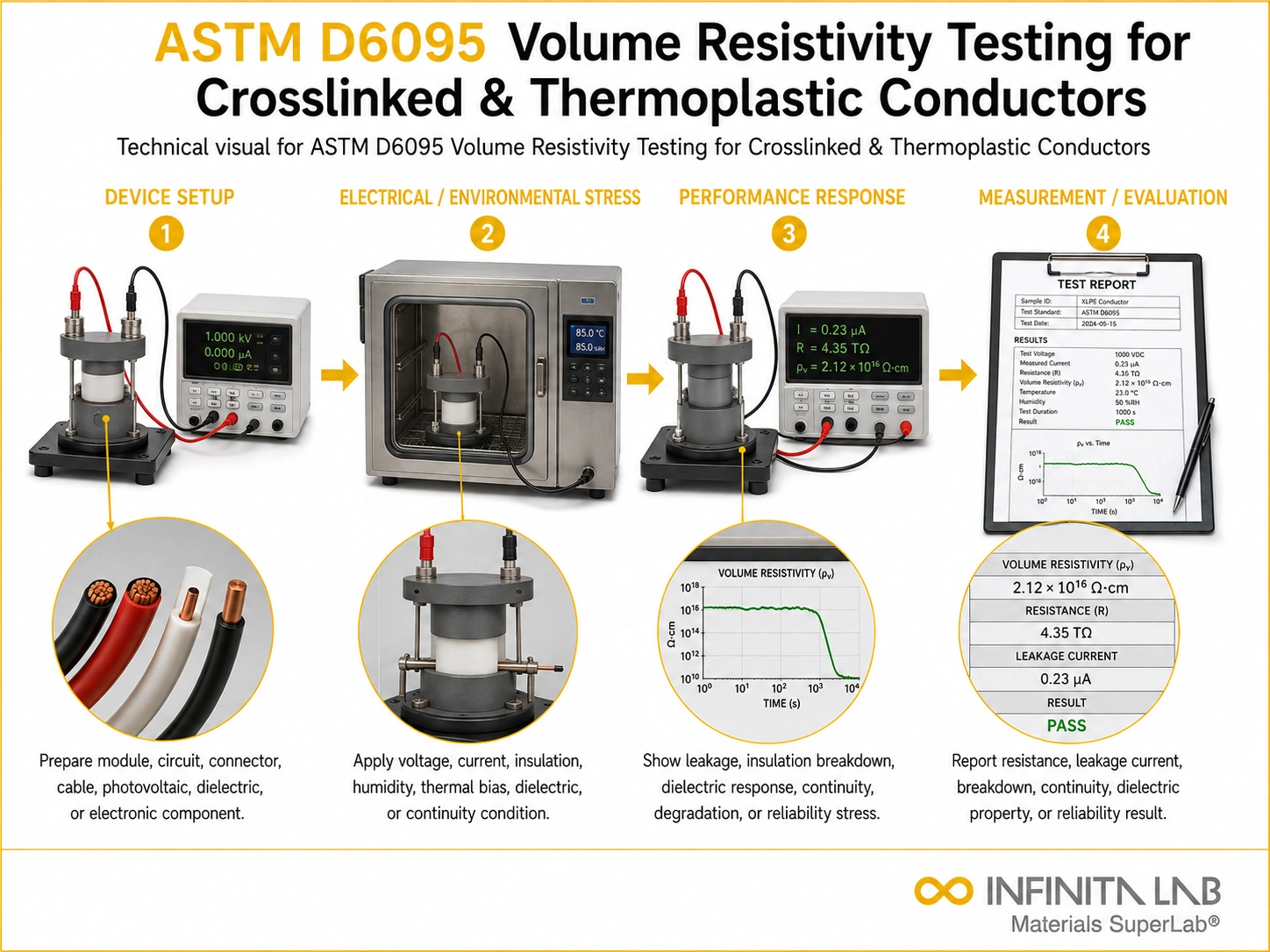
ASTM D6095 test method determines the properties of extruded crosslinked and thermoplastic semiconducting wires and cables by measuring their volume resistivity. The conductor shield is taken as the strand shield, and longitudinal volume resistivity is determined. The final results are expressed in SI Units.
TRUSTED BY


Get ASTM D6095 compliant results — request your volume resistivity conductor insulation testing quote
- Overview
- Scope, Applications, and Benefits
- Test Process
- Specifications
- Instrumentation
- Results and Deliverables
What Is ASTM D6095 Volume Resistivity Conductor Insulation?
ASTM D6095 is a standard test method for determining the volume resistivity of extruded crosslinked and thermoplastic semiconducting wires and cables. This test evaluates the electrical behavior of semiconducting compounds by measuring their electrical resistance.
The results help establish safety standards, current transmission efficiency, and charge dissipation characteristics. ASTM D6095 is critical for assessing the reliability and performance of power cables used in electrical and industrial applications.

Applications and Benefits of ASTM D6095 Volume Resistivity Conductor Insulation Testing
Scope
ASTM D6095 measures the volume resistivity of semiconducting shields used in wire and cable applications.
It evaluates:
- Electrical resistivity of conductor shields
- Insulation shield performance
- Current transmission behavior
- Charge dissipation properties
- Electrical safety characteristics
- Reliability of semiconducting compounds
This method applies to extruded thermoplastic and crosslinked semiconducting materials used in cable construction.
Applications
- Power transmission cables
- Electrical wiring systems
- Automotive wiring harnesses
- High-voltage cable insulation
- Industrial electrical systems
- Research laboratories
- Quality control testing
Benefits
- Provides standardized resistivity measurement
- Ensures electrical safety compliance
- Supports cable design optimization
- Helps select suitable semiconducting materials
- Improves product reliability
- Enables performance comparison between materials
Our ASTM D6095 Testing Procedure
Specimen Conditioning & Sample Preparation
The cable specimen is conditioned, and the conductor shield is exposed by bisecting the sample.
1Electrode Setup
Potential and current electrodes are positioned at a specified spacing.
2Resistance Measurement
Electrical resistance is measured with two readings for accuracy.
3Data Collection & Calculation
Readings are recorded, and volume resistivity is calculated using the standard formula.
4ASTM D6095 Test Parameters and Requirements
| Parameter | Details |
|---|---|
| Applicable Materials | Semiconducting wires and cables |
| Sample Length | 10 inches to 2 feet |
| Electrode Spacing | 50 mm (potential), 1 inch (current) |
| Conditioning Temperature | Standard laboratory conditions |


- Electrode assembly
- High-resistance meter
- Temperature-controlled chamber
- Precision calipers
- Data acquisition system
- Insulated test fixtures
Equipment and Instrumentation Used for ASTM D6095 Testing
What You Receive: Test Report, Data, and Certification
- Volume resistivity values
- Resistance measurement data
- Compliance certificates
- Material performance reports
- Quality control documentation
ASTM D6095 Volume Resistivity Conductor Insulation FAQs
ASTM D6095 determines the longitudinal volume resistivity of extruded crosslinked and thermoplastic semiconducting conductor and insulation shielding materials. The measurement helps characterize the electrical behavior of these materials used in wire and cable applications.
The method is specifically applicable to extruded crosslinked and thermoplastic semiconducting materials used as conductor shields and insulation shields for wire and cable. Conductor shields are also commonly referred to as strand shields.
ASTM D6095 measures the electrical resistance between electrodes on the specimen surface and uses the specimen's dimensions to calculate volume resistivity. The specimen geometry is designed so that the current path is primarily through the material volume between the electrodes.
Volume resistivity is an important indicator of the electrical behavior of semiconducting shielding materials. It can help evaluate characteristics related to safety, static-charge control, and current transmission and can be useful in predicting the behavior of semiconducting compounds.
ASTM D6095 testing supports material qualification, quality control, product development, and specification compliance for semiconducting conductor and insulation shielding materials. Consistent resistivity measurements help manufacturers verify that shielding compounds have the required electrical characteristics for their intended cable applications.
Why Choose Infinita Lab for Volume Resistivity Conductor Insulation Testing
At the core of this breadth is our network of 2,000+ accredited laboratories across the USA, offering access to over 10,000 testing methods and analytical services. From advanced materials characterization (SEM, TEM, RBS, XPS) to mechanical, chemical, environmental, biological, and standardized ASTM/ISO-compliant testing, we deliver unmatched flexibility, specialization, and scale. You are never limited by geography, facility, or methodology — Infinita Lab connects you to the right expertise and testing solution, every time.

Looking for an Accredited Partner for ASTM D6095 Volume Resistivity Conductor Insulation Testing?
Send query us at hello@infinitalab.com or call us at (888) 878-3090 to learn more about our services and how we can support you.



Request a Quote
Submit your material details and receive testing procedures, pricing, and turnaround time within 24 hours.
 Quick Turnaround and Hasslefree process
 Confidentiality Guarantee
 Free, No-obligation Consultation
 100% Customer Satisfaction
