


ASTM D516: Sulfate Ion Water Testing Services
Accredited ASTM D516 sulfate ion water testing from Infinita Lab, performed to the exact standard requirements - accurate, reproducible results with full documentation for compliance, R&D, and quality control programs.
TRUSTED BY


Get ASTM D516 compliant results - request your sulfate ion water testing quote
- Overview
- Scope, Applications, and Benefits
- Test Process
- Specifications
- Instrumentation
- Results and Deliverables
What Is ASTM D516 Sulfate Ion Water?
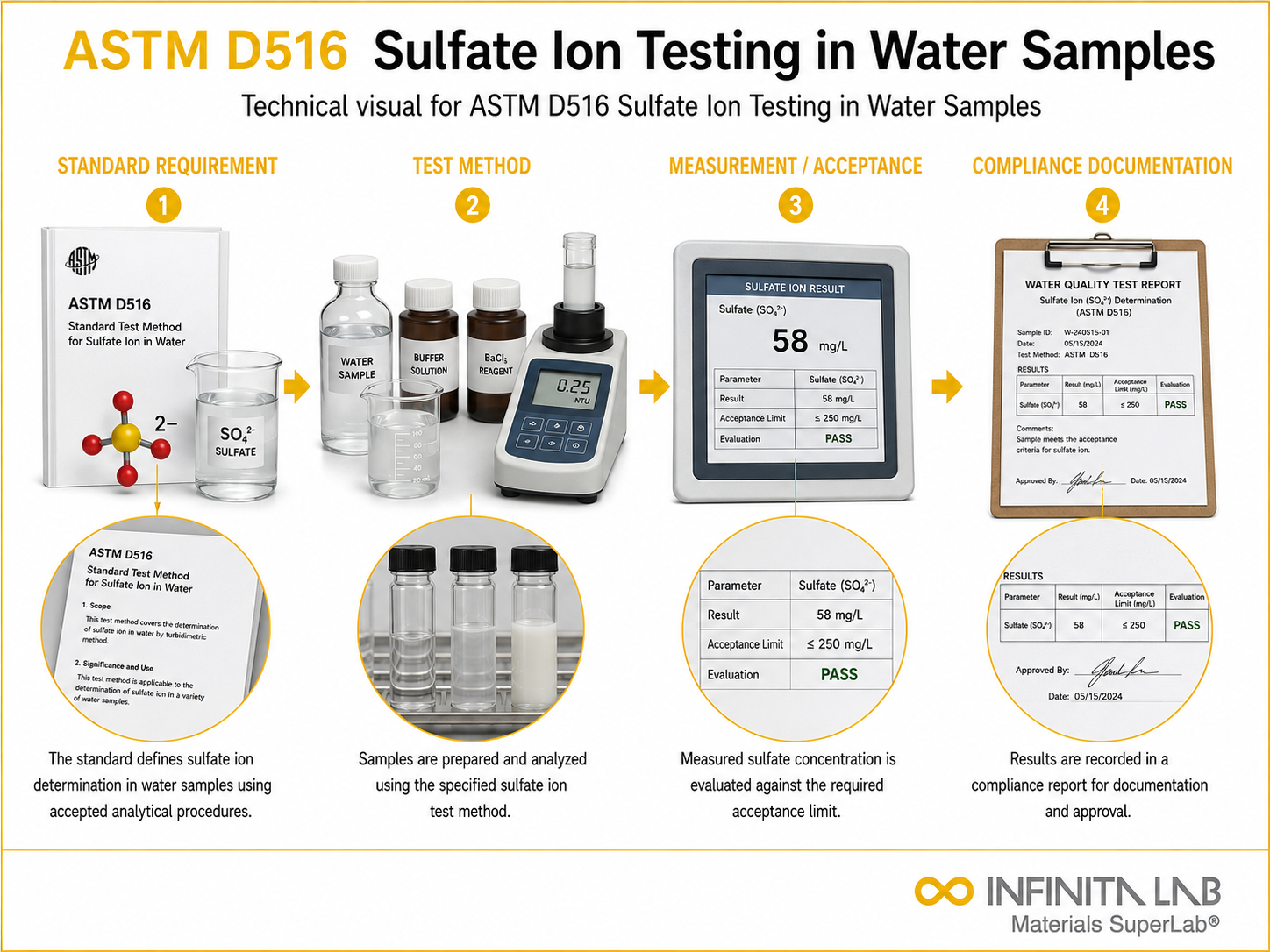
Sulfate is one of the most common dissolved constituents in natural and process waters, and measuring it accurately matters across drinking water systems, industrial processing, and boiler or cooling operations. ASTM D516, the Standard Test Method for Sulfate Ion in Water, describes a turbidimetric procedure for determining sulfate ion (SO₄²⁻) concentration and has become the standard reference technique used by water utilities, environmental laboratories, and industrial facilities to quantify sulfate in drinking, ground, and surface waters. Infinita Lab connects clients to accredited partner laboratories equipped to perform ASTM D516 testing with the precision and consistency the standard requires.
The method works by converting dissolved sulfate ions into a fine, uniform barium sulfate precipitate under carefully controlled conditions, using a barium chloride reagent along with a conditioning solution containing glycerin and sodium chloride that stabilises the resulting suspension. The turbidity produced by this suspension is then measured with a nephelometer, spectrophotometer, or photoelectric colourimeter and compared against a calibration curve built from known sulfate standards, allowing analysts to determine the sulfate concentration of the sample within the method’s defined working range.
Sulfate testing is important because elevated concentrations can affect water taste, contribute to scale formation in boilers and cooling systems, and cause corrosion or deterioration of concrete and other materials in contact with water over time. Sulfate is also subject to secondary regulatory guidance for drinking water due to its association with taste concerns and potential gastrointestinal effects at high concentrations. ASTM D516 gives engineers, water treatment operators, and environmental compliance teams a reliable, standardised way to monitor sulfate levels and make informed treatment and compliance decisions.

Applications and Benefits of ASTM D516 Sulfate Ion Water Testing
Scope
- ASTM D516 is a turbidimetric test method for determining sulfate ion (SO₄²⁻) concentration in water samples.
- The method applies to drinking water, groundwater, and surface water matrices.
- It has also been adapted for domestic and industrial wastewater under related turbidimetric protocols based on the same principle.
- The standard’s working concentration range is generally a few milligrams per litre up to approximately 40 mg/L of sulfate ion, with dilution required for higher concentrations.
- Address sample turbidity, colour, and suspended matter before analysis, as they can interfere with the turbidimetric measurement.
- Certain substances, including high levels of polyphosphate, silica, and chloride, are known interferents that can bias results if present above threshold concentrations.
- The former gravimetric and volumetric sulfate test methods have been discontinued in favour of the turbidimetric approach described in the current standard.
- Ion chromatography, described separately under ASTM D4327, is recognised as an alternative technique for sulfate determination, particularly when multiple anions must be measured simultaneously.
- The method requires standardised reagents, controlled precipitation conditions, and calibration against known sulfate standards to produce reliable, repeatable results.
- Proper sample handling and timely analysis help preserve sulfate integrity, since biological activity or matrix changes can otherwise alter results.
Applications
- Monitoring sulfate levels in municipal and private drinking water supplies for taste and secondary water quality considerations.
- Assessing groundwater and surface water quality in environmental monitoring and permitting programs.
- Evaluating boiler feedwater and makeup water quality to help manage scale-forming potential in steam generation systems.
- Supporting cooling tower and industrial process water treatment programs where sulfate contributes to scaling or corrosion risk.
- Characterising wastewater discharges for industrial and municipal treatment facilities subject to effluent monitoring requirements.
- Investigating sulfate sources in groundwater near mining, agricultural, or industrial sites as part of environmental site assessments.
- Verifying water quality inputs for construction and materials applications where sulfate exposure can affect concrete durability.
Benefits
- Provides a standardised, widely accepted method that produces results comparable across laboratories and over time.
- Offers a relatively fast, instrument-based turbidimetric procedure suited to routine and high-throughput sulfate monitoring.
- Helps operators identify scale-forming or corrosive tendencies in process water before they cause equipment damage or downtime.
- Supports regulatory and permit compliance reporting for drinking water and wastewater programs.
- Generates objective, defensible data that can inform water treatment strategy and chemical dosing decisions.
- Enables early detection of changes in water chemistry that may signal contamination or process upsets.
Our ASTM D516 Testing Procedure
Sample Preparation
A water sample is collected and prepared according to laboratory testing procedures.
1Reagent Addition
Chemical reagents are added to react with sulfate ions in the sample.
2Precipitation Reaction
Sulfate ions react to form a measurable compound or turbidity in the solution.
3Concentration Measurement
The sulfate concentration is determined using titration or turbidity measurement techniques.
4ASTM D516 Test Parameters and Requirements
| Parameter | Details |
|---|---|
| Material Tested | Water samples including drinking water, surface water, and wastewater. |
| Test Principle | Chemical reaction of sulfate ions with specific reagents to form measurable compounds. |
| Measurement Method | Turbidimetric or titration-based analysis. |
| Parameter Measured | Sulfate ion concentration in water. |
| Result Expression | Typically reported as milligrams per liter (mg/L) of sulfate. |
| Testing Environment | Laboratory-controlled analytical conditions. |


- Nephelometer – Measures the intensity of light scattered by the barium sulfate suspension to quantify turbidity.
- Spectrophotometer – Provides an alternative absorbance-based measurement of the barium sulfate suspension’s turbidity.
- Photoelectric Colourimeter – Used in some laboratories as an additional option for turbidity-based sulfate quantification.
- Analytical Balance – Ensures accurate weighing of barium chloride crystals and other reagents used in the procedure.
- Timers and Controlled Mixing Equipment – Maintain the precise reaction and measurement timing required for consistent precipitate formation.
- Volumetric Glassware – Delivers accurately measured sample and reagent volumes throughout the procedure.
- Ion Chromatography System – Available at partner labs as an alternative or confirmatory technique under ASTM D4327.
Equipment and Instrumentation Used for ASTM D516 Testing
What You Receive: Test Report, Data, and Certification
- A detailed laboratory report presenting the measured sulfate ion concentration in milligrams per litre for each submitted sample.
- Documentation of the analytical method used, including reference to ASTM D516 and any applicable sample preparation steps.
- Quality control data, such as calibration verification, blanks, and duplicate results, supporting the reliability of reported values.
- Chain-of-custody and sample handling records to support regulatory or contractual documentation requirements.
- Clear flagging of any results affected by interferences, dilution, or matrix-specific considerations.
- Support in interpreting results relative to project objectives, whether for compliance, process control, or investigative purposes.
ASTM D516 Sulfate Ion Water FAQs
ASTM D516 is a standard test method used to determine the concentration of sulfate ions present in water samples through chemical analysis.
High sulfate levels can affect water taste, cause scaling in pipes, and lead to corrosion in industrial systems.
The test can be used for drinking water, surface water, groundwater, and industrial wastewater samples.
High sulfate concentrations in drinking water may cause taste issues and digestive discomfort, especially for sensitive individuals.
Natural mineral deposits, industrial discharges, and agricultural runoff can contribute to sulfate presence in water sources.
ASTM D516-22 is the Standard Test Method for Sulfate Ion in Water. It is a turbidimetric method for determining sulfate ions (SO₄²⁻) in water, with an applicable range of 5–40 mg/L.
Sulfate ions in the water sample are converted into a barium sulfate (BaSO₄) suspension under controlled conditions. The resulting turbidity is measured using a nephelometer, spectrophotometer, or photoelectric colorimeter and compared with sulfate standards to determine the concentration.
The ASTM D516 sulfate turbidimetric method determines sulfate concentration by measuring the turbidity produced by suspended barium sulfate. The measured turbidity is compared with a calibration curve prepared from known sulfate standards.
Why Choose Infinita Lab for Sulfate Ion Water Testing
When your Sulfate Ion Water results have to hold up - for compliance, a customer audit, or an engineering decision - ASTM D516 accuracy and an unbiased third-party report matter more than price. Infinita Lab routes your ASTM D516 sulfate ion water testing to ISO/IEC 17025-accredited U.S. partner labs with hands-on method experience, so you get defensible data, transparent reporting, and turnaround times built around your project deadline - not ours.

Need ASTM D516 Sulfate Ion Water Testing You Can Rely On?
Send query us at hello@infinitalab.com or call us at (888) 878-3090 to learn more about our services and how we can support you.



Request a Quote
Submit your material details and receive testing procedures, pricing, and turnaround time within 24 hours.
 Quick Turnaround and Hasslefree process
 Confidentiality Guarantee
 Free, No-obligation Consultation
 100% Customer Satisfaction
