


ASTM D4660: TDI Isomer Content Testing Services
ASTM D4660 test method determines the isomer content of toluene-2,6-diisocyanate and toluene-2,4-diisocyanate in the mixture of 2,4- and 2,6-toluene diisocyanate isomers. To get accurate results over a broad range of isomer concentrations, two different test methods are applied. The final results are expressed in SI Units.
TRUSTED BY


Get ASTM D4660 compliant results — request your TDI isomer content testing quote
- Overview
- Scope, Applications, and Benefits
- Test Process
- Specifications
- Instrumentation
- Results and Deliverables
What Is ASTM D4660 TDI Isomer Content?
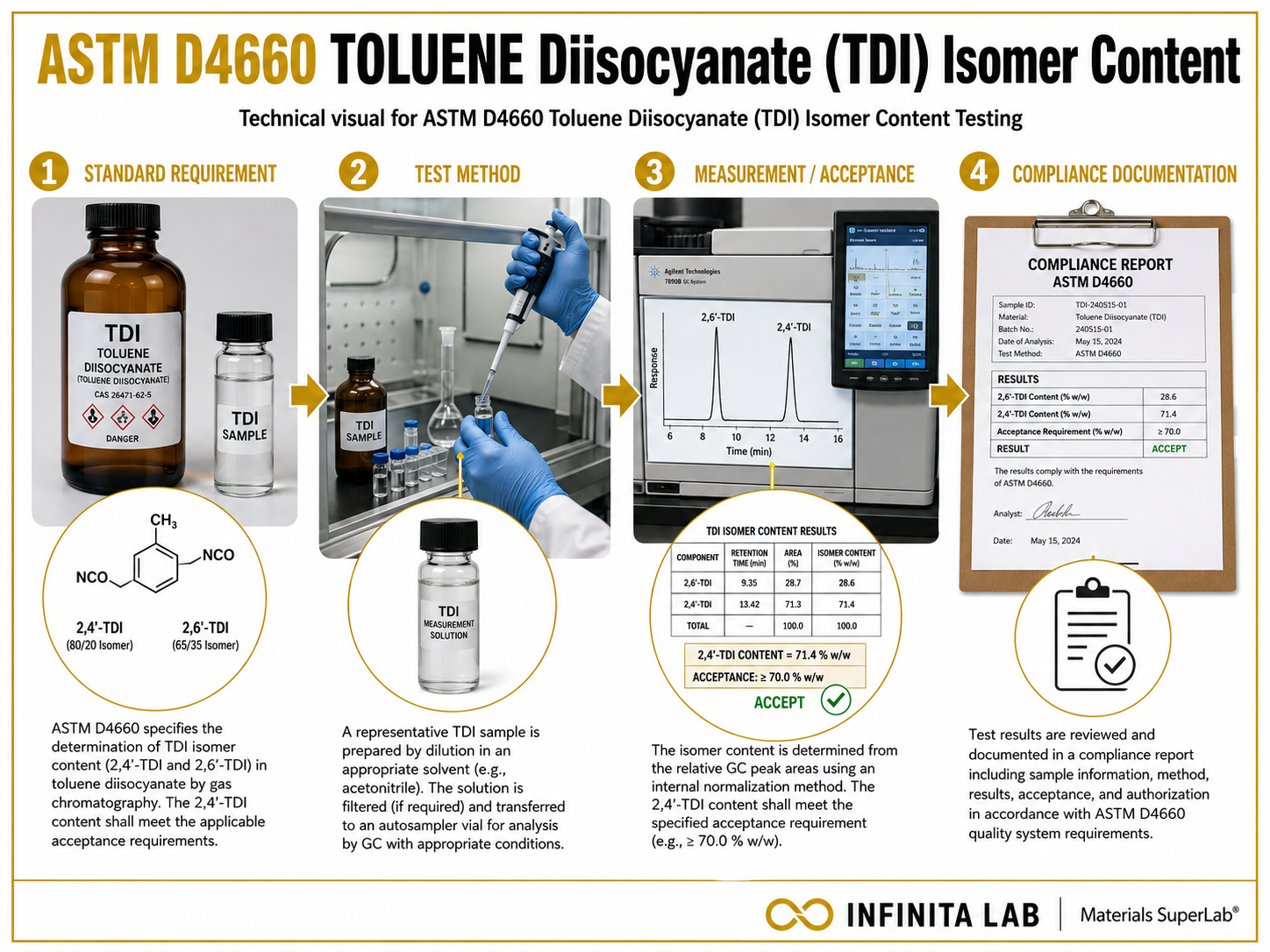
ASTM D4660 defines a standardized gas chromatographic method for determining the isomer content of toluene diisocyanate (TDI), specifically the ratio of 2,4-TDI to 2,6-TDI. TDI is commercially produced predominantly as an 80/20 mixture of the 2,4- and 2,6-isomers (TDI-80) or as a 65/35 mixture (TDI-65), and the precise isomer ratio influences the reactivity, foam processing behavior, and physical properties of the resulting polyurethane products.
The test uses gas chromatography with a capillary column and flame ionization detection to separate and quantify the two TDI isomers. The relative peak areas provide the isomer ratio. Accurate isomer-content data is required for polyurethane foam formulators to ensure consistent processing and product quality, and for TDI producers to verify compliance with product specifications.

Applications and Benefits of ASTM D4660 TDI Isomer Content Testing
Scope
ASTM D4660 evaluates:
- 2,4-TDI isomer content (mole percent or weight percent)
- 2,6-TDI isomer content (mole percent or weight percent)
- 2,4- to 2,6-TDI isomer ratio
- Batch-to-batch isomer ratio consistency
- Compliance with TDI-80 or TDI-65 grade specifications
- Isomer distribution effects on reactivity and foam properties
Applications
- Flexible polyurethane foam TDI raw material qualification
- TDI manufacturer quality control
- Polyurethane slab and molded foam production
- Polyurethane elastomer formulation
- Polyurethane coatings and adhesives
- Incoming raw material inspection for foam producers
- Research and development in polyurethane chemistry
Benefits
- Verifies TDI grade and isomer specification compliance
- Enables consistent polyurethane processing and foam quality
- Detects off-spec or mislabeled TDI shipments
- Supports formulation optimization for specific foam properties
- Provides traceability documentation for TDI raw materials
- Reduces batch-to-batch variability in foam production
Our ASTM D4660 Testing Procedure
Sample Preparation
TDI sample is diluted in an appropriate solvent and prepared for GC injection.
1GC Analysis
Sample is injected onto a capillary GC column; 2,4- and 2,6-TDI isomers are separated.
2Peak Identification
Isomers are identified by retention time using certified TDI reference standards.
3Quantification
Isomer percentages are calculated from relative peak areas using response factors.
4Equipment and Instrumentation Used for ASTM D4660 Testing
| Parameter | Details |
|---|---|
| Test Principle | Capillary gas chromatography with FID |
| Detector | Flame ionization detector (FID) |
| Applicable Materials | Toluene diisocyanate (TDI) |
| Output Units | Mole percent (%) or weight percent (%) |
| Measured Outputs | 2,4-TDI %, 2,6-TDI %, isomer ratio |


- Gas chromatograph with FID and capillary column
- Certified TDI isomer reference standards
- Analytical balance
- Appropriate solvents for sample dilution
- Isocyanate-compatible sample vials
- Data acquisition and peak integration software
What You Receive: Test Report, Data, and Certification
What You Receive: Test Report, Data, and Certification
- 2,4-TDI and 2,6-TDI isomer content (%)
- Isomer ratio (2,4:2,6)
- GC chromatogram with peak assignments
- Batch compliance evaluation
- Compliance reports
ASTM D4660 TDI Isomer Content FAQs
ASTM D4660 determines isomer content of toluene diisocyanate. It evaluates ratio of 2,4-TDI and 2,6-TDI isomers, helping ensure consistency and performance in polyurethane manufacturing applications.
Key parameters include sample preparation, analytical technique such as chromatography, calibration standards, and temperature control. Controlled conditions ensure accurate determination of isomer composition in TDI samples.
The test measures percentage of different TDI isomers present. Results indicate composition balance and influence reactivity and performance in polyurethane systems.
ASTM D4660 applies to toluene diisocyanate used in polyurethane foams, coatings, adhesives, and elastomers where isomer composition affects processing and final properties.
ASTM D4660 results depend on analytical accuracy and sample purity. Interferences or improper calibration may affect results, requiring additional validation methods for precise characterization of isomer content.
Why Choose Infinita Lab for TDI Isomer Content Testing?
At the core of this breadth is our network of 2,000+ accredited laboratories across the USA, offering access to over 10,000 testing methods and analytical services. From advanced materials characterization (SEM, TEM, RBS, XPS) to mechanical, chemical, environmental, biological, and standardized ASTM/ISO-compliant testing, we deliver unmatched flexibility, specialization, and scale. You are never limited by geography, facility, or methodology — Infinita Lab connects you to the right expertise and testing solution, every time.

Looking for an Accredited Partner for ASTM D4660 TDI Isomer Content Testing?
Send query us at hello@infinitalab.com or call us at (888) 878-3090 to learn more about our services and how we can support you.



Request a Quote
Submit your material details and receive testing procedures, pricing, and turnaround time within 24 hours.
 Quick Turnaround and Hasslefree process
 Confidentiality Guarantee
 Free, No-obligation Consultation
 100% Customer Satisfaction
