


ASTM D4607: Activated Carbon Iodine Number Testing Services
Accredited ASTM D4607 activated carbon iodine number testing from Infinita Lab, performed to the exact standard requirements - accurate, reproducible results with full documentation for compliance, R&D, and quality control programs.
TRUSTED BY


Get ASTM D4607 compliant results - request your activated carbon iodine number testing quote
- Overview
- Scope, Applications, and Benefits
- Test Process
- Specifications
- Instrumentation
- Results and Deliverables
What Is ASTM D4607 Activated Carbon Iodine Number?
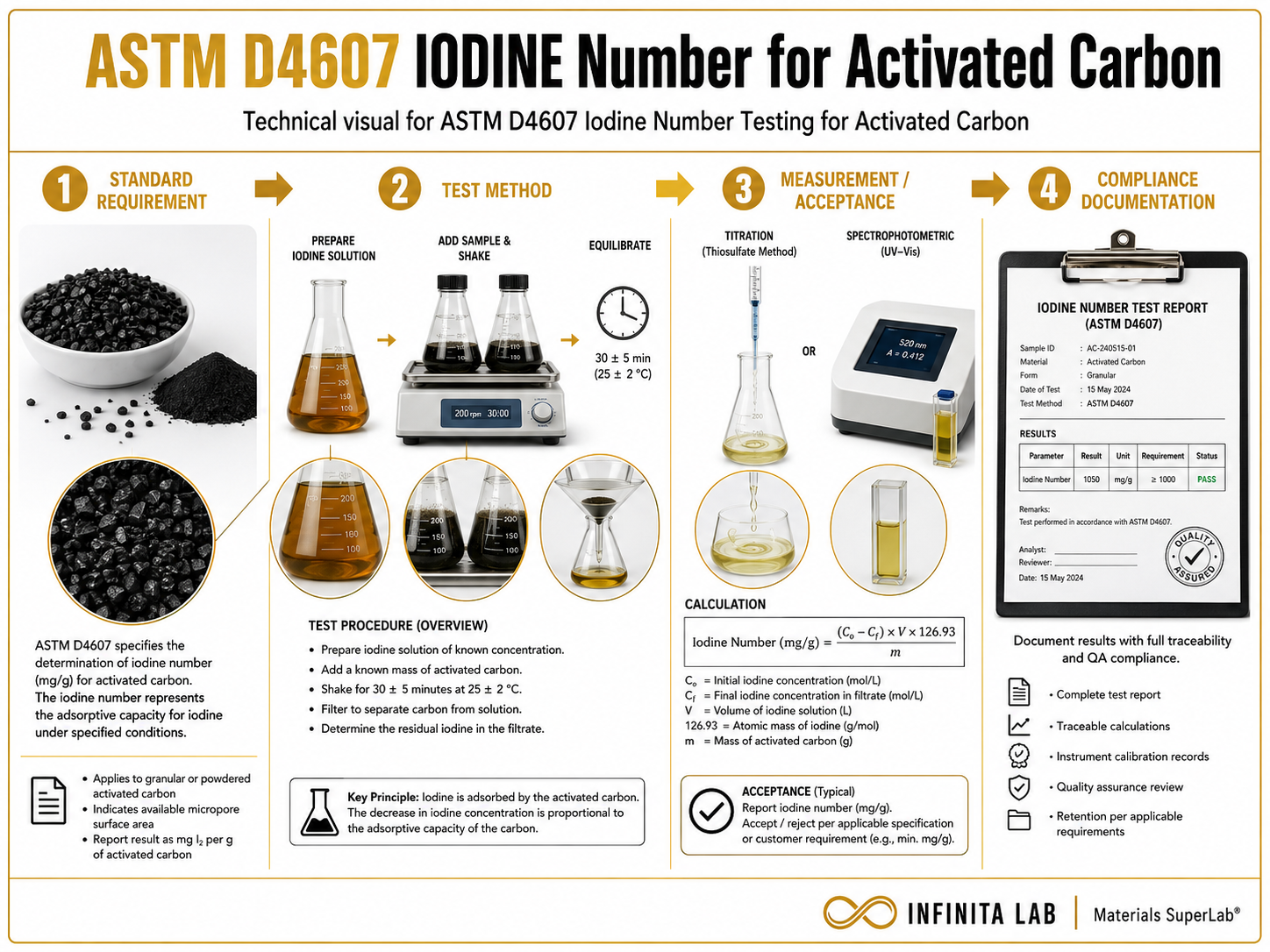
ASTM D4607 determines the iodine number of activated carbon, which indicates its adsorption capacity and micropore content. The test measures how much iodine is adsorbed by the carbon under specified conditions, reflecting its surface area and effectiveness.
This method is widely used in the water treatment, environmental, and chemical industry to evaluate activated carbon used in filtration and purification systems. The iodine number is a key quality parameter that helps assess performance in removing contaminants and improving adsorption efficiency.

Applications and Benefits of ASTM D4607 Activated Carbon Iodine Number Testing
Scope
ASTM D4607 measures the adsorption capacity of activated carbon by determining the amount of iodine it can adsorb from solution.
It helps evaluate pore structure, surface area, and suitability for purification applications.
- Iodine adsorption capacity measurement
- Micropore content evaluation
- Surface area estimation
- Activated carbon quality assessment
- Performance comparison of carbon grades
- Filtration efficiency evaluation
- Quality control and compliance
Applications
- Water and wastewater treatment
- Air purification systems
- Industrial filtration processes
- Chemical processing
- Environmental remediation
Benefits
- Indicates adsorption efficiency
- Helps select suitable activated carbon
- Improves filtration performance
- Supports quality control
- Ensures compliance with standards
- Enhances contaminant removal
- Enables material comparison
Our ASTM D4607 Testing Procedure
Sample Preparation
Activated carbon sample is dried and weighed accurately before testing.
1Iodine Solution Addition
Standard iodine solution is added to the sample under controlled conditions.
2Adsorption and Filtration
Iodine is adsorbed by carbon and remaining solution is filtered.
3Titration and Calculation
Residual iodine is titrated to calculate iodine number.
4ASTM D4607 Test Parameters and Requirements
| Parameter | Details |
|---|---|
| Material Type | Activated carbon (powdered or granular). |
| Reagent Used | Standard iodine solution. |
| Measured Parameter | Iodine number (adsorption capacity). |
| Result Unit | mg/g of iodine adsorbed. |
| Sample Condition | Dry and contamination-free carbon. |
| Test Environment | Controlled temperature conditions. |
| Filtration Step | Removal of carbon particles before titration. |
| End Point Detection | Color change during titration. |


- Analytical balance
- Burette and titration setup
- Filtration apparatus
- Glassware (flasks, beakers)
- Drying oven
- Stirring equipment
Equipment and Instrumentation Used for ASTM D4607 Testing
What You Receive: Test Report, Data, and Certification
- Iodine number values (mg/g)
- Adsorption capacity evaluation
- Carbon quality assessment
- Comparative performance analysis
- Compliance with ASTM D4607
- Test documentation
- Final test certification
ASTM D4607 Activated Carbon Iodine Number FAQs
ASTM D4607 is used to determine the iodine number of activated carbon, which reflects its adsorption capacity and micropore structure, helping evaluate its effectiveness in filtration and purification applications.
The iodine number indicates the amount of micropores and surface area available for adsorption, directly affecting the carbon’s ability to remove contaminants from liquids and gases.
A higher iodine number indicates greater adsorption capacity and higher micropore content, making the activated carbon more effective for removing small molecular contaminants.
Iodine number is an indirect measure of surface area, particularly micropores, which are critical for adsorption of small molecules.
The test mainly reflects micropore adsorption and may not fully represent performance for larger molecules, requiring additional tests for comprehensive evaluation.
ASTM D4607 determines the iodine number of activated carbon to assess its relative activation level and porosity. The result is expressed as milligrams of iodine adsorbed per gram of carbon, helping evaluate its adsorption capacity.
ASTM D4607 involves mixing a standard iodine solution with different amounts of activated carbon, filtering the mixtures, and measuring the remaining iodine by titration. The results are used to calculate the iodine number, which indicates the carbon's relative porosity and activation level.
Why Choose Infinita Lab for Activated Carbon Iodine Number Testing
When your Activated Carbon Iodine Number results have to hold up - for compliance, a customer audit, or an engineering decision - ASTM D4607 accuracy and an unbiased third-party report matter more than price. Infinita Lab routes your ASTM D4607 activated carbon iodine number testing to ISO/IEC 17025-accredited U.S. partner labs with hands-on method experience, so you get defensible data, transparent reporting, and turnaround times built around your project deadline - not ours.

Need ASTM D4607 Activated Carbon Iodine Number Testing You Can Rely On?
Send query us at hello@infinitalab.com or call us at (888) 878-3090 to learn more about our services and how we can support you.



Request a Quote
Submit your material details and receive testing procedures, pricing, and turnaround time within 24 hours.
 Quick Turnaround and Hasslefree process
 Confidentiality Guarantee
 Free, No-obligation Consultation
 100% Customer Satisfaction
