


ASTM D421: Soil Sample Preparation Testing Services
Accredited ASTM D421 soil sample preparation testing from Infinita Lab, performed to the exact standard requirements - accurate, reproducible results with full documentation for compliance, R&D, and quality control programs.
TRUSTED BY


Get ASTM D421 compliant results - request your soil sample preparation testing quote
- Overview
- Scope, Applications, and Benefits
- Test Process
- Specifications
- Instrumentation
- Results and Deliverables
What Is ASTM D421 Soil Sample Preparation?
ASTM D421, Standard Practice for Dry Preparation of Soil Samples for Particle-Size Analysis and Determination of Soil Constants, isn’t a test in the way most people picture testing. It doesn’t produce a number, a limit, or a pass/fail result on its own. Instead, it’s the groundwork – the disciplined, repeatable way a soil sample gets air-dried, broken apart, and sieved before anyone runs particle-size analysis or Atterberg limits work on it. Skip this step, or do it inconsistently, and every downstream result built on top of it becomes suspect.
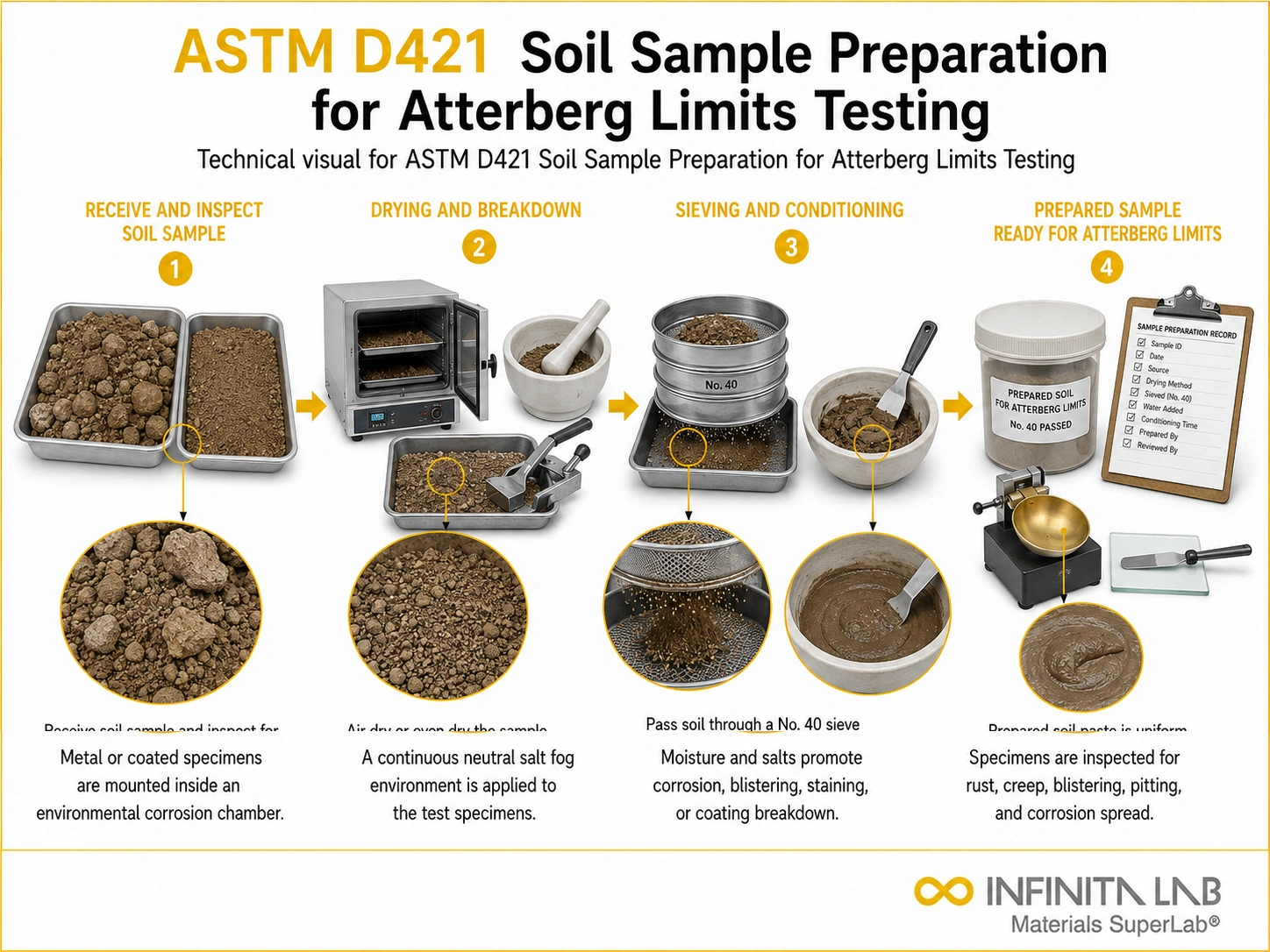
Field soil rarely arrives at a laboratory in a state that’s ready for classification testing. Clumps of clay bind fine particles together, moisture content varies from sample to sample, and coarse fragments sit mixed in with the fines that matter most for plasticity and gradation work. ASTM D421 addresses that by specifying how technicians air-dry the material at a controlled, moderate temperature, then use a mortar and rubber-covered pestle to break up soil aggregations without crushing the individual mineral particles themselves – a distinction that matters enormously for accurate gradation results. The sample then passes through a defined sequence of sieves, typically No. 4, No. 10, and No. 40, with material retained on each sieve reground and re-sieved until the fractions are properly separated and representative portions are split out for the tests that follow.
The output of D421 is a properly conditioned, sub-sampled soil specimen ready to feed into ASTM D422 (or its modern successors, D6913 and D7928) for particle-size distribution, and into ASTM D4318 for liquid limit, plastic limit, and plasticity index. Get the prep wrong, and those downstream numbers won’t reflect the actual soil. Infinita Lab connects clients with accredited geotechnical laboratories equipped to handle this preparation correctly, every time.

Applications and Benefits of ASTM D421 Soil Sample Preparation Testing
Scope
ASTM D421 outlines procedures for drying, disaggregating, and preparing soil samples before laboratory analysis. The method ensures that soil samples are properly conditioned for determining soil constants and particle-size distribution.
The scope includes:
- Covers the dry preparation of soil samples collected from the field so they’re ready for particle-size analysis and soil constants testing.
- Applies to natural soils such as sands, silts, and clays, as well as blended or disturbed samples submitted for classification work.
- Specifies air-drying at a controlled temperature that avoids altering the natural characteristics of the soil.
- Describes the use of a mortar and rubber-covered pestle to disaggregate soil clumps without fracturing individual particles.
- Establishes a sieving sequence, generally through No. 4, No. 10, and No. 40 sieves, to separate the sample into workable size fractions.
- Requires representative sample splitting or quartering so the portions carried forward for testing accurately reflect the parent sample.
- Sets minimum retained masses for the fractions used in subsequent particle-size and plasticity testing.
- Functions as a companion practice to ASTM D422/D6913/D7928 and is treated as a prerequisite step by many accreditation programs.
- Offers an alternative to wet preparation methods for soils where air-drying doesn’t meaningfully affect the results.
- Does not itself generate a gradation curve, plasticity index, or any other reportable engineering value.
Applications
- Supports geotechnical investigations where soil classification data feeds directly into foundation design decisions.
- Used ahead of subgrade evaluation for highway, airfield, and pavement construction projects.
- Provides prepared specimens for earthwork quality control on grading and embankment projects.
- Feeds into borrow-source evaluation, helping engineers confirm that a proposed fill material meets project specifications.
- Applied in environmental and agricultural soil studies where particle-size distribution informs drainage or erosion assessments.
- Forms part of routine construction materials testing programs for site development and infrastructure work.
- Supports research and academic soil mechanics work that requires consistent, repeatable sample conditioning.
Benefits
- Produces consistent, well-conditioned specimens so that downstream gradation and plasticity results are comparable across samples and labs.
- Reduces the risk of skewed results caused by particle crushing, uneven drying, or non-representative sub-sampling.
- Aligns preparation practices with the expectations of accreditation bodies that require D421 alongside D422 testing.
- Saves project teams time by standardising a step that would otherwise be handled inconsistently from lab to lab.
- Improves confidence in classification data used for critical decisions like foundation type selection and fill approval.
- Establishes a documented, defensible chain of preparation that supports quality assurance and regulatory review.
Our ASTM D421 Testing Procedure
Sample Collection
A representative soil sample is collected from the field and transported to the laboratory.
1Drying the Soil
The soil sample is air-dried or oven-dried to remove moisture before preparation.
2Disaggregation of Soil Clods
Soil lumps are gently broken using suitable tools without crushing the individual particles.
3Sample Preparation for Testing
The prepared soil is mixed and made ready for particle-size analysis and determination of soil constants.
4ASTM D421 Test Parameters and Requirements
| Parameter | Details |
|---|---|
| Material Tested | Natural soil samples collected from field locations. |
| Preparation Method | Dry preparation before particle-size and soil constant analysis. |
| Drying Method | Air drying or controlled oven drying to remove moisture. |
| Sample Handling | Soil clods are disaggregated carefully to avoid particle breakage. |
| Particle Integrity | Individual soil grains must remain intact during preparation |
| Laboratory Conditions | Preparation conducted under controlled laboratory conditions. |


- Precision balances – Used to weigh the sample and its separated fractions accurately at each stage of preparation.
- Drying oven or air-drying trays – Used to bring the sample to a controlled, moderate-temperature dry state before disaggregation.
- Mortar and rubber-covered pestle – Used to break up soil aggregations while preserving the integrity of individual particles.
- Brass test sieves (No. 4, No. 10, No. 40) – Used to separate the soil into defined particle-size fractions.
- Mechanical sieve shaker – Used to agitate sieve stacks consistently, improving the repeatability of the separation.
- Riffle-type sample splitter – Used to divide the soil into representative, evenly proportioned sub-samples.
- Sample containers and labelling supplies – Used to track and preserve each fraction through to the testing stage.
Equipment and Instrumentation Used for ASTM D421 Testing
What You Receive: Test Report, Data, and Certification
- A properly conditioned, dry soil specimen split into representative fractions and ready for particle-size or Atterberg limits testing.
- A documented record of retained masses for each sieve fraction generated during preparation.
- Chain-of-custody and preparation notes tying the prepared specimen back to the original field sample.
- Confirmation that the sample was handled in accordance with the applicable preparation practice, supporting downstream test validity.
- Coordination with the receiving laboratory so prepared fractions move directly into particle-size analysis or plasticity testing without delay.
- A single point of contact managing the preparation step alongside any subsequent testing the client has ordered.
ASTM E1019 Carbon Sulfur Nitrogen Oxygen Alloy FAQs
ASTM D421 is a standard practice used for the dry preparation of soil samples before performing particle-size analysis and determining soil constants. It ensures accurate and representative soil testing.
Proper preparation removes soil clumps and separates particles while preserving their natural size and structure. This helps obtain accurate and reliable laboratory results.
Crushing particles changes the actual particle-size distribution, which can lead to incorrect soil classification and inaccurate test results.
Prepared samples are used for sieve analysis, hydrometer analysis, Atterberg limits testing, and other soil property evaluations.
The method can be used for various natural soils, including sands, silts, and clays collected for laboratory analysis.
Why Choose Infinita Lab for Soil Sample Preparation Testing
When your Soil Sample Preparation results have to hold up - for compliance, a customer audit, or an engineering decision - ASTM D421 accuracy and an unbiased third-party report matter more than price. Infinita Lab routes your ASTM D421 soil sample preparation testing to ISO/IEC 17025-accredited U.S. partner labs with hands-on method experience, so you get defensible data, transparent reporting, and turnaround times built around your project deadline - not ours.

Need ASTM D421 Soil Sample Preparation Testing You Can Rely On?
Send query us at hello@infinitalab.com or call us at (888) 878-3090 to learn more about our services and how we can support you.



Request a Quote
Submit your material details and receive testing procedures, pricing, and turnaround time within 24 hours.
 Quick Turnaround and Hasslefree process
 Confidentiality Guarantee
 Free, No-obligation Consultation
 100% Customer Satisfaction
