

What Is ASTM D4186 Soil Consolidation Controlled Strain?
ASTM D4186/D4186M, Standard Test Method for One-Dimensional Consolidation Properties of Saturated Cohesive Soils Using Controlled-Strain Loading, determines the magnitude and rate of consolidation of saturated cohesive soils through continuous axial compression at a controlled rate of strain. Most people call it constant rate-of-strain, or CRS, testing. ASTM Committee D18 on Soil and Rock holds the standard, and Subcommittee D18.05 develops it. Standards distributors list D4186/D4186M-20e2 as the latest edition. That’s the 2020 edition with a second editorial revision. Earlier editions are marked historical.
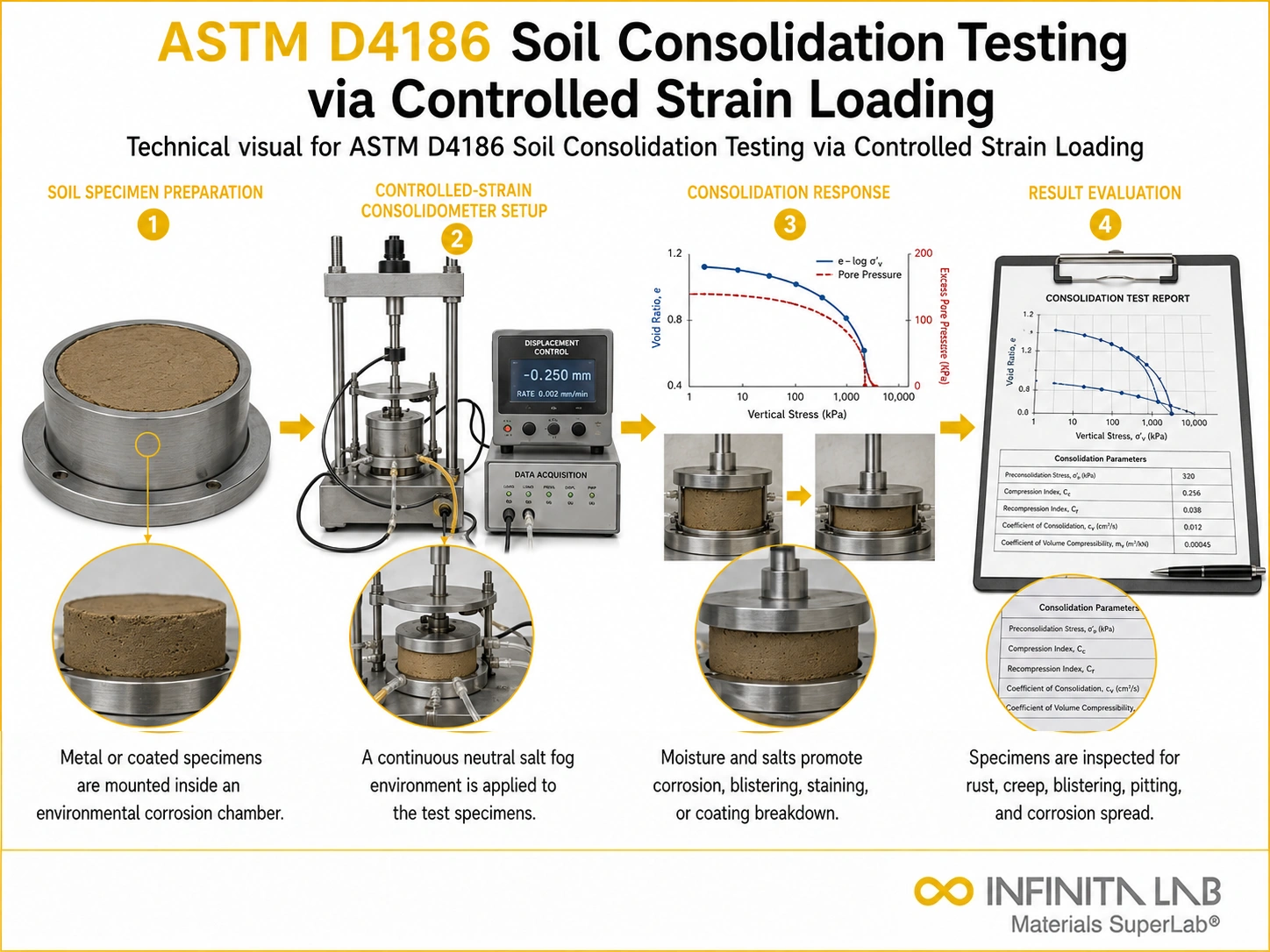
Here’s how a run goes. A specimen sits in a rigid ring, so it’s laterally restrained and drains axially through one surface only. The loading frame drives it at a continuous deformation rate. Meanwhile, the apparatus records axial force, axial deformation, chamber pressure, and the excess pore-water pressure that develops at the base. Those readings give total and effective axial stress and axial strain. From there, the method calculates the coefficient of consolidation and hydraulic conductivity throughout loading. The equations are steady-state and built on stated assumptions such as saturation, homogeneity, and one-dimensional flow.
Cohesive soil behavior depends on strain rate. So the standard limits the rate, ties that limit to the excess pore pressure generated during loading, and keeps results comparable to the incremental-loading consolidation test in ASTM D2435. Within scope, you’ll find intact specimens from Group C and Group D of Practice D4220, plus remolded soil and laboratory-reconstituted soil. The method is used mostly for materials of low hydraulic conductivity. Essentially free-draining soils are a poor fit, since it doesn’t provide meaningful hydraulic conductivity or consolidation coefficient values for them.

Applications and Benefits of ASTM D4186 Soil Consolidation Controlled Strain Testing
Scope
ASTM D4186 describes laboratory procedures for determining the consolidation properties of soils by applying controlled vertical strain to a confined soil specimen. The method helps analyze how soils respond to compression under load.
The scope includes:
- The test method determines the magnitude and rate of consolidation of saturated cohesive soils.
- Continuous axial compression at a controlled rate of strain is used for loading, which sets it apart from the stepped load increments of incremental consolidation testing.
- Lateral restraint and axial drainage to one surface apply throughout the test.
- Axial force and base excess pore pressure are measured while the specimen deforms.
- Intact specimens from Group C and Group D of Practice D4220, remolded specimens, and laboratory-reconstituted specimens are all covered.
- Strain rate is limited so that results can be compared with those from the incremental consolidation test in ASTM D2435.
- Through the loading stage, the method calculates total and effective axial stress, axial strain, the coefficient of consolidation, and hydraulic conductivity.
- Calculations rely on steady-state equations that depend on assumptions such as saturation, homogeneity, and one-dimensional vertical flow; the main equations assume a linear soil model.
- Soils of relatively low hydraulic conductivity are where the method is most often applied.
- It does not produce usable hydraulic conductivity or consolidation coefficient values for essentially free-draining soils.
Applications
- Estimating the magnitude and rate of one-dimensional consolidation settlement beneath foundations, embankments, or fills on clay.
- Pre-consolidation stress and compressibility characteristics can be identified from a continuous stress-strain record.
- Supporting design of earth and earth-supported structures that rest on soft or low-permeability cohesive deposits.
- Intact samples from site investigations can be evaluated alongside remolded or reconstituted material for comparison.
- Research and forensic geotechnical studies get continuous hydraulic conductivity and consolidation coefficient profiles.
- Cross-checking against incremental consolidation results obtained under ASTM D2435.
Benefits
- A continuous loading curve gives a dense record of stress against strain instead of a handful of load steps.
- Tests can run shorter than incremental ones, where each load step has to be held.
- Pore pressure measured at the base lets hydraulic conductivity and the coefficient of consolidation be tracked across the whole stress range.
- Results stay comparable with the widely used ASTM D2435 incremental method, thanks to the strain-rate limits.
- Automated rate control means less operator intervention during the loading stage.
- Engineers can pick out the pre-consolidation stress with more confidence from a well-resolved curve.
Our ASTM D4186 Testing Procedure
Sample Preparation
A soil specimen is trimmed and placed in a consolidation ring to maintain lateral confinement during testing.
1Controlled-Strain Loading
Vertical strain is applied to the specimen at a constant rate using a consolidation testing apparatus.
2Deformation Measurement
Changes in specimen thickness are continuously measured as the soil compresses under load.
3Data Analysis
Stress–strain data is analyzed to determine consolidation and compressibility parameters.
4ASTM D4186 Test Parameters and Requirements
| Parameter | Details |
|---|---|
| Material Tested | Cohesive and fine-grained soil samples. |
| Test Principle | Measurement of soil deformation under controlled vertical strain. |
| Loading Method | Controlled-strain loading applied at a constant rate. |
| Specimen Condition | Soil specimen confined laterally in a consolidation ring. |
| Specimen Dimensions | Typically small cylindrical soil samples prepared for consolidation testing. |
| Strain Measurement | Vertical deformation recorded during loading. |
| Testing Environment | Laboratory-controlled conditions to ensure accurate results. |


- CRS Consolidation Cell – Holds the ring-confined specimen, provides single-surface axial drainage, and connects the base to a pore-pressure transducer.
- Loading Frame with Rate-Controlled Drive – Drives the loading platen at the constant strain rate selected for the test.
- Load Cell – Axial force on the specimen is measured here, so total axial stress can be computed.
- Axial Deformation Transducer – Records specimen compression for the axial strain calculation.
- Base Pore-Pressure Transducer – Reads the excess pore-water pressure at the undrained base. That reading feeds the consolidation and hydraulic conductivity calculations.
- Chamber and Back-Pressure System – Chamber pressure used in the stress calculations is applied and measured by this system.
- Data Acquisition System – Force, deformation, and pressure readings are logged continuously for later analysis.
Equipment and Instrumentation Used for ASTM D4186 Testing
What You Receive: Test Report, Data, and Certification
- Plots of axial strain against effective axial stress for the full loading stage.
- Continuous coefficient of consolidation values across the tested stress range.
- Hydraulic conductivity values, also continuous, calculated from the base pressure record.
- A record of the strain rate, specimen condition, and test setup used for the run.
- The laboratory’s formal report, with raw data available on request, ready for geotechnical design review.
ASTM D4186 Soil Consolidation Controlled Strain FAQs
ASTM D4186 is a laboratory test method used to determine the consolidation and compressibility properties of soils using a controlled-strain loading approach.
Consolidation testing helps predict how soil will settle when structures such as buildings, roads, or foundations apply pressure on the ground.
Controlled-strain loading means the soil specimen is compressed at a constant rate of deformation, rather than applying fixed load increments.
Unlike conventional incremental loading tests, ASTM D4186 uses continuous strain-controlled loading, allowing faster and more detailed soil behavior analysis.
The main purpose is to determine how soil compresses under load and to predict long-term settlement of foundations and structures.
ASTM D4186/D4186M determines the rate and magnitude of consolidation in saturated cohesive soils using controlled-rate compression. The specimen is compressed at a constant strain rate while axial force, deformation, and pore-water pressure are measured to calculate consolidation properties.
Soil testing laboratories prepare a saturated soil specimen and place it in a consolidation apparatus with controlled-strain loading. They measure force, deformation, and pore-water pressure, then calculate compressibility, the coefficient of consolidation, and hydraulic conductivity where applicable.
Constant Rate of Strain (CRS) testing continuously compresses a soil specimen at a controlled strain rate while monitoring axial load and excess pore-water pressure. The measurements are used to determine soil consolidation behavior, compressibility, and hydraulic conductivity.
Why Choose Infinita Lab for Soil Consolidation Controlled Strain Testing
When your Soil Consolidation Controlled Strain results have to hold up - for compliance, a customer audit, or an engineering decision - ASTM D4186 accuracy and an unbiased third-party report matter more than price. Infinita Lab routes your ASTM D4186 soil consolidation controlled strain testing to ISO/IEC 17025-accredited U.S. partner labs with hands-on method experience, so you get defensible data, transparent reporting, and turnaround times built around your project deadline - not ours.

Need ASTM D4186 Soil Consolidation Controlled Strain Testing You Can Rely On?
Send query us at hello@infinitalab.com or call us at (888) 878-3090 to learn more about our services and how we can support you.





