

What Is ASTM D3167 Floating Roller Peel Adhesive?
ASTM D3167 provides a standardised method for measuring the peel resistance of adhesive bonds using the floating roller peel geometry. The floating roller peel test is specifically designed to evaluate adhesives used to bond flexible laminates to rigid substrates, a configuration common in automotive, aerospace, and electronic assemblies.
The test uses a specimen consisting of a flexible adherend bonded to a rigid backing. One end of the flexible adherend is peeled away from the rigid substrate using a roller mechanism that allows the peel angle to float freely, maintaining a consistent peel angle throughout the test regardless of the specimen geometry. The floating roller design reduces variability compared to fixed-angle peel tests and provides a more consistent measure of the adhesive’s peel resistance at the advancing peel front.
Applications and Benefits of ASTM D3167 Floating Roller Peel Adhesive Testing
Scope
ASTM D3167 evaluates:
- Peel resistance of adhesive bonds in flexible-to-rigid laminates
- Effect of peel rate on adhesive peel strength
- Influence of environmental conditioning on peel performance
- Adhesive bondline quality and uniformity
- Comparative peel resistance of adhesive systems
- Effect of surface preparation on peel adhesion
Applications
- Automotive laminated assemblies (fabric-to-panel bonding)
- Aerospace interior laminate bonding
- Electronic device flexible circuit bonding
- Decorative laminate adhesive evaluation
- Foam-to-substrate bonding in seating
- Packaging laminate adhesive qualification
- Research and development in peel adhesion science
Benefits
- Provides consistent peel angle for improved test repeatability
- Applicable to flexible-to-rigid bond configurations
- Detects interfacial adhesion failures from surface contamination
- Enables comparative evaluation of adhesive systems
- Supports adhesive selection for laminate applications
- Provides data for peel strength specification development
Our ASTM D3167 Testing Procedure
Specimen Preparation
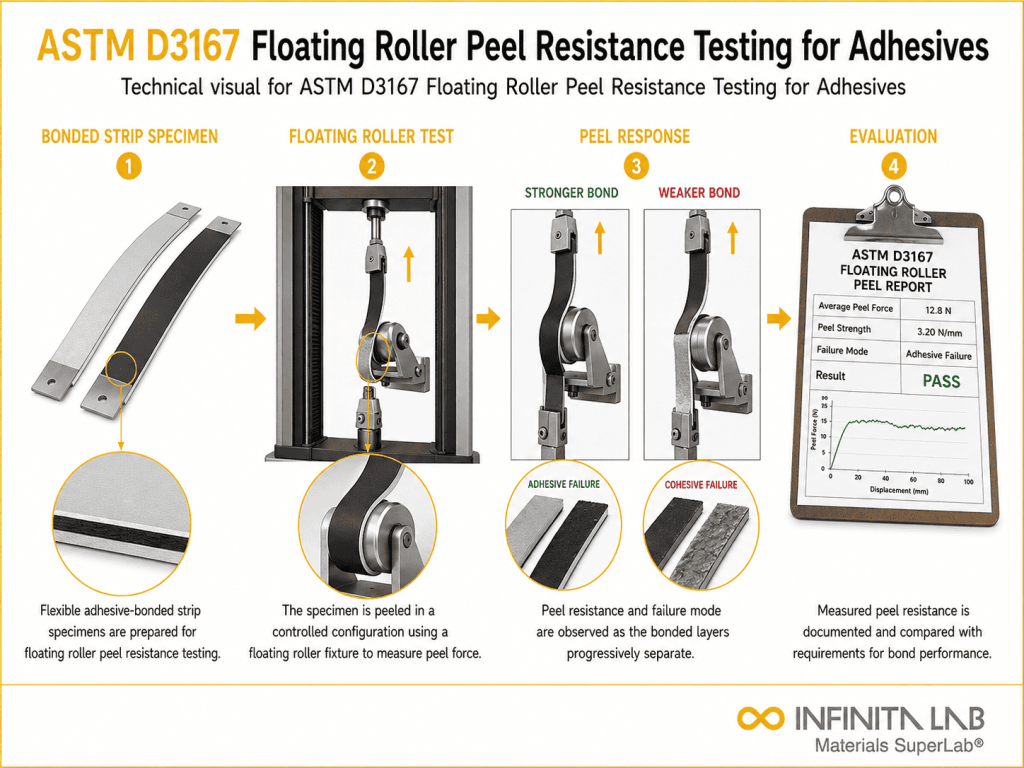
Flexible adherend is bonded to the rigid substrate with the test adhesive and cured.
1Specimen Mounting
The rigid substrate is clamped and the free end of the flexible adherend is attached to the peel roller mechanism.
2Peel Testing
The floating roller is driven at the specified rate; peel load is continuously recorded.
3Data Analysis
Average peel force is calculated and reported as peel resistance per unit width.
4ASTM D3167 Test Parameters and Requirements
| Parameter | Details |
|---|---|
| Applicable Materials | Adhesive bonds between one rigid adherend and one flexible adherend |
| Specimen Types | Bonded strip specimens (rigid-to-flexible) |
| Peel Angle | Controlled constant peel angle using floating roller fixture |
| Standard Flexible Adherend Thickness | 0.63 mm (0.025 in.) |
| Standard Rigid Adherend Thickness | 1.63 mm (0.064 in.) |
| Test Environment | Controlled ambient laboratory conditions |


- Universal testing machine (UTM) with floating roller peel fixture
- Rigid substrate clamp
- Load cell appropriate to peel force range
- Film thickness gauge
- Data acquisition software
- Failure surface examination tools
Equipment and Instrumentation Used for ASTM D3167 Testing
What You Receive: Test Report, Data, and Certification
- Average peel resistance (N/m or lbf/in)
- Peel force vs. displacement curve
- Failure mode classification
- Statistical summary of results
- Quality assurance reports
ASTM D4585 Coating Water Resistance Condensation FAQs
The objective of the peel strength test is to evaluate the efficiency of the adhesive bond, i.e., how well the bond resists peeling, thereby ensuring that the bond can take the stresses satisfactorily.
Typically, clad aluminum alloy (2024-T3) is used for the rigid adhesive, while the flexible adhesive can vary depending on the tested adhesive.
Peel strength is calculated by measuring the average peeling load from the autographic curve, using the load versus head movement data.
It is widely used in automotive, aerospace, packaging, electronics, and adhesive manufacturing industries for bond quality evaluation.
The floating roller maintains a uniform peel angle and smooth separation, ensuring repeatable and reliable peel strength results.
The floating roller peel test evaluates the peel resistance of an adhesive bond between one rigid and one flexible material. The test specimen is prepared by bonding the two materials together, and the unbonded end of the flexible material is wrapped around a roller and secured in a universal testing machine. As the machine applies a controlled pulling force, the roller guides the flexible material as it progressively separates from the rigid surface. The testing system records the force required to maintain peeling, and the average peel force per unit width is calculated. The results help assess adhesive bond durability, compare adhesive performance, and monitor manufacturing quality.
The T-peel test measures the peel strength of an adhesive bond between two flexible materials. A test specimen is prepared by bonding two flexible strips together while leaving their ends unbonded. These free ends are clamped into opposite grips of a universal testing machine and pulled apart in opposite directions, forming a T-shaped configuration. As the machine separates the strips at a controlled rate, it records the force required to progressively peel the bonded surfaces apart. The average peeling force divided by the specimen width is reported as T-peel strength, helping evaluate adhesive performance and bond consistency in flexible laminates, films, and other bonded materials.
Why Choose Infinita Lab for Peroxides Organic Solvents Testing?
When your Floating Roller Peel Adhesive results have to hold up - for compliance, a customer audit, or an engineering decision - ASTM D3167 accuracy and an unbiased third-party report matter more than price. Infinita Lab routes your ASTM D3167 floating roller peel adhesive testing to ISO/IEC 17025-accredited U.S. partner labs with hands-on method experience, so you get defensible data, transparent reporting, and turnaround times built around your project deadline - not ours.

Need ASTM D3167 Floating Roller Peel Adhesive Testing You Can Rely On?
Send query us at hello@infinitalab.com or call us at (888) 878-3090 to learn more about our services and how we can support you.