


ASTM D2582: Puncture Tear Resistance Testing Services
The ASTM D2582 test method is widely used to assess the dynamic tear resistance of plastic films and thin sheets under conditions of end-use snagging-type hazards. The standard specifies the use of SI units as the preferred system of measurement.
TRUSTED BY


Get ASTM D2582 compliant results — request your puncture tear resistance testing quote
- Overview
- Scope, Applications, and Benefits
- Test Process
- Specifications
- Instrumentation
- Results and Deliverables
What Is ASTM D2582 Puncture Tear Resistance?
ASTM D2582 is the standard test method for measuring the puncture-propagation tear (PPT) resistance of plastic film and thin sheeting. It addresses a specific real-world failure mode: the kind of damage that happens when a film is snagged and punctured by a sharp object while in motion, and the puncture then propagates into a tear. This is exactly the hazard that bags, liners, tarpaulins, and packaging films face in service – a sharp point catches the moving film, punctures it, and the resulting hole rips onward. The test measures how well a material resists that combined puncture-and-tear action.
In the test, a specimen is held in a pendulum-type apparatus and a puncturing probe is driven into the moving specimen, initiating a puncture that then propagates as a tear. The energy or distance associated with the propagating tear is measured, giving a value for the material’s dynamic puncture-propagation tear resistance. Because the action is dynamic – the probe strikes and tears a moving specimen – the test captures the snagging behavior far more realistically than a slow, static puncture or a simple tear test would.
ASTM D2582 is used mainly for quality control and comparison of plastic films and thin sheeting, particularly where end-use snagging hazards matter. It complements other film tear and puncture methods (such as Elmendorf tear per D1922, Graves tear per D1004, and static puncture tests) by specifically characterizing the dynamic puncture-to-tear resistance. The standard specifies SI units as the preferred system of measurement.

Applications and Benefits of ASTM D2582 Puncture Tear Resistance Testing
Scope
ASTM D2582 covers the determination of the dynamic puncture-propagation tear resistance of plastic film and thin sheeting, simulating end-use snagging-type hazards in which a puncture initiates and then propagates as a tear.
Key aspects of the test scope include:
- Measured property – puncture-propagation tear (PPT) resistance: the resistance of a moving film to a puncture that propagates into a tear
- Dynamic action – a puncturing probe is driven into a moving specimen, reproducing the snagging-type hazard rather than a static puncture
- Apparatus – a pendulum-type tester that carries the specimen and drives the probe through it, with the propagating tear measured
- Applicable materials – plastic films and thin sheeting (the method is intended for thin flexible materials)
- Comparative use – primarily a quality-control and material-comparison test for relative ranking of films
- Units – SI units specified as the preferred system
Applications
- Film and sheeting quality control – verifying batch-to-batch consistency of the puncture-propagation tear resistance of plastic films and thin sheeting
- Packaging film evaluation – assessing films used for bags, pouches, and packaging that are exposed to snagging and puncture hazards in handling and use
- Bags, liners, and sacks – evaluating the resistance of heavy-duty bags, can liners, and industrial sacks to puncture-initiated tearing
- Agricultural and construction films – characterizing tarpaulins, covers, and sheeting exposed to sharp objects in outdoor and jobsite use
- Material development – comparing resins, formulations, and film structures for their resistance to dynamic puncture-propagation tearing
- Material selection – providing PPT data to select films for applications where snagging-type hazards are a concern
- Specification verification – confirming a film meets a specified puncture-propagation tear resistance requirement
Benefits
- Reproduces a real snagging failure mode – the dynamic puncture-into-tear action mimics how films actually fail when snagged by a sharp object in motion, making the result directly relevant to service performance
- Captures combined puncture and tear – unlike a pure tear test or a static puncture test, D2582 measures the resistance to a puncture that propagates into a tear, the failure that matters for many film applications
- Effective comparative and QC tool – the standardized dynamic test gives a consistent basis for ranking films and verifying batch-to-batch consistency
- Dynamic, not static – testing a moving specimen reflects real handling speeds and conditions better than slow static methods
- Supports film development – PPT data guides the development and selection of tougher, more snag-resistant films
- Complements other tear/puncture tests – fills a specific niche alongside Elmendorf (D1922), Graves (D1004), and static puncture tests for a fuller picture of film toughness
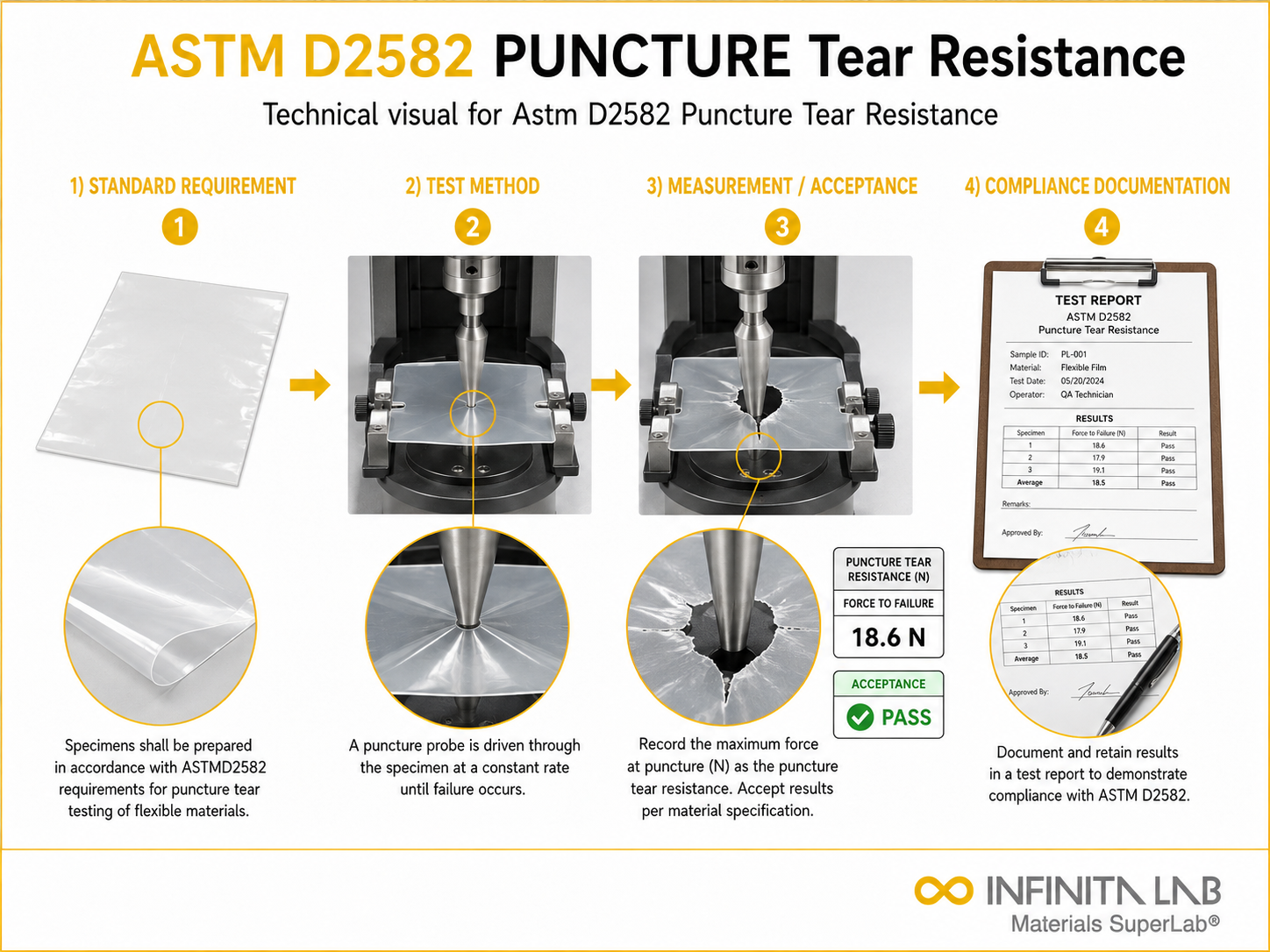
Our ASTM D2582 Testing Procedure
Prepare the Specimens
Cut and condition the plastic film samples, then measure their thickness.
1Set Up the Apparatus
Mount the specimen in the pendulum puncture-tear tester and align the probe.
2Perform the Test
Release the pendulum to puncture and tear the specimen while measuring the absorbed energy or tear distance.
3Calculate and Report
Report the tear resistance, thickness, test direction, and individual and average results.
4ASTM D2582 Test Parameters and Requirements
| Parameter | Details |
|---|---|
| Measured Property | Dynamic puncture-propagation tear (PPT) resistance |
| Test Action | Probe driven into a moving specimen; puncture propagates into a tear |
| Apparatus | Pendulum-type puncture-propagation tear tester |
| Applicable Materials | Plastic film and thin sheeting |
| Hazard Simulated | End-use snagging-type puncture-and-tear |
| Test Direction | Machine and transverse direction as required |
| Conditioning | Standard atmosphere per the method |


- Pendulum-type puncture-propagation tear tester with puncturing probe
- Specimen cutting equipment for consistent specimen size
- Thickness gauge/micrometer for specimen measurement
- Conditioning chamber for specimen preconditioning
- Data recording for energy/tear measurement
Equipment and Instrumentation Used for ASTM D2582 Testing
What You Receive: Test Report, Data, and Certification
- Puncture-propagation tear report – the PPT resistance of the film or sheeting in SI units, with the test conditions documented
- Per-specimen results – individual and average puncture-propagation tear values with the relevant statistics
- Specimen data – thickness and, where relevant, test direction (machine/transverse) for the specimens tested
- Test conditions – apparatus setup, conditioning atmosphere, and number of specimens
- Comparison against specification (where provided) – measured PPT resistance against the requirement or a reference material
- Sample records – film/sheeting identification, material type, and lot information
ASTM D2582 Puncture Tear Resistance FAQs
ASTM D882 tests the tensile properties of thin plastic sheeting and films. It is used to measure tensile properties, including ultimate tensile strength, yield strength, elongation, tensile energy to break, and tensile modulus of elasticity.
The puncture resistance of a plastic film is the amount of force that plastic films can bear when applied to it from an external hemispherical indenter without failure.
ISO 13433: Describes the determination of geosynthetic puncture resistance by a manometric test method commonly applied in civil engineering applications. ISO 7765-2: Pertains to determining puncture resistance of plastic film, flexible sheets, and other flexible materials.
ASTM D882 is used for testing thin plastic materials, including films, sheets, and coatings.
ASTM D882 is commonly used in the packaging industry, for quality control in manufacturing, and in research and development to ensure materials meet performance specifications.
Why Choose Infinita Lab for Puncture Tear Resistance Testing?
At the core of this breadth is our network of 2,000+ accredited laboratories across the USA, offering access to over 10,000 testing methods and analytical services. From advanced materials characterization (SEM, TEM, RBS, XPS) to mechanical, chemical, environmental, biological, and standardized ASTM/ISO-compliant testing, we deliver unmatched flexibility, specialization, and scale. You are never limited by geography, facility, or methodology — Infinita Lab connects you to the right expertise and testing solution, every time.

Need ASTM D2582 Puncture Tear Resistance Testing You Can Rely On?
Send query us at hello@infinitalab.com or call us at (888) 878-3090 to learn more about our services and how we can support you.



Request a Quote
Submit your material details and receive testing procedures, pricing, and turnaround time within 24 hours.
 Quick Turnaround and Hasslefree process
 Confidentiality Guarantee
 Free, No-obligation Consultation
 100% Customer Satisfaction
